
Most people assume that the quality of a morning depends on how long they sleep. And while duration absolutely matters, there’s another, often overlooked factor that shapes how you feel the moment your alarm goes off: when in your sleep cycle you wake up.
You’ve likely had this experience before — you sleep for eight or nine hours, yet wake up feeling foggy, heavy, or strangely disconnected from your body. Other times, after fewer hours, you open your eyes feeling surprisingly refreshed and mentally sharp. This difference isn’t random; it’s a reflection of the brain state in which you wake.
Behind this phenomenon lies a simple idea: sleep unfolds in cycles, not a straight line, and waking up in the wrong part of that cycle can lead to sleep inertia — that disorienting heaviness that lingers long after your alarm. The 90-minute sleep cycle trick is built around this pattern. It encourages people to align their wake-up time with the end of a cycle rather than the middle of one, creating a more natural transition into the morning.
This isn’t about perfection or strict sleep engineering. Instead, it’s a gentle, body-aware strategy that helps you work with your sleep biology, not against it.
How the sleep cycle actually works
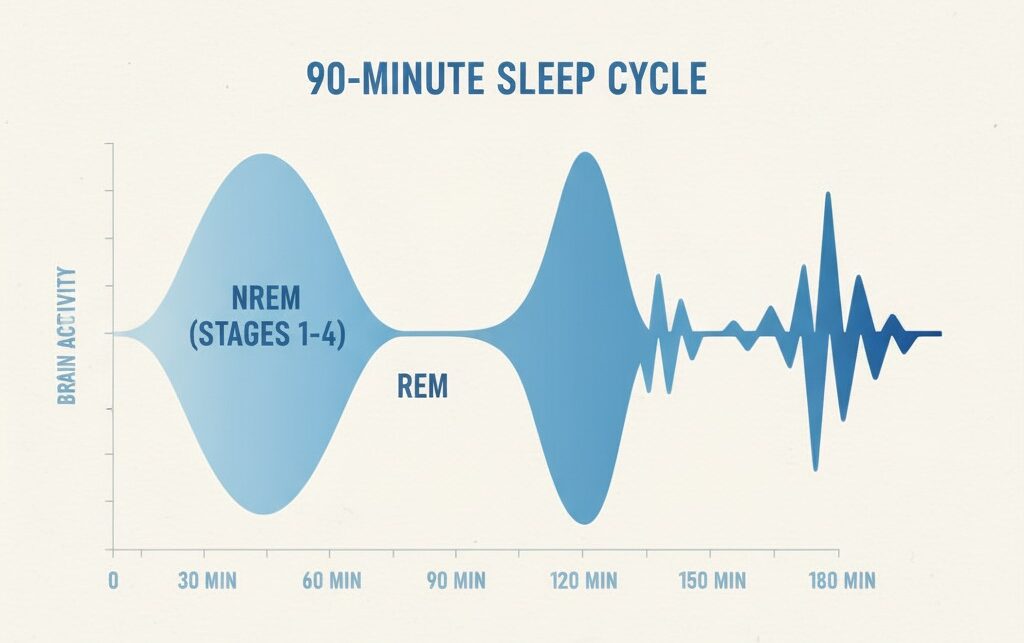
Sleep is not one uniform state. It moves through predictable stages, each with its own brainwave patterns, depth, and purpose. A full cycle typically lasts around 90 minutes, though the range is fairly wide — many adults fluctuate between 80 and 110 minutes depending on age, lifestyle, stress, and circadian rhythm.
To understand the 90-minute trick, it helps to get familiar with the main phases of the cycle.
The first part of a cycle is NREM sleep, or non-rapid-eye-movement sleep. It begins lightly — a transitional moment when your muscles relax, your heart rate slows, and the body starts releasing its grip on consciousness. As NREM deepens, you enter the phases responsible for physical restoration, memory consolidation, and tissue repair.
Further into the cycle is REM sleep. This is where dreams become vivid and emotional processing intensifies. Brain activity spikes, the autonomic nervous system becomes more active, and although the body is immobilized, the mind is remarkably engaged. REM is essential for integrating experiences, regulating emotions, and maintaining cognitive balance.
Together, these shifts create a cycle that repeats throughout the night like a rhythm. The important thing to note is this:
Waking up during deep NREM or at the height of REM is what makes mornings feel rough.
But waking at the end of a cycle — the transition point where the brain is already rising toward lighter sleep — makes waking far more natural.
The Sleep Foundation’s guide to sleep stages explains that this transition zone is when the brain is least resistant to waking. It’s a soft edge rather than an abrupt interruption.
Why waking during REM feels terrible
That feeling of being “hit by a truck” first thing in the morning has a name: sleep inertia. It’s not grogginess in the casual sense, but a measurable physiological state. Harvard Health notes that sleep inertia is marked by slower reaction times, impaired cognitive performance, and a kind of mental stiffness that can take anywhere from 15 to 60 minutes to fade.
This is especially strong if you wake:
during deep NREM sleep
during the peak of REM activity
or immediately after a dream-rich REM period
During REM, your brain is operating in a highly activated mode, processing emotional and cognitive material. Interrupting this state can feel like being yanked out of an unfolding narrative, with the mind taking its time to “reassemble” itself. Meanwhile, the autonomic nervous system — which becomes more active during REM — may still be in a heightened mode, making your heart beat faster or your breathing feel irregular as you wake.
Waking at these moments creates a mismatch between brain state and wakefulness. The body tries to push forward into daytime functioning, but the deeper systems are still immersed in sleep architecture. That mismatch is what makes mornings feel heavy, confused, or draining.
On the other hand, waking between cycles — in that lighter trough — is almost like catching a wave at the right moment. The brain is already rising to the surface.
The 90-minute sleep cycle trick — and why it works
The 90-minute trick is rooted in a simple idea: it’s easier to wake up when the brain is already near the end of a cycle. So the goal is to time your sleep in such a way that your alarm rings at one of those transition points. Instead of merely sleeping “seven hours,” you would aim for something like:
6 hours (4 cycles)
7.5 hours (5 cycles)
9 hours (6 cycles)
The idea is not that these exact numbers create the “perfect” night of sleep. Rather, they increase the likelihood that you wake in lighter sleep. Even a small shift — 10 or 15 minutes — can make a noticeable difference in how alert you feel in the first hour of the day.
This concept also helps relieve one common frustration: waking without an explanation feeling groggy even after a full night. Grogginess might not be a sign of “low-quality sleep”; it may simply be poor timing.
The trick is not prescriptive. It’s a framework that encourages awareness of your sleep architecture. And because your personal cycle length may not be exactly 90 minutes, this method works best when paired with observation rather than rigid rules.
How to estimate your personal sleep cycle length
The most valuable part of using the 90-minute idea is personalizing it. Everyone’s cycles vary slightly — shaped by factors like age, hormones, stress, and chronotype. Instead of assuming your cycles are exactly 90 minutes, you can get a rough sense of your pattern through experience and gentle experimentation.
One way is to pay attention to when you naturally wake without an alarm. Many people find they wake at roughly the same interval — often around 90 minutes after falling asleep or toward the end of a longer cycle in the early morning. Noting this pattern for a few days can give insight into your rhythm without using sleep trackers.
This is important because, as covered in
Sleep anxiety and orthosomnia: when sleep tracking backfires external devices can sometimes increase anxiety or disrupt natural cues. A gentle observational approach is often healthier and more sustainable.
You can also work backward from your ideal wake time. For example, if you need to wake at 7:00, you can count backward in 90-minute segments: 5:30, 4:00, 2:30, 1:00, 11:30, 10:00. Then choose a bedtime that feels realistic for your lifestyle, usually two or three cycles before your wake time.
This isn’t about perfection — even landing within 10–20 minutes of a cycle boundary can make a morning feel significantly easier.
Why the trick works for some people but not everyone
The 90-minute cycle method is helpful, but it isn’t universal. Some people have slightly shorter or longer cycles; others have irregular rhythms due to stress, shift work, or circadian misalignment. While many report improved mornings, some may not feel a dramatic difference — and that’s completely normal.
Cleveland Clinic’s overview of circadian rhythms highlights that individual biological timing plays a major role in sleep structure. This means the 90-minute trick should be used as a supportive tool, not a strict rule.
Even so, for those who struggle with groggy mornings, aligning sleep with the natural arc of brain activity can offer a gentle, welcome improvement — one that feels intuitive once you start paying attention to it.
How to use cycle timing to build a calmer morning routine
Your wake-up experience doesn’t end with the alarm. It echoes through the first hours of the day, shaping your cognitive clarity, emotional steadiness, and overall energy. When you wake during the end of a cycle, the morning feels softer — less like a push and more like a natural rise.
But to make the most out of cycle-based timing, it helps to pair it with a gentle morning routine. The goal here isn’t productivity or discipline; it’s simply to create conditions where your brain can fully transition from sleep state to wakefulness without friction.
Start by giving yourself a few slow minutes after waking. Even when your timing is perfect, the body still needs a moment to recalibrate. Stretching lightly in bed, taking a few unhurried breaths, or simply opening your eyes gradually can prevent the jarring shift that triggers morning stress.
Light exposure also matters. Soft, indirect daylight helps your circadian system register that the “active” part of the day is beginning. If you wake before sunrise, a dim warm light can offer a similar signal without overstimulation. The kinder the morning feels, the more naturally your body’s internal rhythms synchronize across the day.
When paired with the 90-minute timing strategy, these gentle habits help you carry the benefit beyond that first moment of waking — turning the whole morning into a more grounded experience.
How to make sleep cycles more predictable
To get consistent benefits from waking at the right moment, it helps if your sleep cycles themselves are reasonably steady. They don’t need to be perfect — just rhythmic enough that timing becomes easier.
One of the simplest ways to stabilize cycles is maintaining regularity in your wind-down routine. The brain thrives on cues, and when your nights follow a loosely similar pattern, your sleep architecture tends to organize more clearly. This might include dimming lights at roughly the same time, reducing screens within an hour before bed, or choosing a calming pre-sleep activity.
Environment plays a significant role here as well.
If you want to create a more natural foundation for bedtime, this article may be helpful:
Home sleep hacks: how to optimize your bedroom environment.
Keeping the bedroom cool, dark, and quiet makes transitions between sleep stages smoother. Even small adjustments — reducing street noise, using blackout curtains, or choosing breathable bedding — help create the physiological stability that supports predictable cycles.
Another helpful factor is evening light exposure. Bright screens and overhead lighting delay melatonin release, which can shift your entire sleep schedule later, pushing cycles out of alignment with your wake time. Choosing warmer, dimmer light at night helps your brain ease into its natural rhythm.
Finally, consider the timing of your last meal or stimulating activities. Eating heavily right before bed or doing mentally intense work late in the evening can interfere with how smoothly your sleep cycles unfold.
None of this needs to be rigid. These are environmental signals that help your internal rhythm flow more consistently. When you give your brain gentle predictability, your cycles tend to follow.
Why waking up at the right time feels so different
People often underestimate how sensitive the brain is to the exact moment of waking. But the transition out of sleep is one of the most delicate shifts in human physiology. In the same way you wouldn’t interrupt someone mid-sentence, waking the brain mid–sleep process can feel like cutting off a thought before it has a chance to resolve.
When you wake at the end of a sleep cycle, the brain is already drifting toward lighter stages of NREM. Activity levels begin to rise, sensory awareness increases slightly, and the body prepares for the next cycle. Interrupted here, you’re not forcibly pulled into wakefulness — you’re simply invited into it.
This makes mornings feel:
clearer
calmer
less pressured
more mentally present
and more physically grounded
The contrast between this and waking from REM is dramatic. During REM, your brain is in a state of intense internal processing — emotional narratives, memory consolidation, autonomic activation. Pulling someone awake from this state creates a sharp neurological mismatch: waking consciousness arrives before the brain is ready to “switch channels.”
When you time your wake-up with the natural edge of a cycle, the experience feels almost like rising with a tide.
The psychology behind waking gently
There’s another layer to the 90-minute sleep cycle trick that’s worth noting: the psychological impact of predictable waking.
When you start the morning with clarity — rather than the fog of sleep inertia — the entire day tends to feel more controllable. This has nothing to do with productivity; it’s rooted in something simpler: agency.
A smooth wake-up reduces the stress signals the brain receives early in the day. Instead of a cortisol spike triggered by a harsh alarm in the middle of REM, your nervous system has a chance to shift gradually. This creates a chain reaction:
thoughts feel more organized
decision-making feels less pressured
emotional responses feel steadier
the day feels less chaotic
These subtle early cues shape the body’s stress rhythm for hours afterward. A gentle wake-up isn’t just a pleasant moment — it’s a physiological mood-setter.
Using cycle timing without becoming overly exact
One important reminder: the 90-minute trick is helpful, but it should never become a source of perfectionism. Sleep cycles are not clockwork. They fluctuate based on hormones, stress, physical activity, illness, and even the emotional weight of the day.
If timing becomes too rigid, it risks turning into the kind of hypervigilance described in:
Sleep anxiety and orthosomnia: when sleep tracking backfires
The trick is to use the 90-minute rhythm as a soft guideline, not a rule. If you’re within roughly 10–20 minutes of a cycle boundary, the benefit is usually the same. What matters is consistency, not precision.
Think of the method as a way of cooperating with your natural rhythms rather than managing them.
A gentle way to try the 90-minute timing tonight
If you’re curious to experiment, here’s a simple, non-rigid approach:
Choose your wake time.
Count backward in 90-minute intervals.
Pick a bedtime that feels doable within that pattern.
Try to keep your wind-down routine steady.
Notice how you feel the next morning without judgment.
Even one or two nights can give you a sense of whether the timing feels intuitively better for your body.
If it helps, you can pair this with a calming sleep technique such as:
Deep breathing for better sleep: a simple nighttime technique.
Breathwork can ease the transition into your first sleep cycle, especially if you’re aiming for a particular bedtime.
Conclusion: waking at the right moment is a gentle art
The 90-minute sleep cycle trick isn’t a hack in the trendy sense. It’s a way of respecting the natural rhythm your body already carries. When you align your wake-up time with the brain’s transition between cycles, mornings gain a clarity that feels both subtle and profound.
You’re not chasing perfection or micromanaging sleep; you’re simply moving with the grain of your biology.
And mornings that begin gently tend to shape days that unfold more calmly.