Introduction: the double-edged sword of sleep tracking
In our pursuit of better sleep, many of us turn to technology. From smartwatches to phone apps and high-tech rings, sleep trackers promise insights into our rest—turning something as instinctive as sleep into a measurable, improvable metric.
And in many ways, they deliver. Trackers can reveal how long we sleep, how restless we are during the night, and how our routines affect sleep quality. But for some people, the obsession with these numbers leads to an unexpected problem: worsening sleep, not better.
This growing phenomenon is called orthosomnia—a term coined by sleep researchers to describe a type of insomnia that develops as a result of trying too hard to optimize sleep. The irony is painful: in trying to perfect our sleep, we might be destroying it.
What is orthosomnia?
The word “orthosomnia” comes from the Greek “orthos” (correct) and “somnus” (sleep). In short, it means “correct sleep disorder”—a form of sleep anxiety triggered by tracking devices.
People with orthosomnia don’t just struggle to sleep—they worry excessively about sleeping “well enough.” They check their sleep scores, analyze every data point, and begin to doubt their natural ability to rest without validation from a device.
Common traits of orthosomnia:
Obsession with sleep metrics
Feeling unrested despite full nights of sleep
Anxiety before bed, trying to “do it right”
Changes in behavior based on device feedback
Losing trust in how your body feels without data
This condition was first described in 2017 by researchers at Rush University Medical Center. In their study, several patients showed signs of sleep-related anxiety driven directly by data from consumer-grade sleep trackers.
And this issue is not limited to those with existing insomnia. Even those who previously slept fine may begin to second-guess their rest if their sleep score suggests it was “bad.”
How sleep tracking can make anxiety worse
For some, wearing a sleep tracker is empowering. It reveals helpful patterns—like how caffeine affects sleep, or how a late-night scroll shortens deep sleep stages.
But for others, the numbers become a source of pressure, not clarity.
Imagine this:
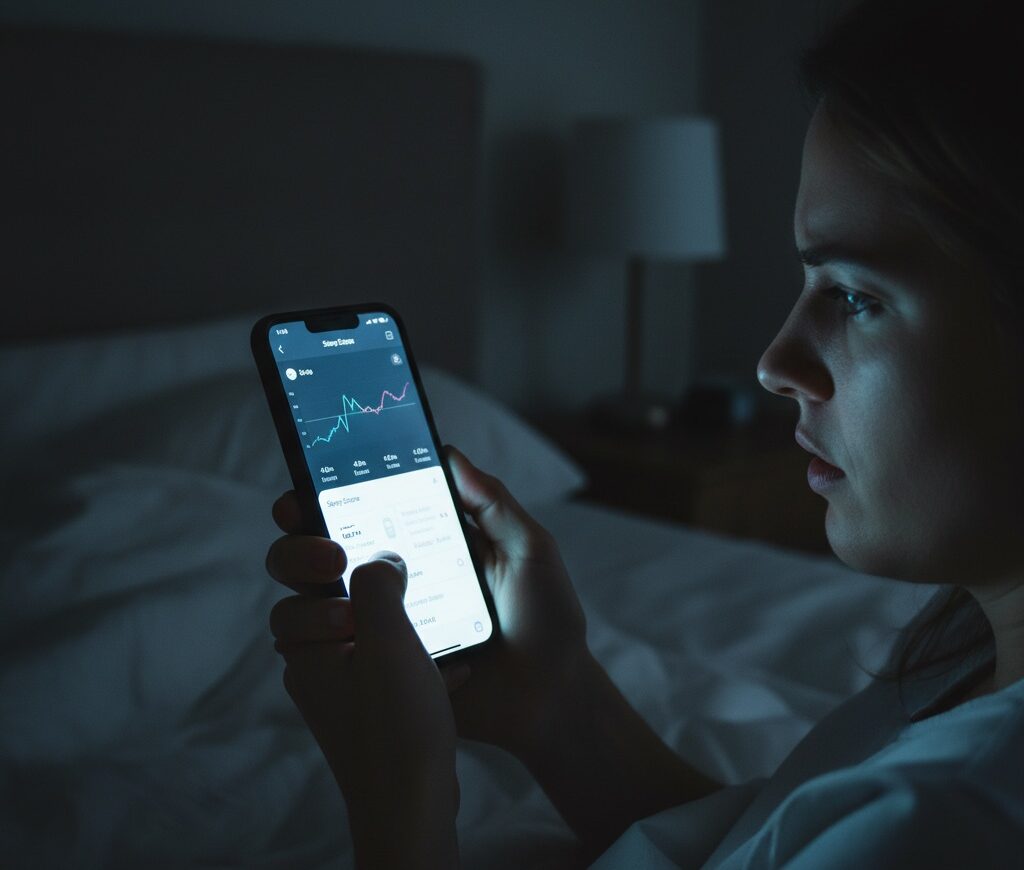
You wake up feeling decent—maybe not amazing, but rested. You check your tracker. It tells you that your sleep score was 62/100. You had “poor” deep sleep and “frequent disturbances.” Suddenly, you’re doubting your rest. You feel anxious. You wonder if something is wrong. And tomorrow night, you go to bed hoping to “beat” the score.
This is where the performance mindset begins—and it rarely helps.
Sleep perfectionism
Sleep becomes something to be won. To perfected. You might start:
Avoiding social activities that could disrupt your “perfect routine”
Getting anxious about bedtime routines not going exactly right
Staying in bed longer just to improve the score
Waking up feeling worse because of what the app told you
This phenomenon, known as sleep perfectionism, is strongly linked with orthosomnia and is especially common in high-achieving, health-conscious individuals.
Ironically, the more you try to control your sleep, the more it can spiral out of control.
When sleep becomes a performance goal
Let’s be clear: sleep is not a competition. It’s a natural biological process, not a report card.
And yet, many apps gamify rest: scores, graphs, color-coded charts. They make it feel like something you can master—if only you follow all the rules.
Over time, this can lead to:
Over-identifying with your sleep score
Feeling shame or guilt for “bad” nights
Fixating on data instead of how your body feels
As Dr. Sabra Abbott, a neurologist and sleep medicine specialist, explains:
“Some people become so focused on getting a perfect night of sleep that it actually becomes the reason they’re not sleeping well.”
In the Baron et al. (2017) study, researchers observed that patients using trackers became more anxious and less satisfied with their sleep—even when their subjective experience was positive. In some cases, they even requested sleep medications to improve their sleep score, despite not meeting the criteria for clinical insomnia.
Signs you might be dealing with orthosomnia
Orthosomnia doesn’t always announce itself clearly. It creeps in through subtle changes in mindset and behavior. If you’ve been using a sleep tracker, here are signs that it might be doing more harm than good:
You feel anxious or restless before bed, trying to “sleep well”
You wake up feeling fine, but feel bad after checking your score
You avoid evening activities to protect your sleep schedule
You base your mood or energy level on sleep app results
You distrust your body’s signals and rely fully on data
You sleep worse on nights you forget to wear the tracker
If these feel familiar, don’t worry—you’re not alone. The first step is recognizing the difference between awareness and obsession. Sleep data can be helpful, but only if it serves you, not controls you.

Is it the tracker or the mindset?
Not everyone who uses a sleep tracker will develop orthosomnia. For many people, these tools offer helpful data and support better routines. The issue arises when the mindset shifts from curiosity to control—when tracking becomes less about awareness and more about performance.
So, is the tracker to blame? Not entirely. Like any tool, it depends on how we use it.
Think of it like a bathroom scale. For some, it’s just information. For others, it becomes a source of shame, stress, and obsession. The same goes for sleep trackers.
When tracking helps:
You’re noticing patterns and using them to guide healthy changes
You remain flexible with your routine
You don’t panic when your score dips
You combine data with how you feel
When tracking hurts:
You judge your day based on your score
You override your body’s natural cues
You feel anxious when you forget to track
You make sleep a goal rather than a need
Orthosomnia isn’t caused by data—it’s caused by how we relate to data. And the good news is: we can change that relationship.
What to do instead: a healthier approach to sleep and tracking
The goal isn’t to throw away your tracker (unless you want to). It’s to reclaim your sense of trust in your body—and to stop giving numbers more authority than your lived experience.
Here’s how to shift toward a more balanced, mindful relationship with sleep.
1. Focus on patterns, not perfection
One bad night isn’t a crisis. One good night isn’t a miracle. What matters is the overall trend—and how consistent habits influence that trend.
Use your tracker to spot helpful patterns:
Does late-night eating impact your sleep?
Do you sleep better after outdoor walks?
How does caffeine after 2 PM affect your rest?
Let go of daily scoring. Zoom out. Look at the bigger picture.
2. Check in with your body, not just your app
Ask yourself in the morning:
“How do I feel?”
“Do I feel rested or groggy?”
“Did anything interrupt my sleep?”
Then check your tracker only if needed—not out of habit. If you feel fine, but the data says otherwise, give your own experience more weight.
Trust builds over time, and it begins with listening inward.
3. Limit screen time before bed (even for tracking)
Ironically, many people use phones to check sleep data right before bed—a habit known to disrupt rest. The blue light, the mental stimulation, and the emotional reaction to sleep scores all interfere with winding down.
Instead:
Set a tech cutoff at least 30–60 minutes before sleep
Review sleep scores in the morning or afternoon, not at night
Avoid “doomscrolling” health data—especially when tired
Your bedtime routine should support calm—not analytics.
4. Try sleep journaling instead
Sometimes the simplest tools work best. Keeping a sleep journal lets you reflect on:
When you went to bed and woke up
What your routine looked like
How you felt emotionally
How rested you felt the next day
It’s qualitative, not quantitative—and that’s a good thing.
You don’t need a device to know you’re making progress. Your own awareness is powerful.
5. Practice mindfulness or CBT-I techniques
Cognitive Behavioral Therapy for Insomnia (CBT-I) is the gold standard for treating chronic sleep issues. One of its key principles? Breaking the cycle of sleep anxiety through reframing, behavior changes, and relaxation techniques.
Some strategies you can try:
Cognitive restructuring: challenge unhelpful thoughts like “If I don’t sleep 8 hours, I’ll be useless”
Stimulus control: use the bed only for sleep and intimacy—not scrolling or overthinking
Relaxation before bed: try progressive muscle relaxation, body scans, or deep breathing
You can also explore sleep-focused apps like Sleepio or CBT-i Coach—designed to guide you gently back to natural sleep.
6. Take a break from your tracker
Even a short break—1–2 weeks—can reset your relationship with data.
During that time:
Focus on how you feel, not how you score
Stick to consistent sleep-wake times
Build routines that feel nourishing
Reflect on whether your sleep improves without tracking
Some people return to their devices with a new perspective. Others never go back. Either way, the goal is to feel empowered, not controlled.
7. Reframe what “good sleep” means
Sleep isn’t about perfection. It’s about restoration. Flexibility. Trust.
“Good sleep” isn’t just 8 hours of uninterrupted slumber—it’s feeling refreshed, resilient, and emotionally balanced. And that can vary, day to day, season to season.
Sometimes good sleep means falling asleep easily. Sometimes it means getting back to sleep after waking. Sometimes it means accepting a restless night without panic.
You are more than your sleep score. Always.
Final thoughts: don’t let the numbers define your rest
Technology can be a powerful tool—but it’s not always the answer. For some, sleep trackers open the door to awareness and improvement. For others, they create a new form of pressure that sabotages the very rest they seek.
If you find yourself caught in the loop of checking, comparing, and chasing perfect sleep, take a breath. Step back. Sleep is not a project. It’s a human rhythm—messy, beautiful, and imperfect.
At Calm Sleeply, we believe that sleep should feel like a gift, not a test. Trust your body. Listen to what it needs. And remember: sometimes, the most restful night is the one you don’t measure.
Read also: The ‘bed-rotting’ and therapeutic laziness trend: when rest becomes the goal