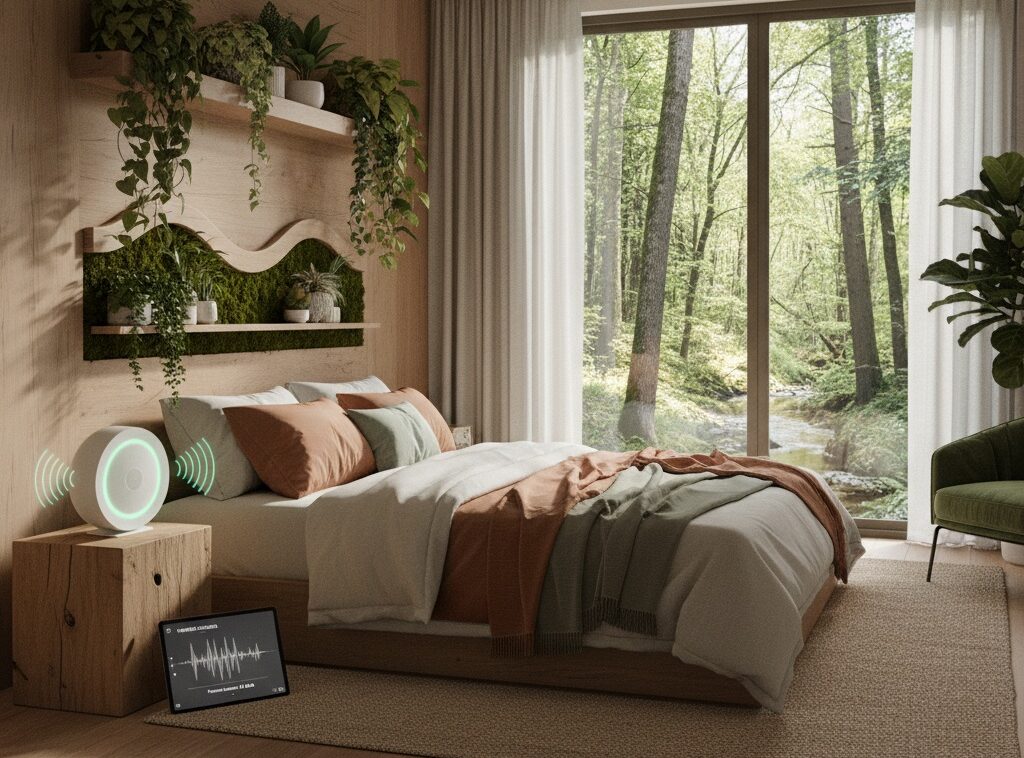
In the fast pace of modern life, our days are filled with screens, city sounds, and artificial light — and by the time we reach our bedroom, the natural world often feels far away. Yet, our bodies and minds evolved in close connection with nature. The sound of rustling leaves, the scent of rain, or the sight of morning light once signaled safety and rest. Reconnecting to these natural cues can calm the nervous system and restore the sense of balance that deep sleep requires.
Recent studies show that exposure to natural sounds and spaces lowers stress hormones, slows heart rate, and supports emotional regulation. The concept of biophilia — our innate attraction to nature — suggests that bringing natural elements back into our homes may be key to better rest. By combining nature sounds and biophilic design, you can create a sleep environment that feels peaceful, grounding, and restorative.
Why nature helps us sleep better
Humans are biologically wired to respond positively to the natural world. For most of our history, sleep happened outdoors — under the stars, surrounded by the rhythm of the earth. The brain learned to associate these patterns and sounds with safety and restoration.
When you hear the soft patter of rain or distant waves, your brain recognizes these as signals of calm. These sounds are continuous, predictable, and non-threatening, which helps reduce activity in the amygdala — the part of the brain that triggers anxiety and alertness. Unlike sudden, irregular noises such as car horns or loud TV sounds, nature’s rhythm tells your body it’s safe to relax.
Researchers at Brighton and Sussex Medical School found that listening to natural sounds shifts the brain from an “external” mode (focused on tasks and worries) to an “internal” mode (rest, reflection, and calm). This transition mirrors what naturally happens as we drift toward sleep.
The connection goes beyond sound. Visual cues — like green hues, natural textures, and organic shapes — lower blood pressure and support mood regulation. Simply looking at greenery or natural patterns activates the parasympathetic nervous system, helping the body unwind after a busy day.
Nature sounds: the science of sonic calm
Nature sounds are more than pleasant background noise — they work on a deep physiological level. Neuroscientific research shows that listening to natural soundscapes (such as flowing water, birdsong, or wind) reduces activity in the limbic system, which governs stress and emotional responses. In one 2017 study, participants who listened to forest sounds experienced lower heart rates and greater alpha brainwave activity — the same state associated with meditative relaxation.
These sounds also encourage entrainment, where your brain waves begin to match the rhythm of the sound. Slow, gentle, repeating sounds like rainfall or waves can guide your mind into a slower, sleep-ready state. This is why white noise machines that simulate nature often outperform synthetic or mechanical noises.
By contrast, urban soundscapes — even low-level traffic — tend to activate vigilance. The unpredictability of sirens or engines keeps the brain alert, even if you’re not consciously aware of it. Replacing these artificial interruptions with a stable, organic soundscape can therefore make a meaningful difference to sleep depth and continuity.
If you’re looking to bring nature’s soundtrack into your night, here are a few simple ideas:
Choose authentic recordings. High-quality recordings of ocean waves, rain, or forest sounds (from apps or sound platforms) tend to feel more soothing than generic “white noise.”
Use smart sound devices. Modern sleep sound machines or smart speakers let you set timers, adjust volume, and even match sounds with your sleep stages.
Experiment with sound layering. Combine subtle ambient music with gentle water sounds for a personalized calm environment.
Keep volume low. The goal is immersion, not stimulation — your soundscape should blend naturally with silence, not overpower it.
The key is to create a consistent auditory environment that your mind associates with rest. Over time, the simple act of turning on your “night forest” or “soft rain” track can become a psychological cue — telling your body it’s time to unwind.
Biophilic design: bringing nature indoors
If nature sounds engage your hearing, biophilic design brings calm through your other senses — sight, touch, and even smell. The concept, introduced by biologist Edward O. Wilson, is based on our intrinsic need to connect with the natural world. When this connection is missing, we experience what psychologists call “nature deficit” — a subtle but real form of mental fatigue that can interfere with sleep.
Biophilic design isn’t about filling your bedroom with plants. It’s about reintroducing the patterns, materials, and atmosphere of the outdoors in subtle, balanced ways. Natural textures like linen, wood, and stone remind your brain of organic environments, grounding you in a sense of simplicity and comfort.
Lighting also plays a crucial role. Soft, warm-toned light that mimics sunset encourages melatonin production, while exposure to harsh white or blue light suppresses it. By adjusting lighting temperature — through dimmable lamps or smart bulbs — you can create a more natural day-to-night rhythm in your sleep space.
Color psychology aligns with this principle too. Shades of sage, clay, sand, or muted blue are proven to promote calm and stability, echoing the serenity of landscapes. Even simple touches like a woven rug, natural fiber curtains, or a wooden headboard can shift the energy of your bedroom toward tranquility.
Finally, plants do more than look beautiful — they improve air quality and humidity, creating a fresher environment that supports deeper breathing and relaxation. Studies suggest that keeping even one or two low-maintenance plants (such as snake plants, lavender, or peace lilies) can have measurable effects on mood and perceived comfort.

Combining sound and space: how to build a sensory sleep sanctuary
When sound and design work together, they form an immersive experience that signals safety, calm, and restoration. Imagine walking into your bedroom and instantly feeling your shoulders drop, your breath slow, and your thoughts quiet — that’s the power of a biophilic sleep sanctuary.
Start by aligning your sensory inputs:
Sound: Choose one or two consistent natural soundscapes (like soft rain or gentle waves). Keep the sound source on the opposite side of the bed from where you sleep so the direction feels organic, not artificial.
Sight: Layer textures — linen sheets, a cotton throw, wooden furniture, or a small plant. Even framed botanical prints or photographs of nature can evoke calm if live plants aren’t possible.
Smell: Incorporate subtle, earthy scents — such as cedarwood, lavender, or vetiver. You can diffuse essential oils for a few minutes before bed or place a small sachet near your pillow.
Light: Allow for soft transitions. Dimming lights 30–60 minutes before sleep mimics dusk and tells your brain melatonin release should begin. Consider pairing this with the start of your night soundscape for a complete sensory cue.
These small, harmonious cues work together to communicate one message to your nervous system: it’s time to rest. Over time, this routine creates a form of conditioned relaxation, similar to how hearing ocean waves might remind you of vacation calm.
Mistakes to avoid when creating a nature-inspired sleep space
Even though biophilic principles sound simple, it’s easy to overdo them. A restful space should feel light, uncluttered, and intentional. Here are common mistakes — and how to avoid them:
Too many visual elements. Nature is not chaotic; it’s balanced. Avoid filling your room with too many textures, plants, or colors. Instead, let one or two natural focal points (like a plant or a wooden headboard) set the tone.
Artificial nature overload. Synthetic “forest” wallpapers or digital waterfall screens can feel forced. It’s better to have real materials — wood, cotton, clay — than fake representations of nature.
Ignoring acoustics. Natural sounds work best when the rest of the environment is quiet. If your bedroom faces a busy street, add sound-dampening materials (thick curtains, soft rugs) before layering nature sounds.
Strong scents or oils. Overly intense aromatherapy can irritate the senses instead of relaxing them. Choose mild, natural scents and avoid burning candles overnight.
Blue light conflict. Even the most peaceful environment won’t help if you’re scrolling through your phone in bed. Combine biophilic design with a digital detox before sleep — consider our guide How to do a digital detox evening for better sleep and mental clarity.
The goal is not to recreate the forest but to echo its calm logic — the sense of balance, softness, and quiet rhythm that nature embodies.
A short nighttime ritual: grounding through nature
Try this simple routine inspired by biophilia and mindfulness to prepare your body for rest:
Dim the lights 30 minutes before bed. Let your room slowly transition into softer tones — amber, warm white, or candlelight.
Play your chosen nature sounds. Focus on rhythmic sounds — ocean, rain, or a forest at dusk. Listen as if you’re breathing in time with them.
Open your window slightly if the air quality allows. Feel a light breeze or smell fresh air for a few moments — this brief exposure to real elements strengthens your brain’s connection to nature.
Touch something natural. A linen pillowcase, a wooden object, or even a stone can serve as a grounding anchor.
Take five slow breaths. Inhale through the nose, exhale through the mouth. Imagine the air as a natural flow cleansing your mind before sleep.
This small ritual doesn’t require effort — just awareness. Over time, it transforms your bedroom into a living, breathing ecosystem of rest.
The deeper impact: nature, mood, and dreams
Interestingly, nature-based sleep environments may not only improve how fast we fall asleep, but also influence dream quality. Research from the University of Vienna found that exposure to nature imagery before bed increases emotional positivity in dreams. Participants who watched short clips of forests and rivers reported more peaceful dream content compared to those who viewed urban scenes.
This connection highlights how nature doesn’t just calm our waking mind — it seeps into the subconscious. By surrounding yourself with organic materials, soothing soundscapes, and gentle lighting, you’re essentially programming your brain for serenity even while you sleep.
That’s why people who spend time outdoors or decorate their rooms with natural elements often describe their rest as “deeper” or “more complete.” Nature gently retrains the body to trust its rhythms again — and in doing so, sleep becomes not just recovery, but reconnection.
Final thoughts: a return to simplicity
In a culture obsessed with optimization — sleep trackers, productivity tools, and biohacking — the most profound improvements often come from returning to what’s timeless. Biophilic design and nature sounds remind us that rest doesn’t have to be complicated. It’s about realigning with the quiet wisdom of the natural world.
When your space feels alive — softly breathing through textures, tones, and gentle sounds — it holds you, much like the earth holds the forest. You don’t have to chase sleep; it arrives naturally, like night follows dusk.
Creating this kind of environment is not decoration — it’s restoration. It’s a way to rebuild your relationship with rest, one leaf, one sound, one breath at a time.