
The invisible link between your phone and your pillow
You probably already know that scrolling before bed can keep you awake. But what’s less obvious is why it’s so hard to stop — and how your digital life continues long after you put the phone down.
The truth is, our online selves don’t log off when we do. Every message, comment, or unread notification lingers in the mind like background noise. Even when your body is ready for sleep, your brain is still processing your digital world — replaying conversations, comparing images, or anticipating responses.
In the age of constant connection, your phone isn’t just a tool. It’s part of your identity, a mirror of your social life, emotions, and sense of belonging. And when that identity is active 24/7, true rest becomes almost impossible.
This article explores the hidden relationship between digital identity and sleep, how online stress seeps into your subconscious, and what you can do to restore calm between your waking and dreaming worlds.
The hidden connection between digital stress and sleep
Most of us think of online stress as something emotional — feeling overwhelmed by messages, negativity, or endless scrolling. But your brain treats digital interaction as real-world experience. It can’t fully distinguish between a tense conversation over text and one face-to-face.
Each like, message, or alert triggers microbursts of dopamine (reward) and cortisol (stress). This unpredictable cycle — of stimulation and anxiety — trains your brain to stay alert for the next hit of novelty.
When you scroll in bed, your nervous system receives mixed signals: your body is lying still, but your brain is still working. That confusion delays the production of melatonin, the hormone that prepares you for sleep. You may not realize it, but even brief screen exposure keeps your brain in “day mode,” making it harder to fall into the slower, calmer rhythms of rest.
This creates a kind of digital residue — the mental and emotional traces left behind after online activity. It’s why you might close your apps but still replay a comment or check your phone “just one more time.”
Over time, digital residue becomes a habit loop: stimulation → anxiety → checking → temporary relief → more stimulation. Breaking that loop requires understanding how deeply it influences both mind and body.
What happens to the brain when you stay connected too long
Your phone isn’t just keeping you entertained — it’s training your biology.
Here’s what happens when you stay digitally engaged late at night:
Dopamine keeps you scrolling. Every notification or “like” triggers a micro-reward, keeping your brain curious and slightly restless.
Cortisol disrupts calm. Even minor stress (a negative post, a work email, a controversial comment) releases stress hormones that raise heart rate and alertness.
Blue light confuses your clock. The wavelength emitted by screens suppresses melatonin and delays your circadian rhythm.
Cognitive load increases. Your prefrontal cortex — the thinking part of your brain — stays active, analyzing, comparing, and predicting outcomes.
The result? Your body might be in bed, but your mind is still online. You’re physically resting but mentally wired.
When this happens repeatedly, your brain starts to associate your bed with mental activity instead of rest — a phenomenon that sleep researchers call conditioned wakefulness. You train yourself to think and react instead of release and recover.
That’s why digital stress doesn’t just delay sleep — it changes how your brain interprets bedtime altogether.
Online persona vs. inner self
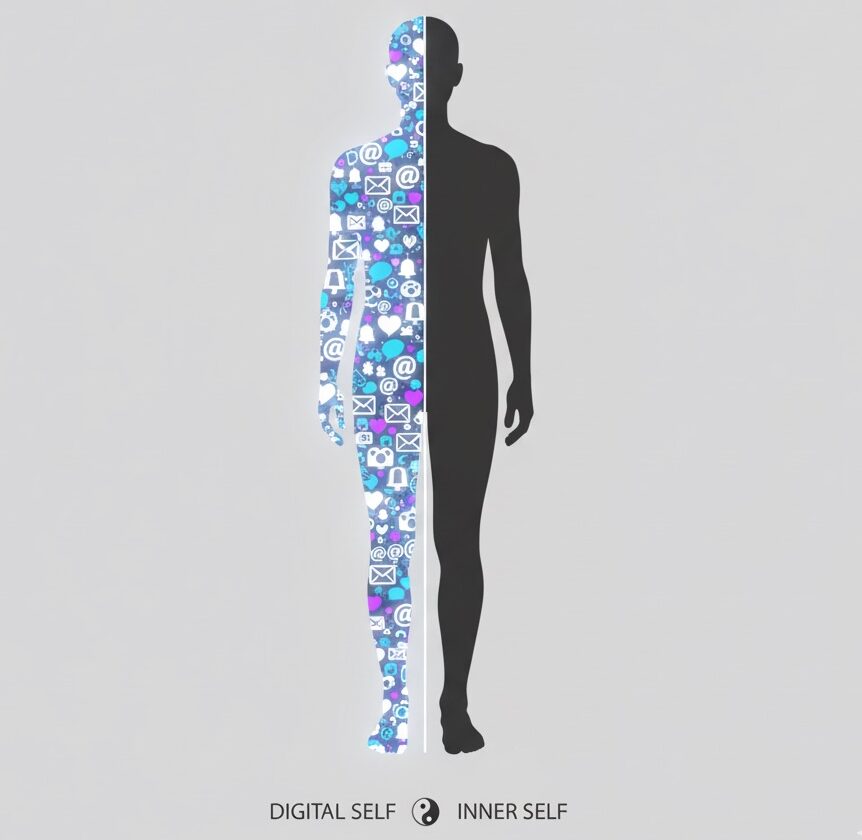
Social media adds another layer to the equation: identity. Online, you can shape how others see you — your achievements, lifestyle, and thoughts — but that performance creates pressure to maintain consistency.
Psychologists call this performance fatigue: the emotional weariness that comes from constantly curating your digital presence. Even subtle behaviors — editing photos, checking reactions, crafting replies — activate the same brain regions involved in social evaluation and approval.
At night, when silence finally arrives, those thoughts echo louder:
“Did that post sound okay?”
“Why didn’t they reply?”
“Should I check one more time?”
This is how digital identity anxiety manifests. It’s not just fear of missing out (FOMO); it’s fear of losing connection — of being unseen or misunderstood in a space that never sleeps.
Offline, your mind needs distance to integrate emotion and experience. But when your digital self is constantly active, your inner self has no space to rest. This tension — between curated presence and authentic being — often surfaces at night, when external noise fades and internal noise takes its place.
How digital stress shows up in your sleep
You might not realize how much your online activity shapes your dreams, body, and emotional state during rest. Digital stress doesn’t always feel like stress — sometimes it appears as subtle disruptions:
Difficulty winding down — your thoughts race even when you’re tired.
Fragmented sleep — light sleep cycles, frequent awakenings, or vivid dreams about social interactions.
Increased orthosomnia — anxiety about sleep quality itself, especially if you track it with apps or wearables.
Dream overflow — replaying online experiences, conversations, or content in your subconscious mind.
A 2022 study by Frontiers in Psychology found that participants exposed to prolonged screen time before bed had higher emotional reactivity and lower slow-wave sleep — the phase most critical for memory and restoration.
When your nervous system remains slightly activated overnight, your sleep might look “normal” in duration but feel unrefreshing. You wake with tension in your shoulders, mild anxiety, or an urge to check your phone — all signs that your digital mind never fully powered down.
Why it’s so hard to disconnect
The hardest part about managing digital stress isn’t knowing what to do — it’s doing it. The digital world is designed for engagement. Infinite scrolls, push notifications, and algorithmic feeds exploit the same reward systems that keep gamblers at slot machines.
But here’s the paradox: the more we try to stay “caught up,” the more disconnected we feel. The brain interprets constant information as unfinished business, fueling subtle stress that carries into the night.
In a sense, every alert and update tells your subconscious, “Something important might happen soon.” And when that message repeats hundreds of times a day, it becomes nearly impossible for your brain to relax.
This is why true digital rest requires more than turning off your phone — it requires psychological closure. You have to convince your mind that the day’s interactions are complete, that nothing vital is waiting online, and that it’s safe to switch off.
Evening detox and cognitive reset
You can’t simply “turn off” stress — especially when it’s emotional and digital at the same time. But you can guide your brain into a state of completion, helping it transition from constant connection to calm rest.
This process begins with cognitive offboarding — a gentle, intentional ritual that tells your mind: “The digital day is over.”
Here’s how to build one:
Create a digital curfew. Choose a consistent time — ideally one hour before bed — when all screens go dark. Set an alarm that says “Log off, not just sleep.” It reframes disconnection as an act of care, not restriction.
Change the setting. Move your phone to another room or place it in a “charging zone” outside the bedroom. The physical act of leaving it behind helps your mind detach from its digital identity.
Transition with analog calm. Replace screens with something tactile: stretch, read, journal, make tea. These repetitive, sensory activities ground your attention in the present.
Clear emotional residue. If your mind still replays online interactions, try a simple journaling practice: write down one phrase from the day that stuck with you, acknowledge it, and close the page. The act of externalizing helps release the loop.
Signal safety to your body. Soft lighting, steady breathing, and quiet soundscapes all tell your nervous system that the alert state is no longer needed.
It’s not about perfection — it’s about consistency. The more often your body experiences this digital sunset, the faster it learns to relax without resistance.
Building a healthier digital identity
To reduce nighttime stress, you have to look beyond the screen — into the psychology of why we stay online.
Your digital identity isn’t inherently harmful. It connects, expresses, and informs. The problem starts when the curated self overshadows the authentic self — when online validation begins to define inner worth.
Ask yourself:
Do I check my phone out of curiosity or out of habit?
Do I scroll to connect or to escape?
Does my online life add calm or tension to my evenings?
This kind of reflection is digital mindfulness — observing your behavior without judgment. Once you notice your patterns, you can start redesigning them.
Try this reframing exercise:
Instead of saying, “I need to stop scrolling before bed,” say, “I’m choosing to rest my mind so I can wake up clear.”
That shift from avoidance to intention changes how your brain perceives the habit — it becomes self-care, not deprivation.
You can also redefine how your digital identity interacts with rest:
Curate your feed with calm — follow creators who promote slowness, reflection, and wellbeing.
Disable unnecessary notifications — if it’s not urgent, it can wait until morning.
Keep one “offline hour” a day — not as punishment, but as a gift of mental stillness.
Your goal isn’t to vanish from the digital world. It’s to become present in both worlds: online and offline, connected and calm.
The neuroscience of letting go
When you build distance between your screen and your pillow, your brain begins to shift from beta waves (alert, focused thinking) to alpha and theta waves (relaxed and imaginative states).
These are the frequencies associated with creativity, emotional integration, and eventually — sleep. But they don’t appear instantly; they need transition.
Digital overstimulation keeps the prefrontal cortex active — the part of the brain responsible for decision-making and self-evaluation. That’s why even after turning off your phone, your mind keeps reviewing the day’s content.
A few simple cues can accelerate this shift:
Dim warm light — it signals dusk to your internal clock.
Deep breathing or body scans — they calm the sympathetic nervous system.
Soft sound patterns — like pink or brown noise, to guide the brain toward rhythmic rest.
Once your senses begin to soften, your brain starts letting go of analytical thinking. This is where rest truly begins.
Redefining connection
True rest doesn’t come from withdrawal — it comes from balance. Humans are social beings, and online spaces fulfill real emotional needs. The goal isn’t to delete your accounts but to reconnect with what matters most: authenticity, attention, and intentionality.
Try to make your connection time conscious:
Schedule short digital check-ins instead of constant browsing.
Decide when you’ll engage and when you’ll rest.
Use your phone as a tool, not a timeline.
And remember: you can be present online without being consumed by it. The healthiest digital identity is one that serves your real life — not replaces it.
When technology supports your rest
Ironically, the same technology that disrupts sleep can also help protect it — when used wisely.
Apps and devices designed around digital wellbeing can guide you toward healthier habits:
Screen time limits: Built-in features on iOS and Android help you schedule app downtime automatically.
Bedtime modes: These darken your display, mute notifications, and remind you to unplug.
Blue light filters: Reduce circadian disruption after sunset.
Mindfulness apps: Tools like Calm, Insight Timer, or Headspace can guide evening relaxation or help you meditate offline.
The difference lies in intentional use. Technology should serve as a bridge to calm, not a barrier to it.
Reclaiming the quiet
The greatest luxury in the digital age isn’t access — it’s absence. The ability to pause, breathe, and be with your own thoughts is becoming rare, yet it’s exactly what your mind needs to process and heal.
Silence — both digital and mental — gives your nervous system space to reset. It allows emotions stirred by online interactions to settle naturally instead of spiraling.
You don’t need to disappear to find peace; you just need moments of quiet to remind your brain that it’s safe to rest. Each time you create distance from the screen, you’re reestablishing your boundaries — between stimulation and serenity, performance and presence.
That’s the foundation of better sleep: not escape, but equilibrium.
In a world where our digital and physical selves are intertwined, rest requires awareness, not disconnection. Your phone isn’t the enemy — it’s your relationship with it that shapes your sleep.
Every night, your digital identity travels with you into the quiet. The conversations, comparisons, and notifications linger in the background of your thoughts. But by learning to close that loop — through ritual, reflection, and self-kindness — you give your brain permission to rest fully.
When your mind stops chasing information, it starts finding peace.
And when you reclaim that inner stillness, sleep becomes not just an act of recovery — but a gentle return to yourself.
Read also: