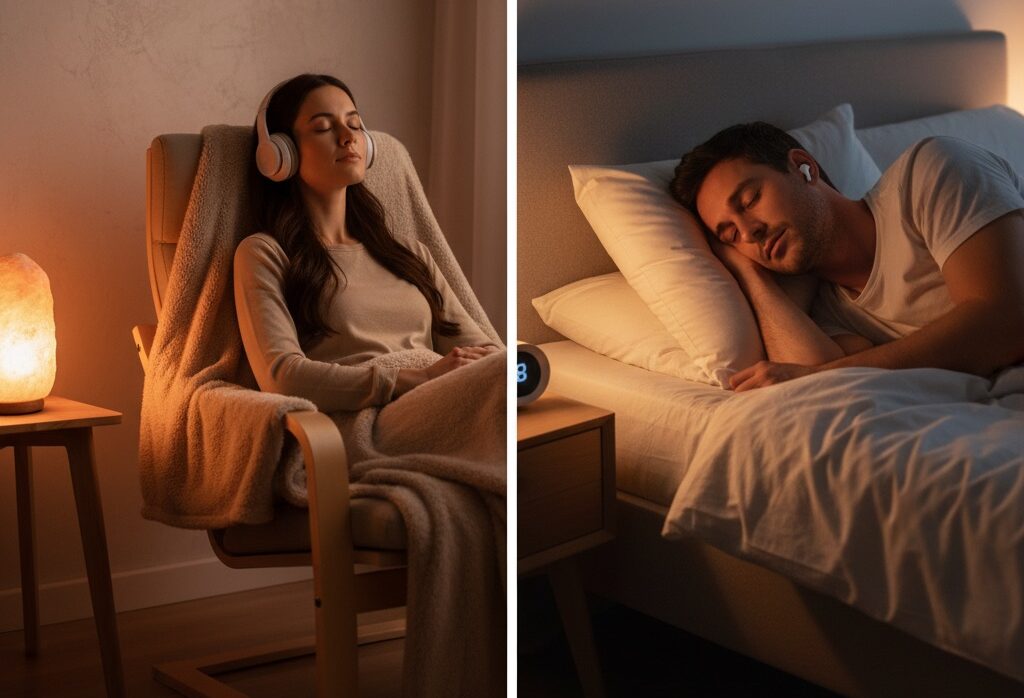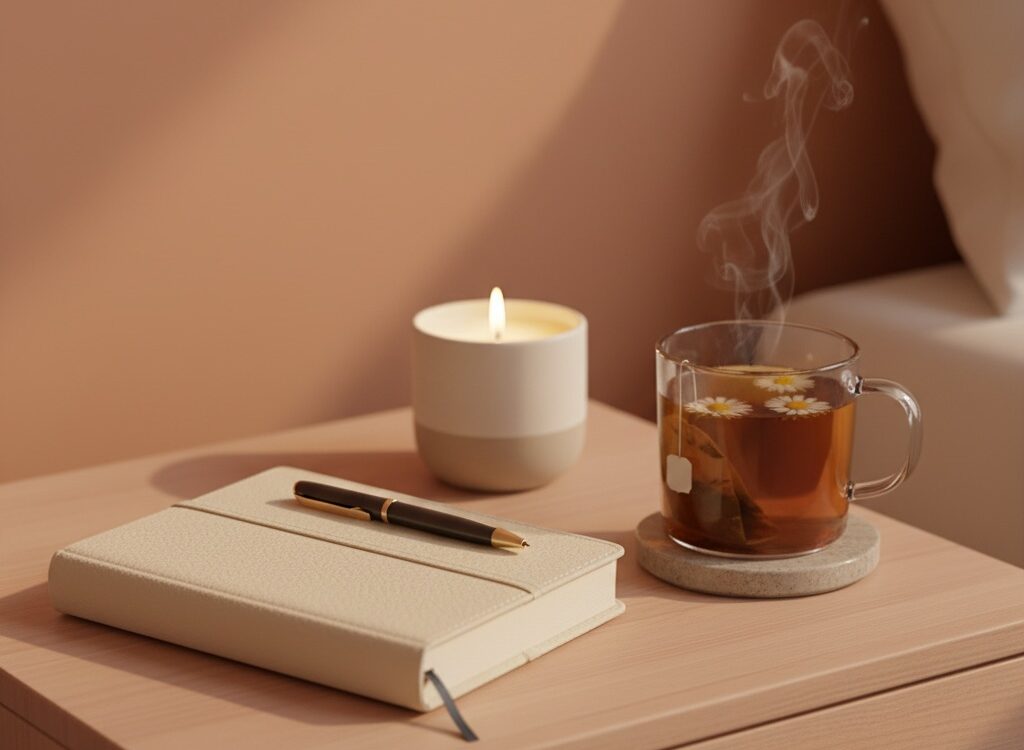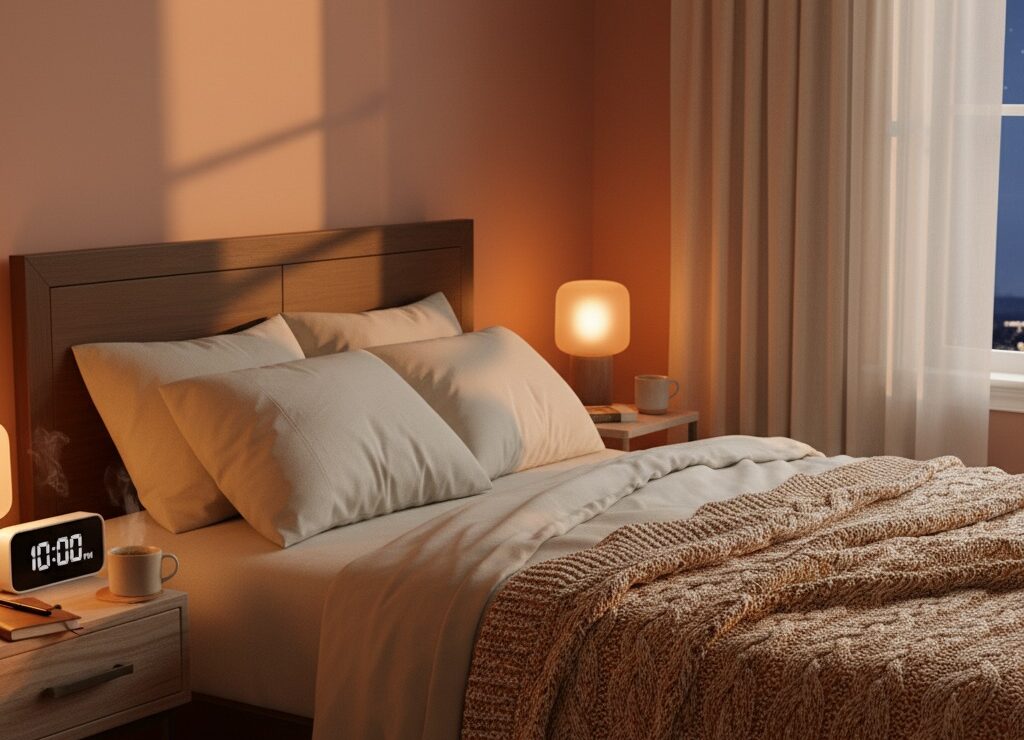
There is a moment at night that almost everyone recognises. You lie down in bed, the room is dark, your body is still, and your brain suddenly becomes louder. Thoughts repeat. Emotions intensify. The mind begins solving problems that were not urgent all day, but feel urgent now. This is a classic pattern for anxiety at night. It is not created by danger. It is created by stillness.
When the mind becomes overactive, most people try to calm it through thoughts: trying to reason with themselves, trying to “stop thinking”, trying to talk themselves down mentally. But the nervous system does not calm through logic. It calms through the body.
Here is where tactile grounding becomes powerful. Tactile grounding is the practice of using texture, weight, pressure, and physical sensation to bring attention back into the body. It works because the nervous system responds strongly to somatic input in the skin. Instead of fighting thoughts, you redirect your focus to sensation. Instead of trying to mentally control anxiety, you physically anchor yourself into the present moment.
This is the difference between a technique that is cognitive and one that is somatic. Cognitive calming is “inside the mind”. Somatic calming is “through the body”. At night, somatic approaches are often more effective because the body is already in a restful state, but the mind is not. Tactile grounding helps the mind catch up.
How touch regulates the nervous system in the evening
Touch is one of the oldest regulatory systems the body has. Before humans developed complex language, we regulated through physical contact, warmth, pressure, and texture. Today we often underestimate this sensory system because modern culture prioritises thoughts, words, ideas, talking, analysing. But the nervous system does not prioritise thought. It prioritises safety. And safety signals in the adult body are still based on very old sensory patterns: skin contact, pressure, softness, warmth, gentle texture, stable surface.
When you touch a calming texture, or when weight is placed on the body, sensory receptors in the skin send information directly to areas of the nervous system that reduce hyperarousal. These pathways do not require interpretation. You do not need to think about them for them to work. They work automatically.
This makes tactile grounding a helpful strategy at night because most night anxiety is created by rumination. Rumination is “thinking about thinking”. The more someone tries not to think, the louder the thoughts become. Tactile grounding moves attention away from abstract thought and into the physical here-and-now. And because nighttime is already a low-stimulation environment, even a small sensory input can shift the nervous system.
This is why weighted blankets calm many people. It is why pets can help you fall asleep by simply lying next to you. It is why holding a soft object while falling asleep reduces the length of time it takes to settle. Physical sensation is a direct line of communication to the nervous system.
Why tactile grounding often works better at night than breathing exercises
Breathing techniques are effective during the day. But many people report that during the night, breathing exercises sometimes make them more anxious, not less. They become hyper-aware of breathing. They begin to monitor their breath. They begin to worry if they are doing it correctly. Their focus becomes effortful. Effort is stimulating.
Tactile grounding is different because it does not require technique. You do not have to think about “doing it right”. You do not need perfect form. You simply feel. You allow sensation to bring the body into presence.
Touch is also easier for a tired brain. At the end of the day, cognitive capacity is low. The brain is less efficient at complex instructions, but sensation remains available.
Grounding with texture is also powerful because it is low-demand. The body does not need to change anything. It only needs to notice.
Everyday grounding textures you can use tonight
Most homes already contain useful grounding textures — the difference is only in paying attention to them. The nervous system responds well to natural, organic materials and to soft, slightly uneven surfaces. Linen, cotton, wool, wood, and ceramics tend to be particularly regulating because they are not completely smooth or synthetic. Small natural imperfections give the skin information.
For example, running fingers slowly over a linen pillowcase creates micro-sensation. The brain shifts from internal anxiety to this sensory input. Holding a ceramic cup, even briefly, creates grounding because the surface is cool and textured. Applying light pressure to the mattress with the palm of your hand tells your body “I am physically supported right here”.
You can use grounding textures intentionally during your wind-down routine — before anxiety begins, not only when it appears. Even 10–20 seconds of mindful touch is enough to give the nervous system a signal of stability. You can also bring tactile grounding into the moment when anxious thoughts appear. When your mind starts moving quickly, sensation creates a stable anchor point.
The purpose is not to eliminate thoughts. The purpose is to shift state — from mental activation to bodily presence.
Creating your personal tactile grounding toolkit
A tactile grounding toolkit is not a set of products. It is a small collection of sensory anchors that you personally respond to. These should be items that already exist in your life, that feel familiar, and that communicate comfort.
For some people this is a specific blanket. For others, a soft cotton t-shirt, a pillow with a slightly textured case, or a smooth stone they keep near their bed. Some people ground through weight, some through softness, some through subtle texture, some through gentle pressure.
There is no universal object that calms everyone. You learn your own pattern through noticing: what does your body naturally reach toward when it needs comfort? That instinct is data. You can turn that instinct into strategy.
A tactile grounding toolkit becomes most useful when it is available at night within reach. The purpose is not to fix anxiety. The purpose is to provide a physical pathway out of rumination and into presence.
How to use tactile grounding during night awakenings
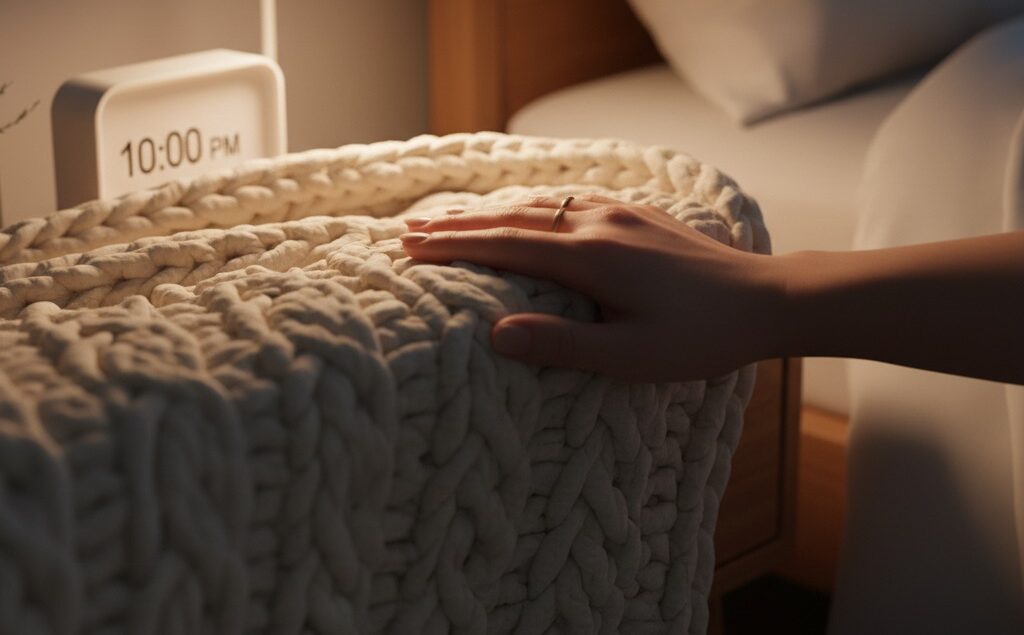
Night awakenings are common — even in people without insomnia. The problem is not waking up. The problem is what happens after waking: thinking. Once the mind becomes active, the body follows it. This is where tactile grounding becomes especially useful, because sensation can interrupt mental escalation faster than cognitive strategies.
If you wake up at night and your thoughts begin building, shift attention into your hands first. Touch is an extremely fast signal. Slowly press your palm into the mattress. Notice the texture of your pillowcase. Slide your fingertips across the blanket for five to ten seconds. The purpose is to wake up the sensory pathways that tell your nervous system “I am safe in my environment right now.”
This approach works even if you do not move much. The body does not need intensity. It needs contact. When you move attention from mind to sensation, you give the brain a different task: feeling instead of analysing. Once the body receives that signal, the process of falling asleep again becomes more automatic. You are not trying to “force sleep”. You are giving your nervous system a pathway back toward rest.
This reduces time awake at night not because you are controlling thought, but because thought no longer has priority. Sensation becomes the dominant input.
Sensation stacking: a more advanced tactile technique
For some people, one type of sensation is not enough. In those cases, a method called “sensation stacking” can create deeper grounding. Sensation stacking means combining two physical sensations at the same time so the nervous system receives stronger, but still gentle, sensory information.
An example: hand on the blanket + gentle pressure from a pillow against your body. Another example: fingers tracing a texture + the weight of a heavier comforter. This does not require intense pressure or complex actions. It simply increases the amount of sensory input the nervous system receives at once.
If your mind tends to overthink strongly at night, sensation stacking can be a more effective tool than a single texture. The goal is not distraction. The goal is to help your nervous system shift state with less effort.
Pitfalls and what not to do
Tactile grounding is simple, but there are a few mistakes people commonly make.
The first mistake is trying to use it like a performance test. Tactile grounding is not a contest of “how quickly can I calm down”. If you treat it as a test, the mind remains in effort mode. Effort is alertness.
The second mistake is switching between objects too quickly. If you move from texture to texture every few seconds, your nervous system cannot settle. Choose one anchor at a time, or two if you are stacking, and stay there for at least twenty to thirty seconds.
The third mistake is using objects that are uncomfortable or synthetic. Artificial materials often provide poor sensory quality. They feel neutral or “nothing”. Natural materials usually offer more grounding because they contain subtle irregularities that give your skin more information. This is why linen, wool, soft cotton, and natural fibres tend to regulate better than slick synthetic textures.
The fourth mistake is trying to think your way through the technique. Tactile grounding is not a cognitive practice. You are not trying to “understand” the sensation. You are letting your body feel it. If your mind comments on the process, simply return to physical feeling.
The benefits of tactile grounding over time
A single night of tactile grounding may help, but the most significant changes appear when it becomes a repeated habit. When the nervous system begins to associate certain textures or objects with relaxation, the response becomes faster. The sensory anchor becomes a conditioned cue for rest.
This conditioning process mirrors how the brain learns any pattern: repetition strengthens association. If you ground with the same textures several nights in a row, your body begins to interpret those textures as signals for safety and sleep. Eventually, your system may start down-regulating even before you complete the grounding action.
This is what creates a reliable sleep tool, not a temporary trick. You are training your nervous system to recognise specific sensory information as a pathway to rest.
Texture as a “bridge” between day and night
Many people struggle with sleep because there is no transition between daytime activation and nighttime recovery. Their habits are mental, digital, rapid. Their sleep routine is minimal or non-existent. They try to go from active to asleep without a bridge.
Tactile grounding creates a physical bridge. The body moves gradually toward low stimulation. The nervous system receives clear information: “We are leaving activation now.” This transition is what most modern people are missing. Bedtime is not the moment to start calming down. It is the final step in a process that began earlier.
Textures help slow down this acceleration. They make the body ready to shift into rest before the moment of sleep. If the body is already halfway relaxed, sleep becomes a continuation, not a fight.
Tactile grounding is not about eliminating thoughts. It is about shifting the focus of the nervous system from mental activity into physical sensation. This process helps quiet anxiety at night because the body takes the lead in regulation instead of the mind.
Touch is an accessible, natural, human tool that most of us forget is available. You do not need special equipment. You do not need perfect technique. You only need the willingness to redirect attention into sensation.
Small sensory habits become powerful when repeated consistently.
At night, when thinking becomes louder, sensation is the fastest way to return to presence.
Read also: