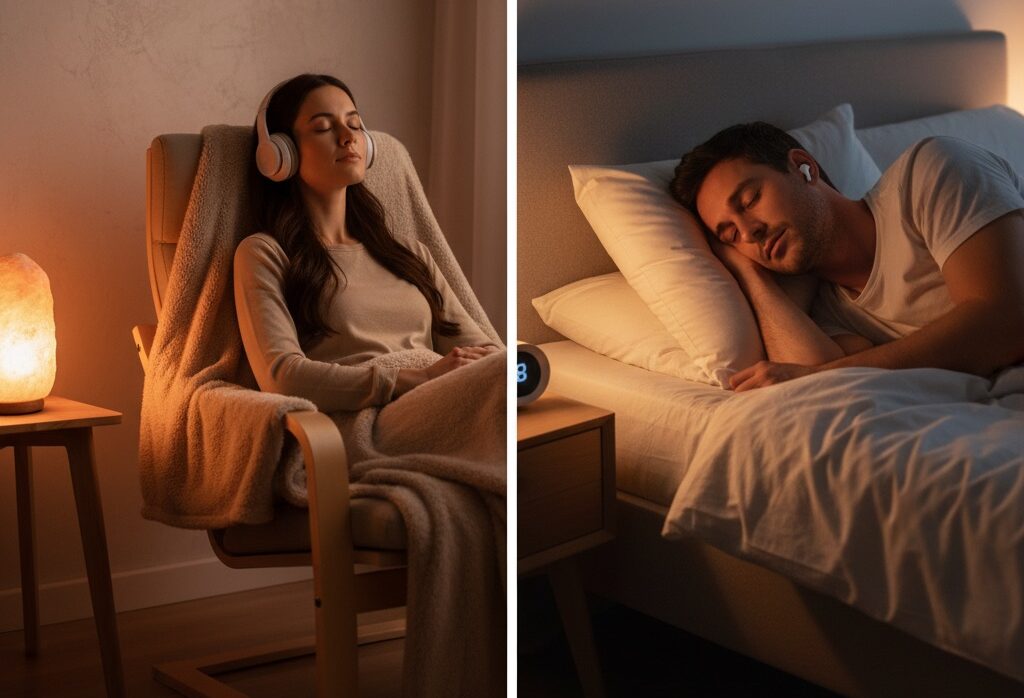
For many people, the moment before sleep is not quiet at all. The body is physically in bed, but internally there is a subtle holding — jaw tight, shoulders lifted a few millimeters higher than needed, breath shallow, a faint sense of guarding. Even when the mind says “I want to sleep,” the body remains prepared for action. This is a common pattern. Sleep problems are often explained through thoughts, screens, worries, but not through the body’s inability to let go of muscular tension.
Somatic unwinding before sleep focuses on a different dimension of nighttime routines — not calming the mind first, but downshifting the body’s neuromuscular tone through tiny, precise micro-movements. These movements are extremely small. Almost invisible. They are not stretches, not exercise, not yoga poses, not massage. They are slow neurological “messages” that tell the nervous system: “Nothing is threatening us anymore. We can release.”
This is important: tension is not simply a muscular issue. Tension is a holding pattern. It is a nervous system strategy.
The body holds when the body does not yet trust that it is time to rest.
This is why stillness alone is not enough.
Lying in bed, doing nothing, does not automatically switch the nervous system from sympathetic activation (action) to parasympathetic dominance (rest). You need a bridge. Somatic unwinding is this bridge.
Why micro-movement works better than passive relaxation
Passive relaxation — lying down and trying to “relax” — often does not work because tension patterns are not passive. They are active. They are held through motor circuits even when there is no movement.
Example: if your jaw is subtly clenched, this is not “just tight muscles.” This is a motor command. The nervous system is saying “hold.” So if you try to simply force yourself to relax it, the nervous system doesn’t immediately deactivate that program.
Micro-movement interrupts the holding pattern indirectly.
Small movement is easier for the brain to downgrade than sudden stillness. Movement gives the brain feedback — “the environment is safe enough to shift state.”
Somatic unwind is not the same as stretching. Stretching often increases tension first (muscles resist the stretch). Micro-movement does the opposite — it lowers tension gradually. It is like gently loosening a knot instead of pulling it harder.
The body stores stress through repetition
In modern life, tension becomes a baseline. Shoulders become the place where we store deadlines. The diaphragm becomes the place where we store social fear. The jaw becomes the place we compress unspoken thoughts. Every day we repeat tiny muscular reactions to stress. These reactions become habitual motor patterns — not conscious choices.
Here is the key point:
The body does not release tension simply because the day is over.
It releases tension because the nervous system receives signals of safety.
If those signals never come, tension persists at night.
This is why somatic unwinding before sleep is effective — it gives direct sensory input that communicates safety to the nervous system. Sleep is not only psychological readiness. Sleep is a motor program of letting go.
Why stillness without transition can backfire
Many people assume:
“I just need to lie still and eventually I will relax enough to sleep.”
But stillness itself can trap tension in place.
If muscles are already contracted slightly, being still keeps them contracted.
Think of social anxiety: when someone “freezes,” they are still, but extremely tense.
Stillness is not equal to relaxation.
Stillness becomes relaxation only after the nervous system reduces neuromuscular tone. That requires movement — but not big movement — micro-movement.
This is the crucial difference.
The somatic pivot: from guarding to letting go
The nervous system has two primary modes:
threat monitoring (guarding)
safety (letting go)
You do not switch between them cognitively.
You switch between them somatically.
Breathing changes, facial muscles change, shoulder elevation changes, interoceptive sensations change.
If you want deep rest, you need to send very primitive signals of safety to the brainstem. The brainstem does not speak language. It speaks sensation.
Micro-movement creates continuous micro-feedback that the environment is safe and predictable enough to reduce vigilance. This allows parasympathetic dominance to increase. This is essential not only for falling asleep but for the quality of the sleep cycle.
When vigilance stays high, sleep may still happen, but it is shallow.
When vigilance drops, the body enters deeper restorative phases.
So somatic unwinding is not just about “falling asleep faster.”
It is about changing the mode of the nervous system before sleep.
Why this approach is especially effective today
Never in history have people ended their day so abruptly.
In previous generations, evenings contained gradual downshifts: sitting by dim light, slow conversations, making tea, slow rituals. There was a curve to night.
Today, most people scroll, scroll, scroll… and then suddenly collapse into bed.
This creates a dramatic state mismatch. The nervous system was in high stimulation and then instantly — no stimulation. One second high dopamine novelty feed, next second darkness. The nervous system cannot process this abrupt shift. It is too sharp.
Micro-movement is a transitional model that helps the nervous system “land.”
It is a controlled descent.
It is a way to create slope.
The modern world lacks slope. It has peaks and then silence. The human organism needs gradation.
This is what somatic unwinding restores: the gradient between stimulation and stillness.
Why this is not “body scanning”
Many people confuse somatic unwinding with body scanning. Body scanning is cognitive attention to body parts. It is mindfulness of sensation. It is useful. But it does not change motor tone directly.
Somatic unwinding is behavioral input to the motor system.
It produces physical change, not only awareness.
You are not simply noticing tension.
You are unwinding tension.
And you are doing it through tiny motion, because tiny motion is neurologically efficient.
The nervous system prefers small signals when learning to release. Large signals stimulate fight-or-flight preparedness. Small signals communicate safety.
Practical micro-movement protocols that release tension before sleep
Somatic unwinding works because it directly influences motor patterns. But the question most people have is: what exactly should I do? The most effective evening somatic unwinding routines are both simple and subtle. They do not require a mat, a workout, a big space, or much time. They require precision and the willingness to move slowly enough that the nervous system can process safety.
Here are three core micro-movement protocols that work reliably at night. You can choose any one of them or rotate them.
1) Jaw + tongue decompression protocol
Why it matters: the jaw is one of the primary holding zones of stress. Many people keep tension here without realizing it. Micro-movements that release jaw tension send immediate safety signals to the brainstem. This is because jaw tension is linked to the same circuits that control startle responses.
How to do it:
Place the tip of your tongue lightly against the roof of your mouth (behind the teeth).
Make tiny circular motions with the tongue (the movement is extremely small).
Next: make micro side-to-side motions with the jaw (only 1-2 millimeters).
Finish by letting the mouth hang slightly open for 10 seconds without collapsing.
This entire protocol takes less than 2 minutes.
Most people do not realize that this alone can dramatically soften the transition into sleep. When the jaw releases, the neck can release. When the neck releases, the diaphragm releases. When the diaphragm releases — breathing deepens and the brain perceives safety.
2) Shoulder shearing protocol
This is not a stretch. Stretching the shoulders at night often stimulates the system. Shearing is different. It is a small sliding motion that signals to the nervous system: “We are not preparing to fight. We are preparing to settle.”
How to do it:
Lie on your back. Let your shoulders settle. Then, very gently, slide your right shoulder forward (toward ceiling) 1–3 millimeters. Then slide back. Then repeat with the left shoulder. Alternate. Slow. Rhythmic.
This creates a subtle melting effect in the upper back and rib cage. The rib cage is also where we store shallow breathing patterns. So releasing shearing tension here prepares the chest and diaphragm for deeper parasympathetic breathing.
3) Pelvic micro-rocking protocol
The pelvis is another root of tension because it’s the base of the spine. When the pelvis is rigid at night, the entire spine stays rigid. The nervous system interprets spinal rigidity as preparedness for threat. Small rocking releases this.
How to do it:
Lie down with knees bent. Imagine your pelvis is a bowl of water. Tilt the bowl slightly forward. Then slightly back. The movement is tiny — less than an inch in either direction.
Done slowly, this sends gentle waves across the spinal fascia. This is extremely effective for unwinding lower body tension.
How to integrate somatic unwinding into a real evening routine
The beauty of micro-movement is that it is deeply flexible. It does not ask for “perfect” conditions. It can integrate into ordinary evening rituals.
Examples of integration:
while removing makeup or doing skincare
while putting on pajamas
while making tea or preparing water at night
while sitting on the bed and reading two pages of a book
while dimming lights or closing curtains
Somatic unwinding does not need to be “a separate practice.”
It can be woven into existing behavior.
Actually — the less ceremonial it feels, the more sustainable it is.
Your nervous system learns best when unwinding is part of the natural rhythm of winding down, not a performance.
The most common mistakes (and how to avoid them)
Trying to “relax” quickly
Relaxation is a side effect, not a goal. Focus on movement, not the outcome.Movement too big
Micro means micro. If movement is large, the nervous system does not interpret it as safety.Treating unwinding like exercise
No reps. No targets. No expectations. Only listening.Doing unwinding only when things are bad
Consistency teaches the nervous system that evening equals release. Irregular use does not build a new baseline.
Why somatic unwinding improves both sleep onset and sleep depth
Most sleep hygiene advises behavior changes like turning off screens or dimming lights. These are useful. But they mostly influence the environment. Somatic unwinding influences the body’s state from the inside.
Deep sleep requires internal surrender.
Internal surrender requires safety signals.
Safety signals are transmitted through the body.
This is why micro-movement works: it’s neurophysiological. Not just psychological.
And it’s why the effects show up not just in how quickly you fall asleep — but how deeply you stay asleep. People who do somatic unwinding often report fewer nighttime awakenings. When micro-tensed shoulders or jaw are softened, the system is less likely to snap into nighttime micro-threat-alert states.
Somatic unwinding before sleep is not about stretching, fitness, or posture. It is about teaching the body that the day is complete.
Through tiny movements you remove tiny forms of holding.
Through removing tiny forms of holding, you remove large blocks to rest.
You are not trying to “force relaxation.”
You are facilitating the body’s natural descent.
This creates a nervous system that can fall asleep without a fight.
And that — in modern overstimulated life — is not a small shift.
It’s one of the most powerful forms of self-regulation you can practice.
Read also: