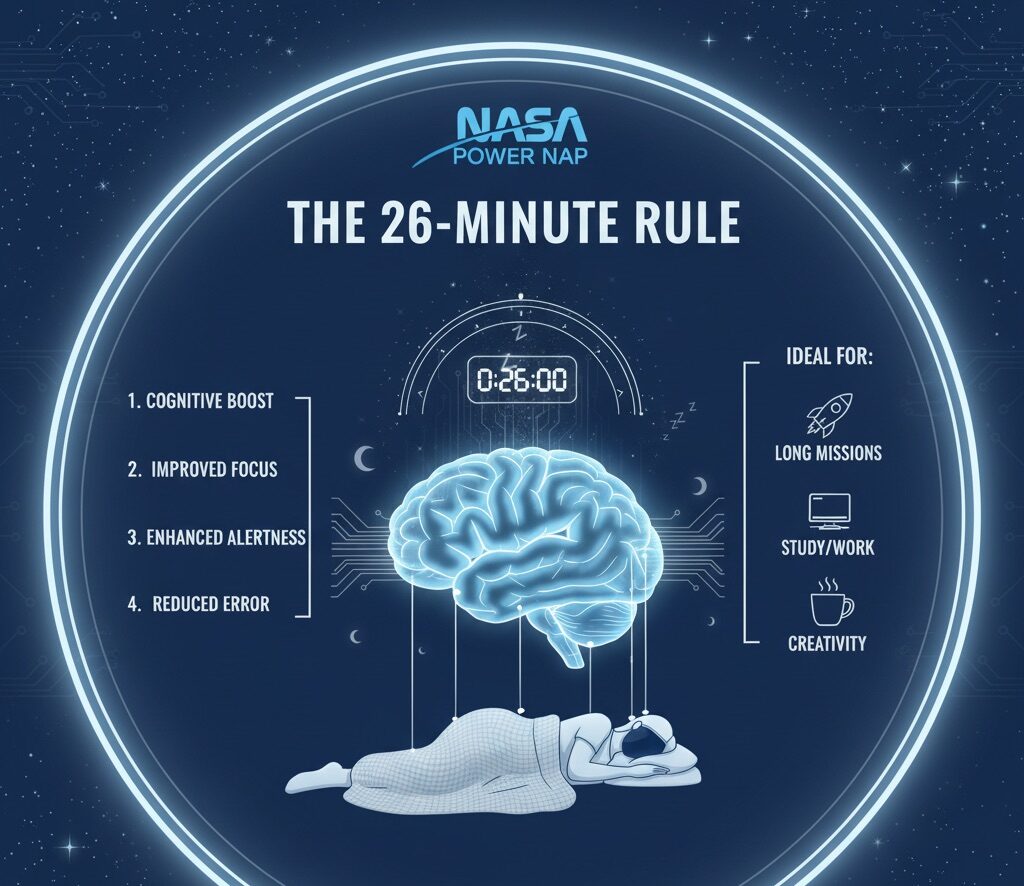
In our nonstop world, daytime rest often feels like a luxury — something reserved for lazy weekends or long flights. Yet science says otherwise. According to NASA’s research on pilot fatigue, a precisely timed 26-minute nap can dramatically boost alertness and cognitive performance.
What began as an experiment in spaceflight efficiency has become a cornerstone of modern sleep science. NASA discovered that short, structured naps could increase alertness by 54% and performance by 34% among pilots and astronauts. The key was duration: long enough to refresh the mind, short enough to avoid grogginess.
This “26-minute rule” may sound oddly specific, but it captures an elegant truth about how the brain cycles through rest. And it’s not just for astronauts — it’s a blueprint anyone can use to recharge during the day without disrupting nighttime sleep.
How NASA discovered the 26-minute rule
In the early 1990s, NASA’s Fatigue Countermeasures Program set out to solve a pressing problem: how to keep pilots and astronauts alert during long missions without overreliance on caffeine or stimulants. The human body simply isn’t built for sustained wakefulness.
Through extensive monitoring of brain activity, eye movement, and performance tests, NASA scientists found that naps between 20 and 30 minutes produced the best balance of recovery and efficiency. Anything shorter offered limited benefit; anything longer risked entering deeper stages of sleep that led to sluggishness upon waking — known as sleep inertia.
The sweet spot turned out to be around 26 minutes. Within this window, the brain enters the lighter stages of non-REM sleep (Stage 1 and Stage 2), which are rich in restorative processes like memory refresh, motor skill consolidation, and emotional reset.
The result was not only sharper reaction times but also better emotional regulation — a crucial factor in high-stress environments like aviation and space missions.
What happens in your brain during a short nap
A nap, though brief, is a microcosm of the entire sleep cycle. It begins with Stage 1, the drifting phase where your brain waves slow, muscles relax, and consciousness starts to blur. You might feel a gentle sense of falling or see flickers of dreamlike imagery — signs that your body is releasing tension.
Within minutes, you enter Stage 2 sleep, the true “sweet spot” for power naps. During this phase, your heart rate slows, body temperature drops slightly, and the brain produces short bursts of rapid electrical activity called sleep spindles.
These spindles are thought to protect sleep from external disturbances and play a key role in memory consolidation and learning. They’re like the brain’s background cleaning system — integrating short-term memories from the day and clearing space for new information.
Importantly, a 26-minute nap typically doesn’t progress into slow-wave sleep (Stage 3), where waking can feel disorienting. By staying in lighter stages, you wake refreshed and focused, rather than groggy and sluggish.
In essence, this is what makes the 26-minute rule so powerful: it taps into the most efficient portion of the sleep cycle without crossing the threshold into deep sleep.
The perfect nap formula
Nap optimization is both an art and a science. While NASA’s data points to 26 minutes as the golden average, your personal ideal might vary slightly — anywhere between 20 and 30 minutes tends to work best.
Here’s how to apply it:
Timing: Early afternoon is ideal, typically between 1:00 and 3:00 p.m. Around this time, your circadian rhythm naturally dips, lowering alertness and making it easier to fall asleep briefly.
Duration: Set an alarm for 26 minutes. Allow 2–5 minutes to fall asleep; your total downtime will be about 30 minutes — enough to feel restored but not groggy.
Environment: Choose a cool, quiet, dimly lit space. Use an eye mask or soft background sound if needed.
Body position: Recline slightly rather than lying completely flat — this discourages slipping into deep sleep.
Mindset: Treat your nap as intentional rest, not a guilty indulgence. A calm, accepting attitude helps you relax faster.
NASA’s research also noted that even if you don’t fall fully asleep, “quiet rest” — a state of relaxed wakefulness — can yield similar benefits. The key is stepping away from stimulation long enough for the nervous system to reset.
Why naps longer than 30 minutes backfire
If short naps feel so good, wouldn’t longer ones be better? Surprisingly, no. Extending your nap beyond the 30-minute mark usually carries you into slow-wave sleep, the deepest stage.
While slow-wave sleep is essential at night for physical recovery and growth hormone release, waking from it during the day can trigger sleep inertia — that heavy, disoriented feeling that lingers for up to an hour.
During slow-wave sleep, the brain’s electrical patterns shift dramatically into delta waves, and blood flow increases to muscles rather than the cortex. When you interrupt this state, your brain needs time to reboot to full alertness.
For most people, that means grogginess, irritability, and reduced cognitive sharpness — the opposite of what a nap should achieve.
To stay within the optimal range, think of your nap as a mental espresso shot — potent, refreshing, but best in moderation.
Avoiding sleep inertia: the gentle wake-up
The moment you wake can determine whether your nap energizes or drains you. To avoid inertia, try these gentle wake-up cues:
Natural light: Open your eyes near daylight or turn on a soft lamp. Light immediately suppresses melatonin and signals your brain to shift into wake mode.
Movement: Stretch your arms, roll your shoulders, or take a slow walk. Physical activity helps re-oxygenate your body and restart blood flow to the brain.
Hydration: Drink a glass of water or herbal tea. Dehydration can amplify fatigue sensations after a nap.
Breath awareness: Take three deep breaths to center yourself — a mini-transition between rest and activity.
NASA pilots used structured wake-up routines like these before resuming work, ensuring their minds were alert but calm — a balance that’s equally valuable on Earth.
The circadian connection: why nap timing matters
Not all naps are created equal. Their effectiveness depends on where they fall within your circadian rhythm, the internal clock that governs sleepiness and alertness across 24 hours.
Most people experience a natural dip in alertness 6–8 hours after waking — roughly early to mid-afternoon. This lull is biologically programmed and not just a result of lunch or low energy.
Napping outside this window — for example, in the late afternoon or evening — can disrupt nighttime sleep, shifting your circadian rhythm later and reducing overall sleep quality.
The 26-minute rule works best when aligned with this early-afternoon window. It supports your natural rhythm rather than competing with it, offering refreshment without confusion.
If you’re unsure when your body’s low point occurs, track your daily energy curve for a week. Notice when focus wanes, eyelids feel heavy, or you crave caffeine. That’s your optimal nap zone — your biological permission slip for rest.
A cultural shift: from guilt to recovery
One of the biggest barriers to napping isn’t physical — it’s cultural. Many of us associate naps with laziness or inefficiency, yet elite performers, athletes, and even CEOs treat rest as a performance tool.
NASA’s data helped shift that mindset. By proving that short naps enhance reaction time and emotional control, it reframed rest as a strategic skill — one that directly improves productivity and mental health.
Modern sleep science reinforces this: daytime rest improves learning, mood, immune response, and cardiovascular health. It’s not wasted time; it’s preventive care for your mind and body.
So, instead of pushing through the afternoon slump, the smarter — and more human — choice might be to pause for 26 minutes.
How to train your body for effective naps
Like any good habit, napping can be trained. Some people fall asleep effortlessly in daylight, while others struggle to quiet their minds. The good news is that your body can learn to enter light sleep quickly once it associates specific cues with rest.
Start by creating a nap ritual — a simple sequence that signals your nervous system it’s time to wind down. For example:
Silence notifications and dim the lights.
Take a few deep breaths or stretch your neck and shoulders.
Sit or recline comfortably with eyes closed.
Focus on your breathing or repeat a calming phrase.
Consistency is key. The more often you repeat this sequence at the same time each day, the faster your body will respond. Over time, your brain will link these signals to a predictable rest response — just as it does before nighttime sleep.
If you find yourself anxious about “falling asleep quickly,” shift your mindset. You don’t need to chase sleep. Simply rest with intention. Even if you remain half-awake, your brain still enters restorative states that support alertness and focus afterward.
The role of environment: where and how you nap
The right setting can make or break a nap. NASA’s fatigue studies emphasized environmental control as a vital factor in pilot recovery. You may not be in a cockpit, but the same principles apply: the body needs cues of safety and comfort before it can release tension.
Here’s how to optimize your surroundings:
Temperature: Aim for a cool room around 18–20°C (65–68°F). Warmth makes you drowsy, but excessive heat can interrupt sleep.
Lighting: Use blackout curtains, an eye mask, or simply turn away from direct light. Lower light intensity helps the brain produce melatonin, the hormone of relaxation.
Sound: A soft background hum, such as white noise, ocean sounds, or gentle music, can mask external disturbances.
Posture: Recline slightly — enough to relax but not so much that you sink into deep sleep. A comfortable chair or sofa works well.
Scent: A few drops of lavender or chamomile essential oil can condition your mind to associate a scent with calmness.
If you’re napping at work, try a quick rest at your desk or a quiet corner with a travel pillow. Many companies now design “nap pods” or rest zones, acknowledging that short naps increase productivity and morale far more than another cup of coffee.
Power napping for different lifestyles
While NASA’s 26-minute rule was born from aviation studies, it’s now being adapted for everyday life — from athletes to students and remote workers. Here’s how to personalize it:
1. The office professional
A midday nap can replace the afternoon coffee crash. Schedule it right after lunch, when alertness naturally dips. Use a reclined chair, noise-canceling headphones, and a 25-minute timer. When you wake, stand up, stretch, and take a few deep breaths before returning to work.
2. The student or creative
If your work demands focus and creative problem-solving, try a nap during long study or writing sessions. Research from the Sleep Foundation shows that short naps improve pattern recognition and memory recall, making them ideal for learning new material.
3. The shift worker
For those working late or irregular hours, naps are not optional — they’re protective. Strategic naps before or during night shifts can sustain alertness and prevent fatigue-related errors. NASA suggests planned “anchor naps” of 20–30 minutes before demanding tasks.
4. The athlete
Professional athletes use naps as recovery tools. Studies in sports medicine show that short naps before afternoon training can enhance reaction time, decision-making, and mood, all thanks to neurochemical resets in the brain.
No matter your schedule, the principle stays the same: rest is fuel, not downtime.
The science of caffeine naps
An intriguing variation on the 26-minute rule is the “caffeine nap” — a technique also popularized through NASA research. Here’s how it works: you drink a small cup of coffee or tea right before your nap. Because caffeine takes roughly 20–30 minutes to enter your bloodstream, its alertness effect peaks right as you wake up.
This creates a “double boost”: the nap clears adenosine (a fatigue-related chemical in the brain), and the caffeine blocks its return. Studies show that this combination can enhance alertness more than either method alone.
Just be mindful not to use caffeine naps too late in the day, as they may delay nighttime sleep. Early afternoon is still the ideal window.
The psychology of letting go
The biggest obstacle to effective napping is often mental, not biological. Many people carry guilt or restlessness — a sense that they “should be doing something.” But neuroscience reminds us that rest is an active state of recovery, not wasted time.
During a nap, the default mode network — the brain system linked to reflection and creativity — becomes more active. This network integrates emotions, connects distant ideas, and restores your sense of coherence. In that sense, naps can be moments of quiet creativity as much as rest.
Letting yourself nap isn’t laziness; it’s trust — trust that stillness has value. When you pause, you allow your brain’s natural rhythms to restore harmony between focus and calm.
When naps might not help
Though short naps benefit most people, they’re not ideal in every situation. If you struggle with insomnia or difficulty falling asleep at night, frequent late-day naps can disrupt your circadian rhythm.
In such cases, keep naps early and brief, or replace them with quiet rest periods — meditation, deep breathing, or simply closing your eyes for a few minutes. These activities calm the nervous system without interfering with nighttime sleep cycles.
Also, if you find that naps make you feel more groggy rather than refreshed, check for underlying causes like inconsistent sleep, high caffeine intake, or chronic stress. The goal isn’t perfection — it’s awareness and gentle adjustment.
A nap-positive culture
From Japan’s inemuri (the art of napping in public) to modern wellness offices in Silicon Valley, attitudes toward daytime sleep are slowly changing. What used to be seen as indulgence is now recognized as a vital part of cognitive hygiene.
NASA’s 26-minute rule has played a symbolic role in this shift. It gave permission to rest with purpose — to see naps as part of performance optimization, not weakness.
Imagine a culture where short, restorative breaks are celebrated as investments in clarity, safety, and wellbeing. Where students nap before exams, designers nap before brainstorming, and healthcare workers nap between shifts.
We’re beginning to move in that direction, guided by science that values recovery as much as productivity.
Bringing the NASA nap home
To integrate the 26-minute rule into your own life, start small:
Choose your time: Aim for early afternoon, when your energy dips naturally.
Set your space: Quiet, dim, and comfortable — no phone, no urgency.
Use a timer: Set 26 minutes, and let go of expectations.
Re-enter gently: Stretch, hydrate, and give yourself two minutes to fully awaken.
Try this for a week. You may notice clearer thinking, steadier moods, and even better nighttime sleep — because balanced daytime rest supports overall circadian health.
You can also combine your nap ritual with relaxation techniques, like the deep breathing exercises from our article Deep breathing for better sleep: a simple nighttime technique. This pairing calms your nervous system and makes it easier to drift into light rest.
Over time, you’ll learn to trust your body’s rhythm. The goal isn’t to nap every day but to understand when your body is asking for pause — and to respond kindly.
Rest as resilience
The NASA 26-minute nap rule reminds us that sleep is not just the absence of wakefulness — it’s the foundation of it. A short nap can reframe your entire afternoon, bringing mental clarity where there was fog, and calm focus where there was tension.
In an era that glorifies constant motion, taking 26 minutes to rest is a quiet act of self-respect. It’s how we remind our overworked minds that recovery is productive too.
So next time you feel that afternoon crash coming on, skip the extra coffee. Close your eyes, breathe deeply, and give your brain what it truly needs: a brief return to balance.
Because sometimes, 26 minutes can change the course of your day — and your mind.
Read also: