
Most people have heard the advice: “If you can’t fall asleep, try counting sheep.” It’s a charming image — soft animals hopping over a fence in endless succession. But the technique didn’t survive for centuries because of its cuteness. It survived because it taps into a core sleep principle: the mind cannot truly think and count at the same time.
Counting pulls the brain away from rumination and toward something predictable, repetitive, and cognitively light. It interrupts the mental loops that often keep you awake — loops built on worry, replaying conversations, planning, or anticipating the next day.
But for many people, traditional sheep counting doesn’t work.
The imagery can feel forced, the repetition becomes boring rather than soothing, and the technique doesn’t anchor the mind in any sensory reality. When counting feels generic, the mind slips back into its habitual busy loops.
This is where modern cognitive distraction methods come in — updated versions of “sleep counting” that build on the same psychological principles but offer more grounding, more structure, and more calming sensory engagement. They’re not about perfect accuracy; they’re about giving your mind a pathway that’s so gentle and rhythmic that sleep becomes a natural next step.
The science behind cognitive distraction
To understand why counting works — and how to build more effective alternatives — it helps to look at the underlying neuroscience.
Nighttime overthinking happens when the brain stays in high cognitive arousal. This state keeps mental activity fast, analytical, and internally noisy. According to the Sleep Foundation’s exploration of cognitive arousal, intrusive thoughts increase sleep latency because the mind struggles to downshift. In other words, the system meant to quiet itself at night cannot find the “brake.”
Cognitive distraction techniques — including counting — gently redirect the mind’s focus away from stressful content. They don’t eliminate thoughts; they outcompete them. The mind receives a new task that is:
simple
rhythmic
emotionally neutral
low-effort
repetitive
This combination stabilizes attention without activating problem-solving networks. It provides just enough occupation to keep thoughts from spiraling, but not enough challenge to prevent sleepiness.
Harvard Health notes that mental redirection methods help slow nighttime cognitive activity by giving the brain a structured, low-demand focus. Counting becomes a form of mental pacing.
At night, the mind needs monotony — something steady enough to soften mental loops, yet gentle enough to let the nervous system drift.
Why the mind responds well to structured, low-effort counting
Counting functions like a cognitive dimmer switch. Instead of “switching off” thoughts — which almost never works — it gradually lowers the intensity of mental activity. The rhythm of counting acts as a counterweight to fast, nonlinear thinking.
Here’s why it’s effective:
1. Counting slows down thought velocity.
Rumination is fast, chaotic, associative. Counting is slow, linear, predictable.
2. It gives the mind an alternative path.
You can’t deeply focus on a number sequence and fully ruminate at the same time.
3. It reduces emotional charge.
Numbers are neutral. They don’t carry emotional weight.
4. It activates different neural pathways.
Counting uses the brain’s sequencing networks rather than its evaluative networks.
5. It’s finite yet flexible.
Counting has direction but no urgency — a rare combination for a busy mind.
But the classic sheep method doesn’t engage the senses or adapt to different thinking styles. Modern sleep counting methods do. They allow the mind to lean into something more grounding, more imaginative, or more sensory — depending on what supports your internal rhythm.
Modern “sleep counting” methods beyond sheep
Sleep counting has evolved far beyond the idea of animals hopping over a fence. Modern approaches integrate breath, imagery, sensory cues, and directionality — creating counting sequences that are both calming and mentally absorbing enough to interrupt rumination.
These methods aren’t meant to be performed perfectly. In fact, losing track is a sign that the brain is softening. The goal is to create a gentle cognitive drift — the mental equivalent of rocking yourself to sleep.
Below are four contemporary approaches that tend to work particularly well.
1. Counting with sensory anchors
In this method, each number is paired with a sensory cue.
For example:
counting “1” while noticing the warmth of your blanket
counting “2” while feeling the weight of your body on the mattress
counting “3” while sensing the gentle rise of your breath
This shifts counting from a mental activity to a sensory rhythm. The mind stays occupied, but the body becomes the anchor — creating a slow descent into physical presence.
This method resembles sensory grounding techniques highlighted in Somatic navigation, but offers a more structured cognitive component.
2. Backwards counting with breath
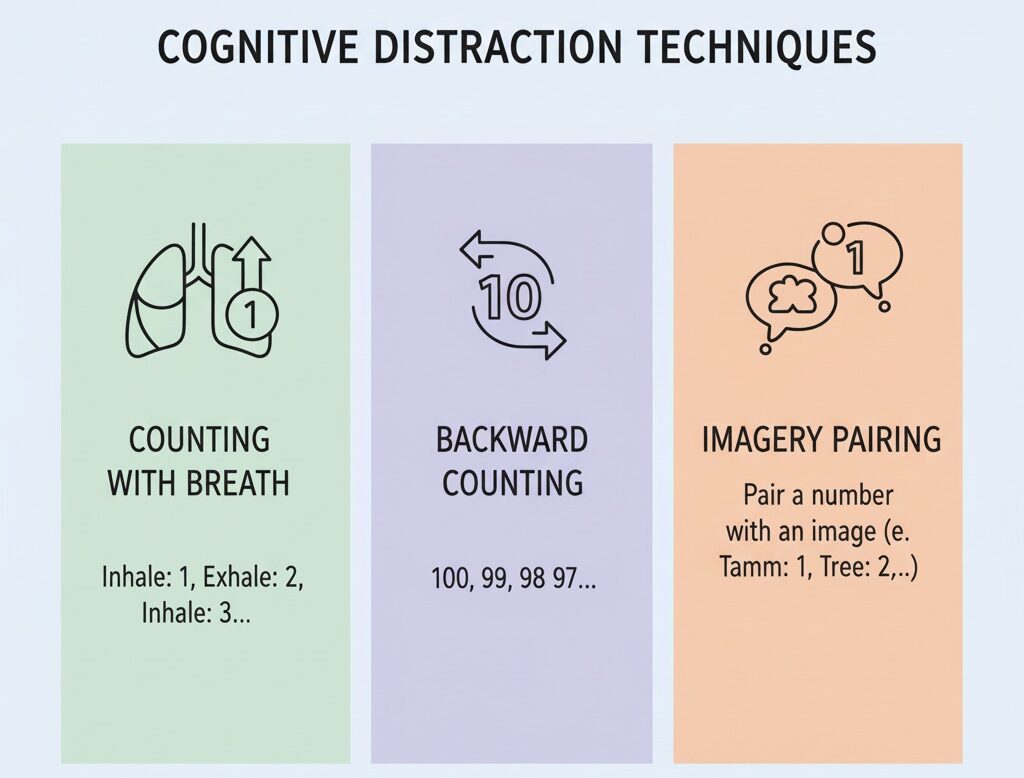
This method introduces directionality — a helpful feature for people whose minds feel restless or scattered. You simply count backward from a number like 100 or 50, matching each number with an exhale.
The combination works because:
backward counting requires slightly more attention
exhaling activates the parasympathetic nervous system
breath and numbers sync into a single calming rhythm
After a few cycles, the mind often softens into drowsiness. If you lose track (and you will), you simply restart gently.
3. Visualized number pathways
Here, counting is paired with imagery — but not sheep. Instead, you visualize numbers appearing one by one in a relaxing environment, like soft clouds, gentle waves, or slow-moving lanterns.
The imagery should feel calm, not stimulating. The numbers appear slowly, as if drifting into view.
This method works beautifully for visually oriented thinkers because it interrupts mental loops with soft, repetitive scenes that have no emotional charge. It’s counting, but through a sensory lens.
4. Counting paired with soft imagery storyline
This approach blends counting with a drifting scenario — for example, imagining yourself walking down a path, where each step corresponds to a number. Or picturing yourself descending a staircase, each step bringing you deeper into quiet.
It’s not storytelling; it’s pacing. The cognitive demand remains low, but the mind gains a soothing narrative structure.
These modern methods transform counting from something mechanical into something sensory, grounding, and tailored to the mind’s natural rhythms.
How counting techniques reduce nighttime overthinking
Nighttime overthinking is essentially uncontrolled cognitive pacing. The mind speeds up because there is no structure keeping it stable. Counting provides that structure. It introduces a mental metronome — a repeating, rhythmic pattern that interrupts nonlinear thought.
Counting also redirects the mind away from emotional content. Rumination thrives on meaning:
What if this happens tomorrow?
Why did that conversation feel off?
How do I solve this?
Numbers have no meaning. They are pure form, not content. This makes them uniquely effective at “cooling” the emotional temperature of the mind.
Cleveland Clinic’s overview of calming nighttime anxiety emphasizes the importance of diverting the mind from emotionally charged thought patterns. Counting does exactly that: it gives the mind something neutral to hold onto.
When combined with sensory cues, numbers become a bridge between mind and body. They guide attention downward, into slower physiological rhythms — and sleep follows the descent.
How to choose the right method for your mind’s pace
Every mind has its own nighttime rhythm. Some people need something very simple and repetitive; others need a bit more structure to stay engaged without becoming stimulated. Understanding your own pace can make sleep counting far more effective.
If your thoughts tend to accelerate quickly — jumping from topic to topic — a grounding method like counting with sensory anchors can help stabilize attention. Each number becomes connected to the physical body, which reduces the mind’s tendency to drift into mental narratives.
If your mind gets stuck on a specific thought and loops around it, a method that involves directionality, like backwards counting with breath, may help more. The backward sequence provides just enough cognitive engagement to interrupt the loop, while the paired exhale naturally slows the nervous system.
If you’re a visually oriented thinker, visualized number pathways may feel almost effortless. The soft imagery keeps the mind occupied without activating emotional or analytical networks. This method is especially helpful for people prone to vivid mental activity at night — the kind of internal imagery that becomes stressful rather than soothing.
And if your mind prefers a sense of progression, step-counting with a gentle scenario can create a felt sense of moving deeper into rest. It’s not storytelling; it’s emotional pacing — a descent that mirrors the body’s physiological downshift.
Choosing the right technique is less about accuracy and more about alignment. You’re learning what kind of mental rhythm brings your system into quiet.
How counting integrates with your wind-down environment
Counting techniques work best when the environment supports the same direction — away from stimulation and toward sensory softness. The nervous system relies on environmental cues to understand that it’s time to lower alertness, so pairing counting with an intentional wind-down setting can amplify the effect.
Light is one of the strongest signals. Dimming the lights or switching to warm-toned lamps helps soften the visual field, reducing the brain’s expectation for attention and detail. Harsh overhead lighting keeps the mind alert; gentle light helps it exhale.
Sound affects mental pacing too. Quieting the room or introducing gentle background sound — low ambient music, soft white noise, or a slow instrumental track — creates a steady auditory environment. This complements the internal rhythm created by counting.
Comfort also plays a powerful role. When your shoulders settle into a pillow or your body feels comfortably weighted under a blanket, the nervous system receives cues of safety. These cues mirror the principles we explored in Somatic navigation: how body-based mapping calms the mind before sleep. When your body feels safe, your mind doesn’t feel obligated to stay alert.
Counting becomes part of the environment — a thread in a broader sensory tapestry. The more of these cues that align, the easier the mind descends.
How counting supports, rather than competes with, rest
Some people worry that counting might feel too active or too effortful. But good counting techniques do the opposite — they work with the body’s natural sleep processes rather than against them.
Sleep is not a sudden switch; it’s a layered transition. The brain moves from wakefulness into light sleep, then deeper sleep, gradually losing its grip on structured thought. Counting mirrors this descent. You start with intentional focus, but as drowsiness grows, the numbers become softer, vaguer, more dreamlike. Eventually, they stop entirely — and that’s the signal that sleep has taken over.
Cognitive distraction doesn’t compete with this process. It fills the space between wakefulness and sleep with something gentle enough to drift away from. It slows the mental pacing just enough for the body’s natural mechanisms to take over.
This is why losing track of the numbers is not a “mistake.” It’s success. It means the mind no longer has the cognitive tension needed to hold the sequence, and sleep is close.
Counting becomes a mental glide path — not an effort, not a task, but a softening.
Why structured distraction reduces nighttime anxiety
Nighttime anxiety isn’t just emotional; it’s physiological. When the mind races, the body often follows — faster breath, a slight tightening in the chest, a rise in heart rate. These signals reinforce the idea that the mind must stay alert, which creates more anxiety.
Counting interrupts this cycle by introducing predictability. Predictable sequences reduce the brain’s sense of threat. Something orderly and rhythmic tells the nervous system that nothing requires immediate evaluation.
Cleveland Clinic’s overview of calming nighttime anxiety explains that structured mental tasks reduce anxious looping by providing a gentle cognitive boundary. Counting creates that boundary without stimulating problem-solving areas of the brain.
What makes counting especially helpful is that it replaces ambiguity — the “open space” where worries take root — with something known and calming. Even a simple sequence like “99… 98… 97…” creates emotional containment.
At night, the mind longs for containment. Counting provides it.
How sleep counting interacts with breath and bodily rhythms
Although counting is primarily cognitive, its effects are deeply physical. As the mind slows, breath deepens. As breath deepens, the nervous system downshifts. As the nervous system downshifts, heart rate decreases. This layered interaction mirrors the physiological relaxation explored in Deep breathing for better sleep.
Many people naturally begin breathing more slowly when counting — especially when counting backward or pairing numbers with exhales. This creates a feedback loop:
slower thoughts → slower breath → calmer nervous system → slower thoughts
Sleep sits at the end of this loop, not as a forced destination but as the natural outcome of slowing everything down.
This is why counting often begins as a mental technique and ends as a bodily one. By the final moments before sleep, the body takes over. Breath leads. Muscles soften. The numbers fade.
When counting doesn’t work and how to adjust
Sometimes counting feels ineffective at first. This doesn’t mean it’s the wrong technique; it often means the mind or body needs a softer entry point.
If counting feels too active, start by pairing numbers with breath.
If counting feels too boring, try visualized number pathways.
If counting feels too easy to lose track of, try backward sequencing.
If counting feels too abstract, add sensory anchors.
The goal is never to “get it right.” The goal is to create enough structure that your mind feels gently held.
Most people discover that once they find the right pacing, the mind begins to anticipate the counting sequence as a cue for sleep — the same way certain songs or scents can evoke memories. The brain loves patterns, especially calming ones.
The deeper meaning of sleep counting
Despite its reputation as a simple trick, sleep counting speaks to something profound about how the mind rests. It shows that the brain doesn’t need to be silenced — it needs to be guided. It needs continuity, structure, and gentle direction.
Counting gives the mind permission to let go.
It shows the brain that it doesn’t have to solve anything.
It replaces complexity with rhythm.
It offers predictability in a moment that often feels internally loud.
In a world where so much of our cognitive energy is spent managing, planning, responding, and predicting, sleep counting becomes a rare space of neutrality.
And neutrality is one of the most restful states the mind can experience.
Conclusion: counting as a soft mental drift toward sleep
“Counting sheep” may have been the starting point, but the deeper truth is that counting — in any calming form — is a gentle art. It guides the mind away from loops and toward rhythm. It transforms mental turbulence into something slower, softer, and more manageable. It creates a pathway the brain can follow downward into sleep.
The most effective sleep counting techniques are the ones that meet you where you are. They don’t demand precision. They don’t require discipline. They simply offer a mental handrail — steady, predictable, and kind.
In the quiet moments between wakefulness and sleep, that’s often all the mind needs.