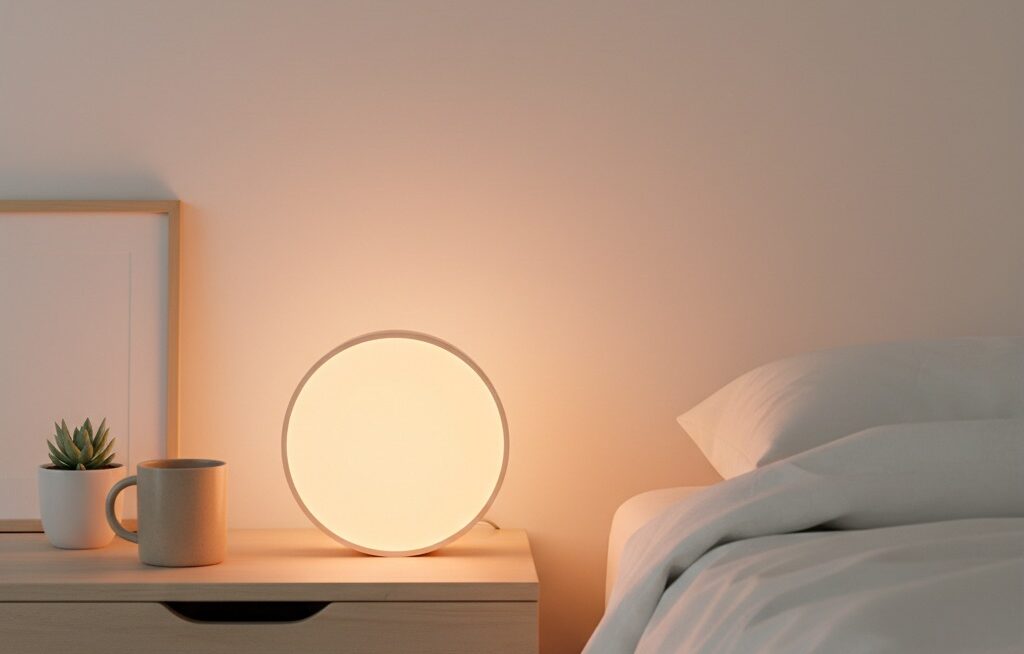
Most people imagine that mornings are shaped by willpower — alarms, routines, discipline. But neuroscience suggests something more subtle: your day is shaped long before your first conscious thought. It begins in the sensory cues that greet you the moment you open your eyes.
A faint aroma. A shift in light. A familiar sound.
Tiny signals, almost invisible, yet powerful enough to set the emotional tone for hours.
In sleep science, this is known as sensory anchoring — the way your brain uses simple sensory inputs to predict what kind of day is coming. It’s the same mechanism that helps you relax when you enter your bedroom at night or feel alert when you step into bright daylight. The nervous system doesn’t wait for your decisions; it responds instantly to cues.
The “one sensory cue” rule takes this idea a step further: instead of overwhelming yourself with full morning routines, you choose one reliable sensory signal — scent, light, or sound — to mark your transition from sleep to wakefulness. Just one. Consistent, gentle, predictable.
This minimalistic approach doesn’t compete with your morning energy. It shapes it.
The science behind sensory cues and waking
As we move from sleep to wakefulness, the brain shifts through a cascade of changes — decreased melatonin, rising cortisol, activation of the reticular activating system. But the speed and smoothness of that transition depend heavily on sensory input.
Here’s what research shows:
Light
Morning light exposure helps regulate your circadian rhythm and improves alertness by suppressing melatonin. Harvard Health highlights how even subtle increases in morning brightness help stabilize your internal clock.
Scent
Aromas such as citrus or peppermint can activate the limbic system, the part of the brain tied to mood and motivation. Certain relaxing scents — lavender or chamomile — can ease the shift out of sleep without overstimulation.
Sound
Gentle, predictable sounds support smoother waking than sudden alarms. Rhythmic sound patterns help reduce cortisol spikes and allow wakefulness to unfold in a calmer arc.
The power of a sensory cue lies in what it tells the brain:
“A new part of the day is starting. Let’s transition.”
It’s the same principle used in nighttime routines — like the breathing practice explored in our article Deep breathing for better sleep: a simple nighttime technique.
Just as breath becomes an evening cue, scent, light, or sound can become a morning cue.
Why the “one sensory cue” rule works better than full routines
Morning routines can be helpful, but for many people — especially those dealing with fatigue, stress, or inconsistent sleep — highly structured mornings become overwhelming. The mind wakes slowly, the body resists pressure, and routines start to feel like obligations rather than support.
The “one sensory cue” rule works because it:
1. Reduces decision fatigue
You don’t need to perform five steps or think about sequencing. The cue simply happens, and your body responds.
2. Anchors the nervous system
Predictability is soothing. A consistent sensory cue becomes a signal of stability, something particularly helpful for people who struggle with nighttime anxiety or inconsistent mornings.
3. Fits even the busiest lifestyles
Whether you work from home, commute, or rotate shifts, a single cue is easy to maintain.
4. Builds a bridge between sleep and wakefulness
Your brain loves continuity. A gentle cue forms a transition — one that feels kinder, more grounded, and less jarring than alarms or rushed mornings.
5. Works with the body, not against it
Instead of forcing alertness, it invites it.
The result is a morning that feels intentional without feeling forced — a small ritual with meaningful impact.
Choosing your cue: scent, light, or sound
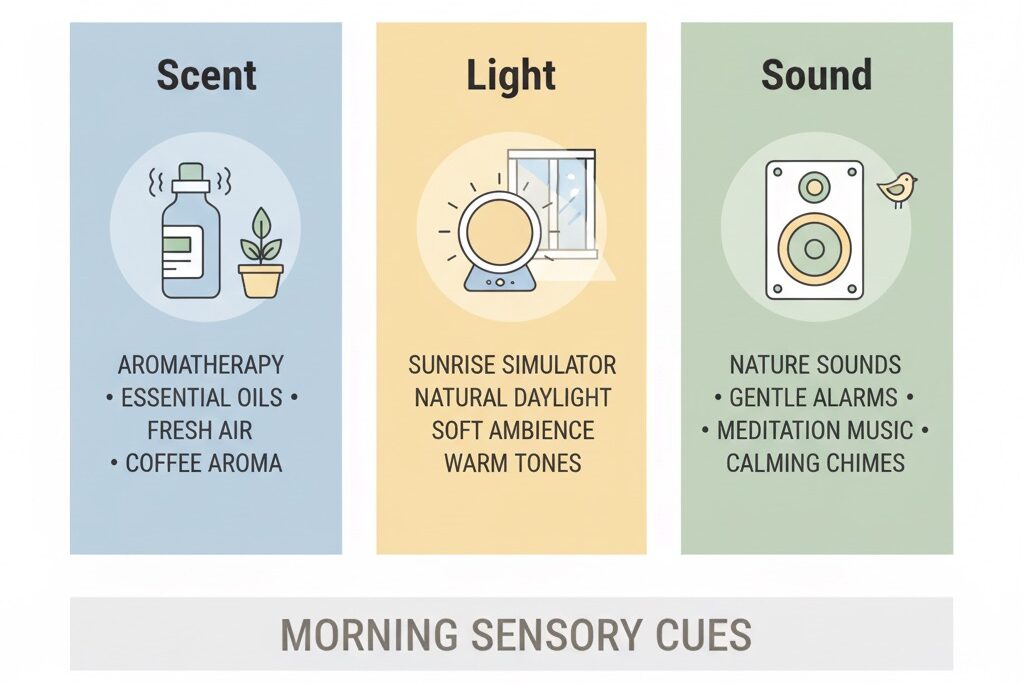
The beauty of this method is its simplicity. You choose one sense to guide your morning. No pressure to do all three. The idea is to start with a single anchor and let it become your automatic wake-up companion.
Below are the three categories — explained not as lists of tasks, but as sensory experiences and the science behind them.
Scent as your morning anchor
Scent interacts directly with the limbic system — the emotional and memory center. Because of this shortcut to the brain, it can create strong associations. For example, citrus notes are linked with mild alertness, while peppermint can increase clarity and reduce morning fog.
A gentle diffuser that turns on at the same time each morning, or a roll-on aroma you apply as soon as you sit up, becomes a wake-up signal your brain learns to trust.
This works particularly well if your nights involve stress-related tension, as aroma anchors help soften the emotional transition into wakefulness — something we explore in our article on evening routines and environment resets.
Light as your morning anchor
Light is the most powerful circadian cue. Even a small increase in brightness can trigger alertness pathways. A sunrise lamp, sheer curtains that let daylight in, or a single soft lamp switching on automatically can set the tone.
You don’t need bright, artificial light — just enough to shift melatonin levels gradually.
Light anchors are ideal if:
you wake feeling groggy,
mornings make you feel disoriented,
or you struggle with winter sluggishness.
Morning light also balances mood-regulating hormones, which can ease low-mood mornings — a connection explored in Caffeine cut-off times: what science says about your last cup, where we discuss circadian timing and alertness.
Sound as your morning anchor
Sound is the gentlest anchor. Instead of a loud alarm, a curated sound cue — soft chimes, a consistent melody, ambient hums, nature sounds — can help your nervous system rise gradually.
A predictable sound pattern becomes a sensory bridge: not silence, not abrupt noise, but something in between.
People who experience nighttime overthinking or morning anxiety often find sounds grounding. Rhythmic audio cues can help regulate breath and slow the mental rush — similar to how body scanning calms nighttime thoughts, as we cover in
The role of body scanning in reducing nighttime overthinking.
How to apply the rule and why it works
One of the most surprising things about the “one sensory cue” rule is how little it asks from you. You don’t need a complicated morning routine or a long checklist of habits. Instead, you give your brain one stable, low-effort signal that tells your nervous system, “We’re shifting into the day.”
When this happens consistently, the brain begins to anticipate wakefulness even before you fully open your eyes. This is the same principle behind night routines — one cue before bed signals the transition toward rest — something we explore in our article on pre-sleep transitions (internal link style referencing: such as the soothing strategies described in Deep breathing for better sleep on Calm Sleeply). Morning cues work in reverse, helping the mind leave its slower, dreamlike state and step into clarity with less friction.
The neurology behind the cue
A sensory cue works because the brain loves predictable patterns. When something repeats at the same moment daily, the nervous system wires it to a cognitive response — a concept known as associative learning.
Light cues influence the suprachiasmatic nucleus, the brain’s internal clock. Even a few minutes of consistent morning light — warm lamp light or sunlight — can anchor your circadian rhythm. This aligns with research summarized by Harvard Health on how morning light stabilizes energy and mood.
Scent cues act differently. Aromas like citrus, rosemary, or mint trigger the olfactory system, which connects directly to the limbic system — the emotional and motivational center of the brain. This makes scent particularly potent for shaping mental state at the start of the day.
Sound cues, meanwhile, influence the autonomic nervous system. Soft rhythmic sound or a specific morning playlist activates neural pathways associated with alertness. Pink-noise–based waking tracks, which we explored in the framework of sound environments in White noise vs. pink noise devices (internal reference), can help the brain transition out of sleep in a gentler, more stable way.
Choosing the cue that suits your nervous system
Not all cues work equally for everyone. Much depends on your sensory profile.
Some people wake best through light — they need brightness to fully shift their cognitive state. Others prefer sound, especially if mornings feel overstimulating. And many people find that scent is the ideal middle ground: grounding, subtle, and nonintrusive.
To choose your cue, consider the tendencies you notice in your mornings:
If you feel foggy or slow → a light cue may help activate the circadian pathways faster.
If you wake easily but with scattered thoughts → a sound cue can shape your mental pace.
If you feel emotionally flat or unmotivated → a scent cue offers a gentle psychological lift.
Here it’s helpful to reflect on emotional tendencies, something we also cover in Evening reflection prompts that regulate your mood overnight, which highlights how sensory awareness can modulate emotional tone early or late in the day.
How to implement the rule without overthinking it
The beauty of the “one sensory cue” rule is simplicity. The goal is not to create a ritual — it’s to create a signal. A small moment that repeats daily until your brain reads it as the “start of day” code.
Here are a few ways to implement it, without turning it into a routine full of steps:
Option 1 — Scent cue
Keep a small bottle of an energizing essential oil beside your bed. The moment you sit up, inhale once or twice. No meditations, no affirmations — just a single inhalation. Your olfactory system does the rest.
Option 2 — Light cue
Turn on the same soft lamp every morning. Don’t use your overhead lights; choose a warm, stable source. The key is consistency — same light, same time, same transition.
Option 3 — Sound cue
Play the same 20–30-second sound environment — a soft pink-noise sequence, gentle chimes, or a calming playlist intro. Avoid loud alarms; they trigger cortisol spikes. Instead, use sound as a gentle activation method.
What matters most is that the cue is predictable and effortless. If it takes too much energy or feels like a task, the nervous system will not register it as a comfort-based anchor.
How this cue influences your emotional baseline
Predictable sensory cues give your mind something valuable: a starting point. Modern mornings often feel chaotic — notifications, rushing, tasks waiting for attention. Without a stable anchor, the nervous system begins the day already scanning for demand.
A single cue acts as grounding. The scent, light, or sound becomes the moment of transition — the nervous system shifts from sleep-mode to wake-mode with less friction, less irritability, and less emotional reactivity.
This principle mirrors the benefits of somatic settling practices, such as body scanning (referenced in our piece on The role of body scanning in reducing nighttime overthinking). Morning cues simply flip the direction: they bring clarity instead of calm.
When repeated daily, one consistent cue can:
reduce morning anxiety,
stabilize mood,
reduce the cognitive “jerk” between sleeping and waking,
and support better energy rhythm across the day.
Circadian-rhythm researchers at the Sleep Foundation also highlight how morning sensory patterns, especially light exposure, regulate cortisol timing and overall daytime alertness.
Your day becomes less about reacting and more about starting intentionally.
What if mornings feel overwhelming?
Many people struggle with sensory overload in the morning — bright lights, loud alarms, sudden requests, mental load. The one sensory cue rule offers something gentler. Instead of creating a full routine, you offer your brain a single point of stability before the rest of your morning unfolds.
If mornings often feel like too much, choose the softest cue possible:
A warm, dim light.
A soft scent such as lavender, bergamot, or vanilla.
A smooth, low-frequency sound (pink noise is better than white noise for this purpose, as we’ve explored in our previous comparisons).
The cue is not meant to energize instantly — it’s meant to orient the nervous system so the transition doesn’t feel abrupt.
Bringing consistency without rigidity
The “one sensory cue” rule should feel like support, not obligation. You don’t have to repeat it at the exact same minute daily. Instead, focus on repeating it in the same phase of your morning: right when you wake up, before you check your phone, before the day starts speaking at you.
Over time, your brain begins to expect it. When expectation forms, even the anticipation becomes soothing. That’s where the real magic happens — the cue becomes not just a signal, but a safety pattern.
And as with any sleep-friendly habit, pairing the cue with an evening rhythm makes the entire cycle more cohesive. If your night includes calming pre-sleep transitions — stretching, soft light, or breathing — your morning cue becomes the other end of a circadian loop that feels intentional, smooth, and emotionally stable.
A gentle conclusion
Your morning doesn’t need to be complicated to be effective. A single sensory cue — one scent, one light, or one sound — can shape how your brain begins its day and how your emotional baseline unfolds.
This principle is simple, grounded in neuroscience, and surprisingly powerful. And like every Calm Sleeply practice, it prioritizes ease, gentleness, and real-world consistency over perfection.
Small sensory anchors matter. They calm the nervous system, stabilize your mental state, and create a sense of rhythmic continuity from night to morning.
Because sometimes the difference between a chaotic start and a grounded one is not a full routine —
but one cue you return to every day.