
For many people, the weekend offers long-awaited freedom: no alarms, no early meetings, and a chance to sleep in or stay out late. But by Monday morning, that freedom often comes at a price. You wake up groggy, your body feels like it’s still on a different schedule, and your energy takes hours to return — even if you technically got more sleep over the weekend than during the week.
This disconnect is often called “weekend jet lag”, but the scientific term is social jet lag — a phenomenon where your internal biological clock is out of sync with your social schedule. And just like crossing time zones, it can leave you feeling disoriented, fatigued, and strangely off-center.
The good news is that social jet lag is not permanent, and there are ways to gently realign your sleep rhythm without becoming overly rigid. Let’s explore what happens in your body during these weekend shifts, why even small changes in schedule matter, and how to recalibrate your internal clock — especially when life doesn’t always stick to a perfect routine.
What is social jet lag?
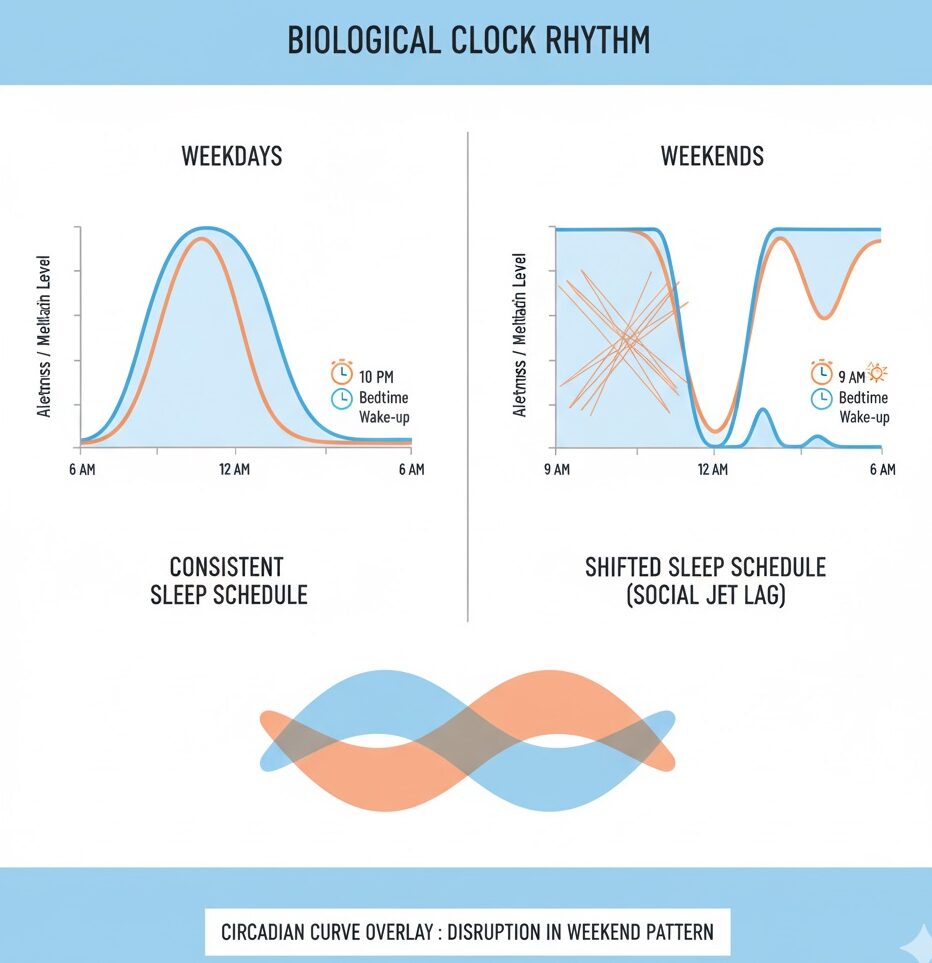
Social jet lag refers to the mismatch between your natural circadian rhythm and your actual sleep schedule, especially on weekends. It’s most common in people who wake up early during the week for work or school, then sleep in or stay up much later on weekends.
Unlike regular jet lag, which involves external time zone changes, social jet lag is internal — your biological clock is still operating on “weekday mode,” even if your social activities suggest otherwise. By shifting your sleep and wake times by two or more hours on Friday and Saturday, you’re effectively giving your body the same disruption as flying across two time zones — without ever leaving your home.
This doesn’t just affect when you wake up. It alters:
your hormone release schedule (like cortisol and melatonin),
your hunger cues and digestion,
your alertness patterns,
and your core body temperature rhythm.
By Sunday night, your body may feel wide awake at bedtime, and waking up Monday morning can feel like dragging yourself out of a deep, cold fog.
Why do weekends disrupt sleep so much?
It might seem like “catching up on sleep” would be a good thing. After all, if you’ve been sleep-deprived all week, sleeping in on Saturday and Sunday feels like a logical way to recover. And to some extent, that’s true — short-term recovery from sleep debt can help with energy and cognitive function. But the problem is what happens next.
Your body’s internal clock — or circadian rhythm — thrives on consistency. It learns when to expect light, food, activity, and rest. When you abruptly change that timing, especially by staying up late and sleeping in, your internal rhythm doesn’t immediately adapt. In fact, research from the Sleep Foundation shows that it can take days for your body to reset after just one disrupted weekend.
What’s more, these weekend shifts often involve less morning light exposure, more artificial light at night, irregular meal timing, and altered caffeine or alcohol intake — all of which compound the circadian confusion.
It’s like giving your body mixed signals: “wake up later, but still be alert for work at 7 a.m. on Monday.” The result? You feel sluggish, mentally foggy, and emotionally irritable — symptoms of what many now call Monday fatigue.
What happens in your brain and body?
To understand why this matters, we have to look at how your body regulates sleep.
Your circadian rhythm is controlled by a master clock in the brain — the suprachiasmatic nucleus — which coordinates everything from hormone production to alertness levels. This clock responds most strongly to light, particularly morning sunlight, and is reinforced by other cues like meal timing, physical activity, and social interaction.
When you shift your sleep schedule on the weekend:
Melatonin release may be delayed, making it harder to fall asleep Sunday night.
Cortisol (which helps you wake up) may be misaligned, leading to grogginess.
Sleep stages may be fragmented, especially deep sleep and REM cycles.
Appetite and digestion rhythms may shift, leading to late-night hunger or daytime fatigue.
Studies, including one from the NIH, show that consistent weekend shifts in sleep timing are linked to higher resting heart rates, insulin resistance, and even mood disturbances like anxiety or irritability.
In other words, your body notices when you treat weekends like a different time zone — and it doesn’t always appreciate the sudden return to “real time” on Monday morning.
Short- and long-term effects of weekend sleep debt
One weekend of disrupted sleep won’t do lasting damage — your body is surprisingly resilient. But regular cycles of social jet lag can build up over time and start to affect more than just your Monday mood.
In the short term, common symptoms include:
morning grogginess (a form of sleep inertia)
irritability or reduced emotional regulation
difficulty concentrating
digestive discomfort
increased cravings for sugar or caffeine
Over the long term, research suggests repeated social jet lag may contribute to:
metabolic issues
disrupted cortisol patterns
reduced sleep quality overall, even on weekdays
higher risk for depressive symptoms
It’s worth noting that even a two-hour shift in weekend wake-up time can significantly affect melatonin release and circadian phase — particularly if paired with inconsistent light exposure.
Why recovery matters — and why sleep timing is key
If you’ve ever returned from a weekend feeling like you need another weekend to recover, you’re not alone. But the solution isn’t just more sleep — it’s restoring rhythm.
That’s because your brain and body don’t only care about how much you sleep — they care about when. A solid eight hours at wildly different times of day doesn’t feel the same as eight hours in sync with your natural cycle.
In the second half of this article, we’ll cover:
gentle ways to reset your rhythm after a disrupted weekend,
how to use light, movement, and nutrition to realign,
and how to approach weekends with more flexibility — not perfection — so you don’t always have to “recover” from them.
How to recover from weekend jet lag
The key to recovering from social sleep debt lies in realigning your internal clock without force. You don’t have to “snap back” into routine with military precision. Instead, your goal is to gently send your body the right signals — light, temperature, movement, and rhythm — to help it return to alignment.
One of the most powerful tools is light exposure. Bright natural light in the morning, especially within the first hour of waking, acts as a strong circadian cue. On Monday, resist the urge to stay indoors in dim light or rely only on overhead lighting. Step outside for five to ten minutes, even on a cloudy day. This morning exposure can shift your melatonin cycle forward and help re-establish alertness, especially after a weekend of late nights. It’s a technique we’ve also seen supported in pre-sleep transitions, but in reverse: in the morning, light acts as an “on” switch for your circadian system.
Movement is another potent signal. Gentle exercise early in the day — a walk, light stretching, or even some active chores — helps reinforce the waking phase. It also prevents the sluggishness often associated with sleep inertia, a grogginess explained in Sleep inertia decoded.
Caffeine can help, but timing is everything. Avoid the common trap of drinking extra coffee late in the morning or into the afternoon to “push through” the Monday fog. Doing so might delay your next night’s sleep, reinforcing the misalignment. Instead, have caffeine earlier in the day and avoid it at least 8 hours before bedtime, a window supported by the research cited in our article Caffeine cut-off times.
Evening habits matter, too. On Sunday night or Monday night, avoid stimulating inputs — bright screens, work emails, or late-night scrolling. Replace them with a digital twilight atmosphere, a routine we detailed in Pre-sleep transitions. The idea is to give your body clear signs that it’s time to wind down, even if your weekend schedule was inconsistent.
Can you “repay” social sleep debt?
Unlike chronic sleep deprivation, weekend jet lag tends to be acute — it flares up and settles down. So yes, you can repay it, but not entirely by sleeping in.
What helps more is regularity over time. If you return to consistent wake and sleep times for three to four nights in a row, your circadian rhythm often stabilizes. The key is not perfect adherence, but consistency in general. You don’t need to be exact to the minute — a 30–45 minute window is usually enough to keep your body clock anchored.
Try to avoid the cycle of “weekend shift, weekday recovery” by reducing the gap. If you normally wake up at 7 a.m. on weekdays and 11 a.m. on weekends, consider shifting your weekend wake-up to 8:30 or 9:00 a.m. It still feels like a break, but doesn’t throw your clock entirely off course.
Another tactic is what sleep researchers call a “bridge nap” — a short, mid-afternoon nap (10–30 minutes) on Sunday or Monday that helps boost alertness without delaying bedtime. NASA’s research on napping, referenced in our article Nap optimization, confirms the restorative value of short naps when timed well.
Preventing social jet lag in the first place
While recovery is possible, the best long-term strategy is prevention — or at least moderation. Social jet lag isn’t about occasional late nights; it’s about repeated shifts that send conflicting cues to your body.
You can reduce the effects of weekend jet lag by:
Keeping some light exposure in the morning, even if you sleep in
Limiting your schedule shift to no more than 90 minutes
Maintaining similar meal and activity times between weekends and weekdays
Not overcorrecting on Sunday night with early bedtime if you’re not tired — instead, follow natural cues and use light/darkness to signal transition
These approaches encourage what chronobiologists call “circadian stability” — a gentle consistency that allows flexibility without chaos.
The emotional side of weekend shifts
Beyond biology, there’s also an emotional component to social jet lag. Many people feel guilt or frustration about sleeping late or staying up, especially if it ruins their Monday energy. But it’s important to approach these patterns with self-compassion.
Weekends often carry emotional weight: they represent freedom, social connection, recovery. Changing your sleep schedule on weekends isn’t just biological — it’s psychological. If you associate Friday night with release and Sunday night with anxiety, your body may respond accordingly.
That’s why part of the solution involves framing weekends as gentle transitions, not full-on detours. You can enjoy downtime and flexibility without fully abandoning your rhythm. And when disruption happens — as it sometimes will — you have tools to come back into sync, without judgment.
Journaling on Sunday evenings, preparing the bedroom microclimate (as we explored in Bedroom microclimate), or engaging in reflective rituals like evening prompts can ground you emotionally and biologically at the same time.
Final thoughts: slow rhythm, not strict rules
Sleep is a rhythm, not a rulebook. It ebbs and flows with your life — your relationships, your stress levels, your social calendar. What matters most isn’t perfection but adaptability — the ability to return to center when life pulls you away.
Weekend jet lag is a sign that your life has multiple layers: work schedules, personal needs, social desires. The solution isn’t to cut those layers out, but to weave them into a rhythm your body can keep up with.
So when Monday arrives and you feel a little off, take a breath. Step into the light. Move gently. Reconnect with your routine — not as punishment, but as a quiet invitation back into balance.
Your body listens. And it remembers. Every step toward regularity is a vote for clarity, calm, and rest — not just on weekdays, but through every part of your life.