
In a world that rarely pauses, the transition from doing to resting can feel almost impossible. You close your laptop, brush your teeth, climb into bed — and yet your mind keeps scrolling, replaying, listing, anticipating. You know you’re tired. You want to sleep. But your brain didn’t get the memo.
This is where the 5-minute wind-down becomes surprisingly powerful. It’s not about meditating for an hour or crafting a perfect bedtime routine. It’s about giving your brain just enough of a pause — a small, intentional ritual — to shift gears from alert to calm. Done regularly, these short moments can become deeply effective signals that say, “The day is over. You can rest now.”
Why a wind-down matters — even if it’s short
Sleep doesn’t come with a switch. Biologically and neurologically, your body needs a transitional phase between wakefulness and rest. Without it, your nervous system may stay stuck in “on” mode — sympathetic activation — long after you’ve turned off the lights.
This is especially true if your day has been filled with screens, multitasking, or emotional intensity. The brain becomes trained to stay alert, prepared, vigilant. And unless you offer it a contrasting state, it will likely keep spinning, even in bed.
Traditional sleep hygiene advice recommends a full 30–60 minute wind-down. That’s ideal — but also unrealistic for many. Busy schedules, caregiving responsibilities, or emotional exhaustion often mean you’re collapsing into bed late, just hoping to fall asleep quickly.
That’s where the five-minute ritual comes in. It’s not a full routine. It’s not even about relaxation in the traditional sense. It’s about creating a tiny signal, repeated often, that becomes associated with “safe to switch off.” Over time, this signal becomes encoded in your brain like muscle memory — and the body begins to respond faster.
This concept aligns with our approach in pre-sleep transitions: creating a moment of neural contrast to help the brain downshift.
What makes a wind-down effective?
A five-minute wind-down isn’t just filler time — it engages specific neurological pathways. At the core is the parasympathetic nervous system, responsible for rest, digestion, and recovery. When activated, this system slows the heart rate, deepens the breath, and softens muscle tone — all of which are necessary for the onset of sleep.
But the parasympathetic system doesn’t activate automatically. It responds to safety, rhythm, and familiarity.
Here’s what neuroscience suggests makes a short wind-down more effective:
Repetition — doing the same activity before sleep each night creates association.
Sensory involvement — activating smell, touch, or sound gives the brain something concrete to anchor to.
Low cognitive demand — the ritual should require almost no thinking, problem-solving, or planning.
Emotional neutrality or comfort — ideally, it’s something soothing, familiar, or mildly enjoyable.
This is why certain activities — like making a cup of tea, dimming a lamp, or applying hand cream — can have surprisingly strong sleep associations over time. They don’t relax you because they’re inherently calming. They relax you because your brain begins to link them with the approach of sleep.
The power of micro-rituals: small, but reliable
When we think of sleep problems, we often think big: chronic insomnia, anxious racing thoughts, hormonal disruption. But sometimes, the solution starts much smaller — with micro-habits that gently shape your state of mind.
The five-minute wind-down is one such micro-habit. It’s based on the principle that ritual creates rhythm, and rhythm regulates the nervous system.
Even something as simple as lighting the same candle each night, or taking five slow breaths while seated at the edge of your bed, can be enough to create a pattern interrupt — a subtle cue that signals to your inner system: the busy part of the day is over.
This is especially helpful if you experience overthinking at night — a topic we explored in body scan meditation. When the mind is stuck in loops, it needs anchoring — not argument. Rituals work because they don’t try to outthink the mind. They gently invite it into presence.
And for those who struggle with evening anxiety or emotional rumination, as described in evening reflection prompts, a short ritual offers something reliable — a thread of control when everything else feels uncertain.
How five minutes shift brain states
Neuroscience has shown that even brief moments of intentional calm can change brain wave activity. While full relaxation or meditation may take longer to reach theta or delta waves (the ones associated with deep rest), even five minutes of a soothing, non-stimulating activity can shift the brain from high beta (alert, focused) to alpha (calm, grounded) — a key state for sleep onset.
These transitions aren’t visible to us in real-time, but we feel them. The way your breath slows. The way your thoughts quiet down just a bit. The way your body feels heavier, less fidgety.
And when this happens consistently — night after night — your brain begins to anticipate it. The ritual becomes not just a cue, but a neurological bridge between day and night.
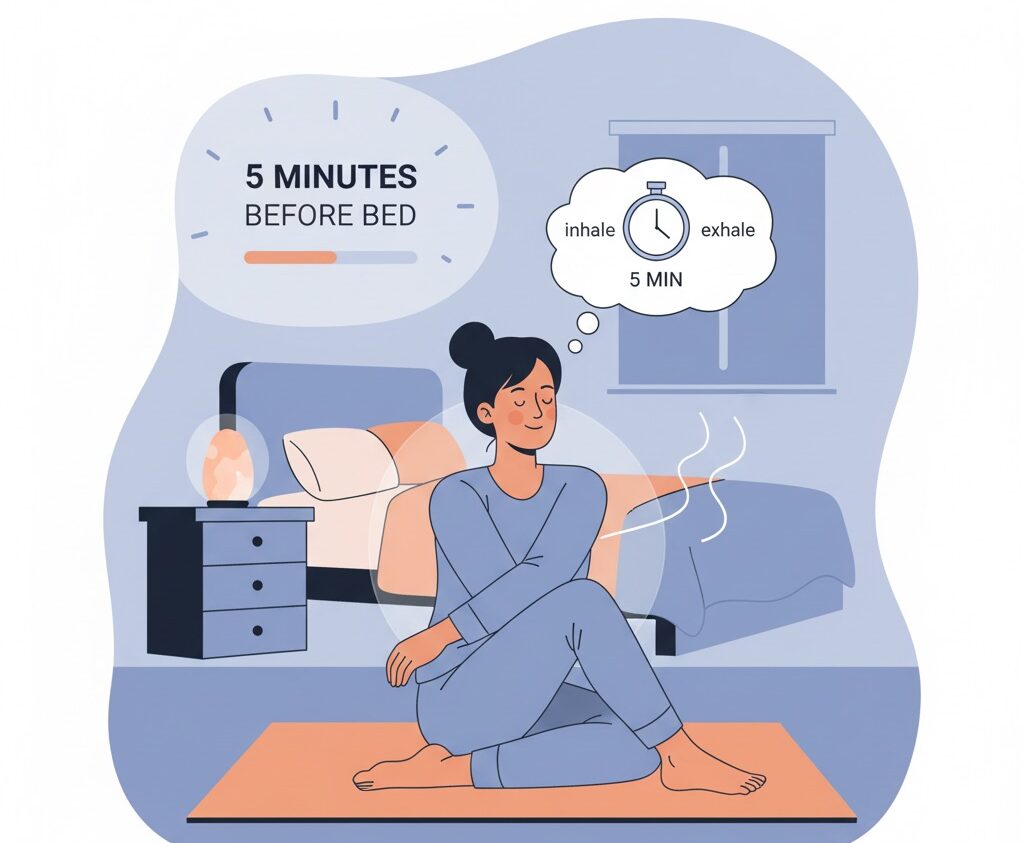
Five-minute rituals that actually help
A short wind-down doesn’t need to be revolutionary to be effective. In fact, the simpler and more repetitive, the better. Think of it less like a new habit, and more like a closing gesture — the body’s version of a period at the end of the sentence.
Here are several types of five-minute rituals that are backed by neuroscience and gentle enough to integrate into any evening, even when you’re tired or busy.
1. Sensory anchoring
Engaging one of your five senses creates a tangible signal for your nervous system. This could be as simple as:
Applying a scented hand cream or essential oil to your wrists
Washing your face with warm water, with full attention to the sensation
Lighting a low-scented candle or using a dim reading lamp
Sipping a warm, non-caffeinated drink, like chamomile or rooibos tea
These rituals don’t just calm your body — they anchor you in the present. As discussed in the Sleep Foundation, sensory grounding is one of the easiest ways to activate the parasympathetic system.
2. Single-task movement
Instead of long workouts or evening yoga sessions, try micro-movement with your full attention. For example:
Five gentle neck and shoulder rolls, breathing slowly
Reaching overhead with a full-body stretch, then relaxing into stillness
Rocking gently on your feet or hips, loosening built-up tension
This movement is not about fitness. It’s about changing your body’s internal tempo. By slowing your motion, you slow your breath — and with it, your mind.
We explore this somatic connection more in body scanning techniques, which also rely on physical awareness to interrupt cognitive loops.
3. Low-stimulation journaling
No need to “process your entire day.” Sometimes, one or two quiet sentences are enough. Consider writing:
One word that describes your current state
A sentence that signals closure (e.g., “I’ve done enough for today.”)
A simple reminder for your morning self
Evening reflection prompts show how these quick acts of expression regulate mood and help the mind transition out of problem-solving mode. The act of writing isn’t about solving — it’s about settling.
4. Breathwork countdown
This can be as simple as sitting upright or lying down, and inhaling for four counts, exhaling for six — five times. That’s under a minute, and it’s enough.
You could also try the “5-4-3-2-1” method: name five things you can see, four you can touch, three you can hear, two you can smell, one you can taste. This form of cognitive distraction helps break the loop of anxious thought spirals, which is especially helpful if you deal with nighttime overthinking.
5. Digital disconnection ritual
This isn’t just about avoiding screens — it’s about marking the end of digital input. Try:
Turning your phone to airplane mode
Unplugging or powering down your laptop
Placing your device in a drawer or away from the bed
Pair this with a quiet phrase like “off for the day” or simply closing your eyes for a few breaths. We explore this more fully in pre-sleep transitions, where the shift from stimulation to stillness becomes a visual and emotional cue.
How to make a five-minute ritual stick
The magic of five-minute wind-downs isn’t in their complexity. It’s in consistency with compassion.
The more often you repeat the same action before bed, the faster your brain will come to associate it with rest. But don’t turn it into pressure. These rituals are tools, not tests.
Here’s how to help them integrate naturally:
Tie your ritual to something you already do (e.g., brushing teeth)
Keep it the same most nights — ritual thrives on familiarity
Let it be small — some nights, even a single stretch is enough
Avoid “perfect ritual” thinking — the goal is downshifting, not performance
Your wind-down doesn’t have to feel relaxing right away. At first, it might even feel silly or unnoticeable. But over time, it becomes an anchor — something your body learns to recognize as a signal to let go.
When five minutes are all you have
Let’s be honest — many nights, that’s all you get. Five minutes between caring for others, wrapping up work, or navigating stress. And in those five minutes, your mind is still racing.
But here’s the truth: five minutes is enough to change your state. It’s enough to shift the rhythm of your breath. To notice the tension in your shoulders. To signal to your brain that it doesn’t need to stay alert. To create just a bit of space between the doing and the dreaming.
Even if you forget or skip it — that’s okay. This isn’t about perfection. It’s about building a micro-practice of coming home to yourself.
As Headspace puts it: small steps, done consistently, retrain the brain faster than grand but sporadic efforts. Rituals work because they are gentle and repeated.
Final thoughts: rituals that remember for you
When you’re exhausted, your brain may not remember how to rest. That’s where your ritual does the remembering for you.
Five minutes. The same small act. A closing gesture at the end of the day.
Over time, these micro-rituals become more than habits. They become signals of safety — proof that it’s okay to stop, to breathe, to be held by the softness of night.
And in that softness, sleep finds its way in.