When your mind won’t stop spinning at night, and counting sheep feels as useful as counting emails, it’s no surprise that people turn to calming audio tools. Apps, videos, and podcasts offering sleep hypnosis or guided meditation have exploded in popularity — promising deeper rest, less anxiety, and faster sleep onset.
But many wonder: which one actually works better? Are they the same thing with different names? Or do they function in distinct ways? And perhaps more importantly, which one is right for you?
In this article, we’ll explore the key differences between sleep hypnosis and guided meditation, what the research says, and how to choose the right method for your sleep style. As with most things related to rest, it’s not about rigid rules — it’s about understanding the tools and listening to what works for your nervous system.
Why are audio-based sleep tools so effective?
Before we dive into definitions, it’s worth asking: Why do spoken-word tools help with sleep at all?
The answer lies in how the brain responds to voice, rhythm, and narrative. When we hear a calm, slow-paced voice — especially with soft music or ambient background — the brain starts to mirror that tone. Heart rate slows. Breathing deepens. Attention shifts away from stressors. It’s a natural entrainment effect.
Sleep is a letting-go process, and audio-based guidance helps facilitate that by:
Reducing internal chatter
Distracting from worries
Offering a sense of comfort or safety
Providing structure during the ambiguous transition from wake to sleep
This is especially helpful for people who experience nighttime overthinking, a topic we explored in body scanning techniques. Whether through metaphor, suggestion, or breath cues, the voice acts as a gentle hand leading you out of mental loops.
What is sleep hypnosis?
Sleep hypnosis is a technique that uses verbal suggestions and calming cues to lead the listener into a deeply relaxed, suggestible state — not unlike guided imagery, but with a therapeutic goal. It’s often used to bypass the analytical mind, gently nudging the subconscious toward calm, rest, or positive association with sleep.
Key characteristics include:
A slow, repetitive voice rhythm
Direct suggestions like “you feel safe now,” or “your eyes are becoming heavy”
Imagery that enhances safety, comfort, and bodily release
Sometimes counting down, like from 10 to 1, to mimic trance states
Despite misconceptions, hypnosis isn’t mind control — it’s a focused, relaxed state of awareness where you remain in control but open to suggestion. In the context of sleep, the goal is not full hypnotic trance but a deep enough relaxation that sleep naturally follows.
According to research from the National Institutes of Health, hypnosis can enhance slow-wave sleep, the deepest phase of non-REM sleep — especially in people who are more suggestible or sensitive to auditory cues.
Common hypnosis tracks often use familiar scripts, low monotone delivery, and a rhythm that mimics delta brainwaves — the ones we naturally access during deep sleep.
What is guided meditation?
Guided meditation, on the other hand, is a broader term that includes various mindfulness-based, present-moment practices. It can include body awareness, breath focus, or thought observation — and isn’t always intended to induce sleep, though many forms are adapted for nighttime use.
Formats can include:
Body scan meditations, where you’re guided to notice sensations from head to toe
Mindfulness meditation, encouraging nonjudgmental awareness of thoughts
Loving-kindness (metta) practices, fostering emotional warmth before bed
Breath-focused scripts, guiding gentle inhale/exhale rhythms
Apps like Calm, Headspace, and Insight Timer often feature these types of guided meditations, particularly tailored for evenings. They may include soft music, nature sounds, or silence between instructions — but the central focus is often awareness rather than suggestion.
While some meditations explicitly aim to help you fall asleep, others are designed to improve sleep quality over time by lowering stress reactivity, calming the nervous system, and reducing anxiety before bed. You can explore how reflective exercises also aid this process in our article on evening prompts.
Key differences: hypnosis vs. meditation
While they might sound similar — both involve a calm voice guiding your attention — hypnosis and meditation differ in intent, language, and mechanism.
| Aspect | Sleep Hypnosis | Guided Meditation |
|---|---|---|
| Goal | Directly induce sleep or deep relaxation | Foster awareness, presence, and calm |
| Tone | Suggestive, repetitive, trance-like | Observational, gentle, often instructive |
| Language | “You are getting sleepy…” | “Notice your breath, without changing it” |
| Structure | Often linear, countdowns or progression | Often open-ended or cyclical |
| Neural effect | Targets subconscious, deep states | Engages prefrontal cortex, emotional regulation |
| When it works best | When the mind resists letting go | When anxiety or ruminating thoughts dominate |
There’s also a cultural difference. Hypnosis is still seen by some as “alternative,” while meditation has become mainstream — though both have robust research behind them.
As Headspace explains, regular meditation trains your brain to become more emotionally balanced across the day, which may indirectly improve sleep. Sleep hypnosis, by contrast, is often used on-demand — a tool for when you can’t fall asleep and need help “powering down.”
What does the science say?
When it comes to comparing the effectiveness of sleep hypnosis and guided meditation, the answer — as with many things in sleep science — is: it depends on the person, the context, and the consistency.
Let’s start with sleep hypnosis.
According to a clinical study from the NIH, hypnosis can increase the amount of time spent in deep sleep, particularly among participants who were more open to hypnotic suggestion. Deep sleep is the restorative phase that strengthens memory, boosts immune function, and helps regulate emotions. In the study, participants who listened to a hypnotic script before bed spent more time in slow-wave sleep than those who didn’t.
These effects are promising, especially for people with insomnia related to stress or hyperarousal, where the body is physically tired but the mind refuses to shut off. Hypnosis essentially “bypasses” the analytical brain, helping the body access deeper physiological rest.
Guided meditation, in contrast, has a larger body of long-term research, particularly in the context of Mindfulness-Based Stress Reduction (MBSR). One meta-analysis published in JAMA found that mindfulness meditation significantly improves sleep quality, reduces time to fall asleep, and decreases sleep disturbances — especially when practiced consistently.
It’s important to note that guided meditation tends to improve sleep readiness over time, while hypnosis is often used as an acute tool for immediate relief.
In other words:
Hypnosis can help tonight
Meditation can help you sleep better long-term
This distinction mirrors what we’ve seen in articles like Sleep inertia decoded, where both immediate and long-term factors influence rest.
Which one is more effective for you?
Rather than declaring a universal “winner,” it’s more useful to consider your own patterns, triggers, and tendencies.
Let’s look at a few sleep profiles:
The overthinker — You lay down and your brain lights up. Meditation that encourages nonjudgmental thought awareness (like body scans or breathwork) might work well. Body scanning helps reduce racing thoughts by offering a focal point without pressure to “clear the mind.”
The sensory sleeper — You respond strongly to sound, tone, or rhythm. Hypnosis might be more effective, especially with voice repetition or counting techniques. It gives your brain something to “surrender” to.
The emotional spiral — If nighttime triggers shame, worry, or emotional looping, loving-kindness meditations or affirmational hypnosis can soothe the inner critic. Try evening reflection prompts as a pre-step.
The highly stressed — Hypnosis may help break through acute tension, while meditation supports long-term nervous system regulation, as we saw in Pre-sleep transitions. Combining both may be ideal.
Can you use both — or combine them?
Absolutely. Sleep isn’t one-size-fits-all, and you don’t have to choose just one method forever. In fact, many people use both, depending on how they feel each night.
Some ways to combine the two:
Use a short guided meditation (like breath awareness) to soften into calm
Follow with hypnosis to drift deeper into sleep
Alternate nights to avoid habituation
Choose based on emotional state (meditation for anxiety, hypnosis for wired fatigue)
You might also explore hybrid tracks — many sleep apps now offer narrative-guided hypnosis, where meditation and suggestion blur together. The boundary between them is fluid.
Some nights you’ll need grounding. Other nights you’ll need to let go. Both approaches offer a path — one through focus, the other through surrender.
Tips for making it work
Whether you’re using hypnosis or meditation, your environment and consistency will influence how well it works. Here are a few tips to enhance their impact:
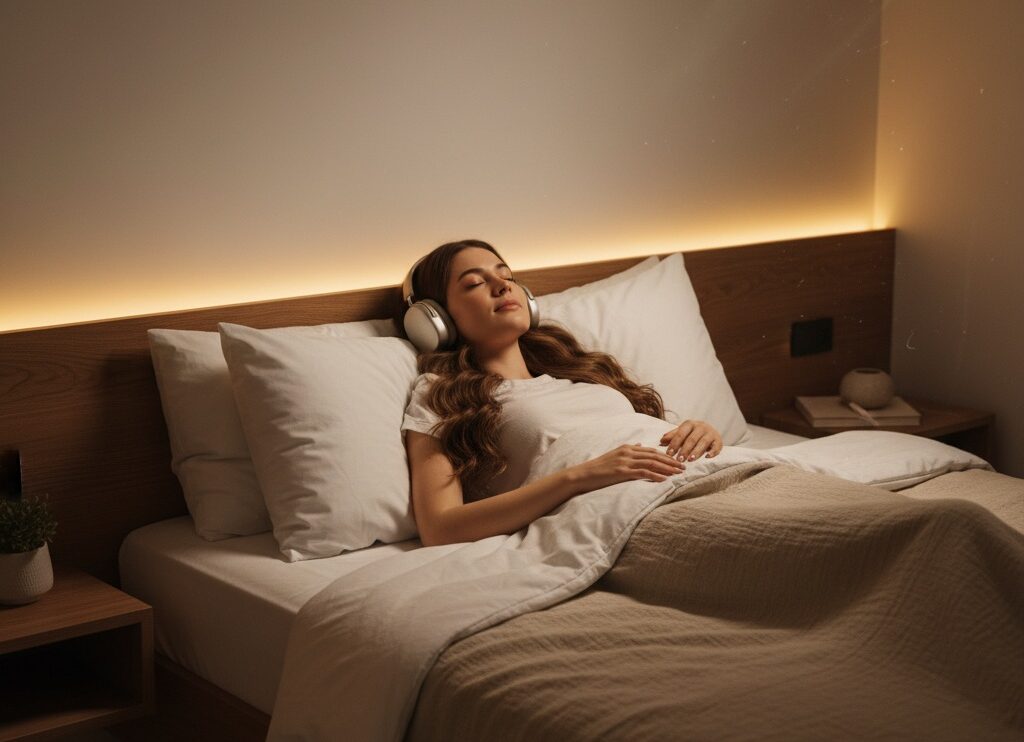
Listen in a comfortable, dim setting — darken the room, use warm lighting
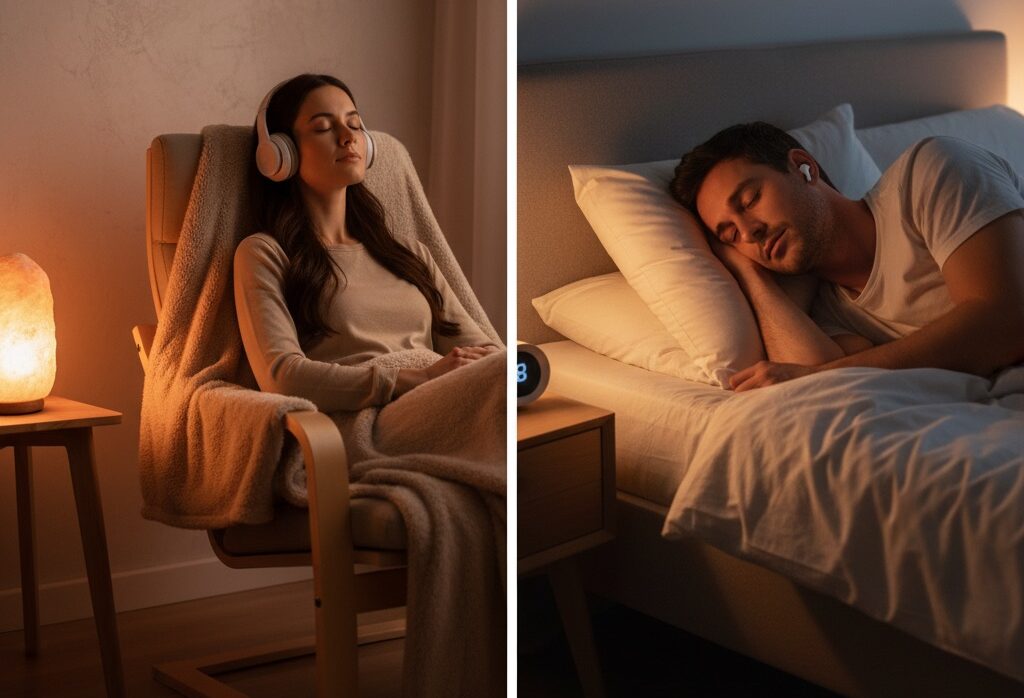
Use headphones or a speaker — make sure the audio is gentle but clear
Avoid switching tracks too often — your brain forms associations through repetition
Try at the same time each night — circadian rhythm thrives on cues
Don’t treat it as a performance — if you don’t fall asleep immediately, that’s okay. Rest counts.
You can also pair your audio ritual with physical cues — such as dimming lights or sipping herbal tea — which further supports the parasympathetic shift needed for sleep. (Learn more in our article on 5-minute wind-down rituals.)
Final thoughts: effectiveness is personal
In the end, the question “what’s more effective?” can only be answered by your own body and mind.
Some people need words that guide; others need words that suggest. Some want to stay aware of their thoughts, while others want to drift beyond them. Some benefit from direct countdowns. Others want silence between breaths.
What matters most isn’t choosing the “right” technique — it’s choosing any technique that you can return to with kindness. That’s what makes it effective.
Sleep is not a test. You don’t win or lose based on how quickly you fall asleep. The true effectiveness of any practice lies in how it supports your nervous system, and whether it becomes a gentle, predictable signal of safety.
So tonight, whether you listen to a hypnotic voice or a mindfulness guide, know that you’re giving your body a bridge — from effort into ease, from noise into stillness, from doing into rest.
And the more often you cross that bridge, the easier it is for sleep to meet you there.