Over the past few years, AI-driven sleep coaching apps have moved from small wellness experiments to mainstream tools. They promise something that feels almost futuristic: personalized sleep insights generated by algorithms that can “learn” your nights, adapt to your rhythms, and guide you toward better rest. These apps claim they can see patterns that humans miss, detect tiny changes in sleep quality, and nudge you gently toward healthier habits.
It’s an appealing idea — especially in a world where more and more people feel disconnected from their natural rhythms. With constant work pressure, irregular schedules, and digital stimulation, many people simply don’t know what a “good night’s sleep” looks like for them anymore. AI promises clarity: numbers, predictions, optimization.
But the question remains:
Can algorithms genuinely improve sleep quality — or do they simply offer the illusion of control?
To answer that, it’s helpful to break down how AI coaching works, what it does well, where it struggles, and how it compares to human-based support. As with all Calm Sleeply product reviews, the goal isn’t to praise or criticize technology, but to bring nuance — especially in a space that affects emotional wellbeing as much as rest.
How AI sleep coaching works
At the core of every AI-driven sleep coaching app is pattern recognition. The app collects data — sometimes from your phone alone, often from a wearable device — and uses machine learning models to interpret it. These models look for consistency, deviations, and correlations that might affect sleep quality.
Typical data inputs include:
-
sleep duration
-
sleep-wake times
-
movement patterns
-
environmental noise
-
heart rate or HRV (if tracked)
-
bedtime behaviors (logged inside the app)
-
circadian timing patterns
The app then creates an evolving “sleep profile.” Over time, it adjusts predictions and recommendations as it sees how your body responds.
A well-designed AI app doesn’t simply say, “You slept poorly.” Instead, it may offer pattern-based insights such as:
-
“Your sleep improved on nights when your bedtime was before 11:30 PM.”
-
“Your rest was deeper on days with afternoon sunlight exposure.”
-
“Waking times were more consistent when phone use ended 45 minutes before bed.”
These insights come not from general rules, but from correlations inside your own personal data. That personalization is the core promise of AI sleep coaching: advice that adapts rather than generalizes.
The Sleep Foundation’s review of digital sleep tools notes that personalization is where AI has the strongest potential. It can scale what human coaches do — observe patterns — but do it at a faster, more granular level.
What these apps can genuinely improve
Used thoughtfully, AI-driven sleep coaching apps can help with several meaningful aspects of rest — not by diagnosing sleep issues (they cannot and should not do that), but by supporting behavioral change.
One of the strongest benefits is consistency.
AI apps often excel at helping people stabilize sleep-wake timing, which is one of the most influential factors in regulating circadian rhythms. By learning the patterns that support your natural rhythm, the algorithm helps guide you toward more predictable sleep windows.
Another benefit is timing awareness.
Many people misjudge their true bedtime habits. AI-generated timelines can reveal drift — the subtle pattern where bedtime becomes later each night until fatigue accumulates. When the app mirrors your behavior back to you, it becomes easier to course-correct.
AI can also support environmental awareness.
Some apps note which nights had higher disturbance levels from noise or movement. Others observe whether sleep improves with earlier light exposure or reduced evening screen time.
These are the kinds of micro-patterns many people overlook. Algorithms catch them quickly.
Finally, AI apps can strengthen behavioral nudges — gentle reminders to wind down, reduce stimulation, or prepare the sleep environment. These nudges aren’t meant to be strict; they’re designed to reduce decision fatigue at the end of the day.
In calm, supportive form, they can create a subtle accountability loop without pressure.
Where AI struggles
Despite their intelligence, AI sleep coaching systems have limitations — sometimes significant ones. One of the most important is data quality. AI is only as accurate as the inputs it receives. If the device misreads movement as wakefulness, or if you forget to log habits, the algorithm may draw conclusions that feel off.
Harvard Health warns that sleep trackers often create a false sense of precision. A graph might look scientific, but the underlying measurements can be approximate.
Another limitation is emotional nuance.
AI can see patterns, but it cannot understand why they exist. For example, if your sleep changes during a stressful period, the app may interpret it as a behavioral drift rather than an emotional one. AI lacks the human ability to detect context — grief, anxiety, burnout, or excitement.
AI coaching also risks feeding into orthosomnia, the tendency to focus so heavily on improving sleep metrics that the behavior becomes stressful. Our Calm Sleeply readers may recall this dynamic from:
Sleep anxiety and orthosomnia: when sleep tracking backfires.
When people begin chasing “perfect sleep scores,” rest becomes performance. AI tools don’t always have built-in buffers against this — though some newer apps are starting to integrate gentler, less numerical approaches.
Finally, AI can’t address complex sleep issues.
It can guide habits and offer patterns, but it cannot interpret symptoms or provide medical insight. This isn’t a flaw — it’s simply a boundary.
AI guidance vs. human-based sleep coaching
Comparing AI to human sleep coaching isn’t about declaring a winner. Each offers something unique.
AI excels at:
-
tracking micro-patterns
-
analyzing long-term consistency
-
providing objective reminders
-
offering data transparency
-
personalizing insights quickly
Humans excel at:
-
emotional interpretation
-
contextual understanding
-
nuance during stressful periods
-
adaptive problem-solving
-
helping people stay grounded
Human sleep coaches can ask questions that AI cannot.
They can sense tone, understand fear, and offer reassurance. They understand that life circumstances shape sleep, not just habits. They can distinguish between a behavioral pattern and an emotional response.
But AI can support daily routines better than a person ever could.
It’s always present, always tracking, always learning.
The ideal situation sometimes becomes a hybrid: AI for daily rhythm, human input for emotional interpretation. Many Calm Sleeply readers find that combining both creates the clearest picture — the algorithm sees patterns, the person understands meaning.
Key features to look for in a high-quality AI sleep app
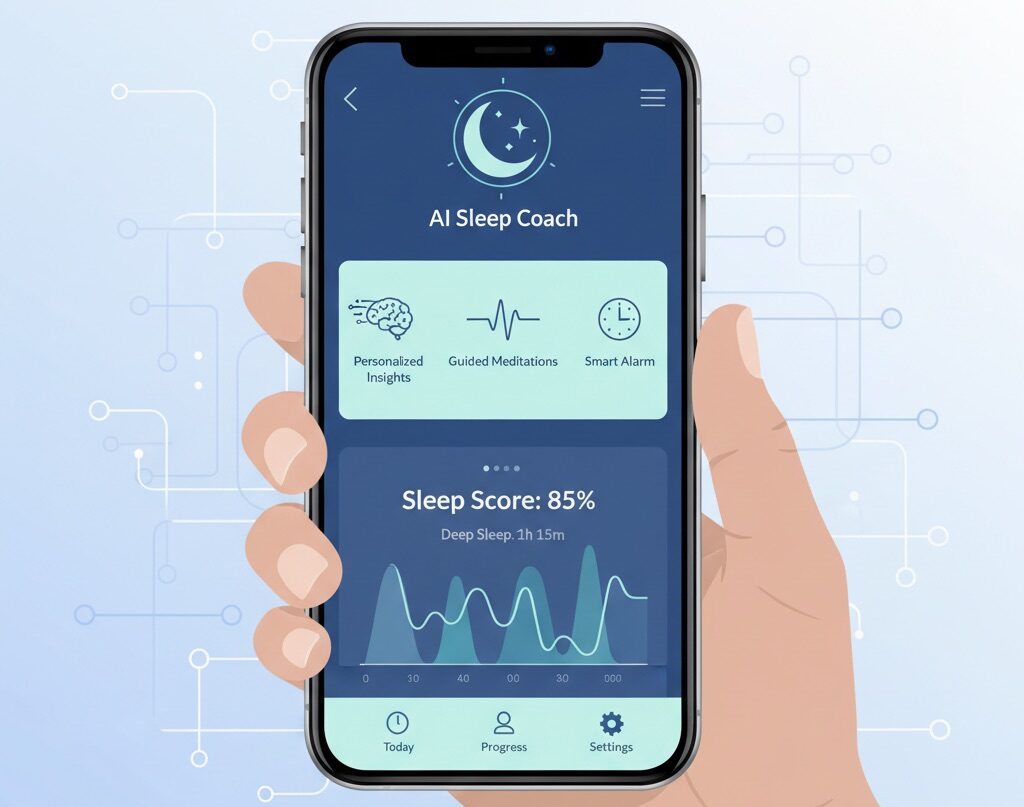
Not all AI sleep coaching tools are built the same. Some focus heavily on metrics and performance, while others prioritize gentle behavioral support. When choosing an app, it helps to ask: Does this tool make my nights calmer, or does it make them more effortful? The best AI sleep apps feel like guidance, not pressure.
One of the strongest features to look for is adaptive coaching — algorithms that change their suggestions based on how your habits shift over time. Rigid apps that repeat the same recommendations — “Go to bed earlier,” “Stay off your phone” — tend to feel generic because they are. Adaptive models, on the other hand, refine their guidance as your routine evolves, which makes the experience feel more human and more relevant.
Another important feature is circadian sensitivity. High-quality apps don’t just track sleep duration; they detect your personal rhythm — when your body naturally prefers to wind down and wake up. This creates a more nuanced pacing than blanket suggestions, and often helps users discover their true “biological window” for rest.
Environmental awareness can also be beneficial. Apps that track noise levels or light exposure can help you understand how your sleep environment shapes your nights. This ties naturally into the principles explored in Home sleep hacks: how to optimize your bedroom environment. Understanding your physical space often reveals patterns you didn’t expect — such as how slight temperature changes affect depth of sleep, or how small disruptions shift your internal rhythm the next day.
Finally, gentle behavioral nudges make a big difference. Not reminders that scold, but ones that encourage: soft messages that guide you toward winding down, dimming lights, or ending screen time without pressure. In Calm Sleeply style, these nudges should feel like a quiet suggestion rather than a rule.
Who benefits most from AI sleep coaching
AI sleep apps aren’t for everyone, but they can be especially supportive for certain types of sleepers.
If you’re someone who thrives on structure, the app’s consistency can create a stable framework. It reduces mental load by making decisions easier — bedtime becomes less about willpower and more about following a gentle rhythm.
People with irregular schedules often find AI tracking helpful too. Algorithms can reveal patterns hidden inside chaotic routines, helping you identify “anchors” that stabilize sleep — even if your work or lifestyle doesn’t allow for strict schedules.
AI coaching may also support individuals who enjoy quantitative feedback. Seeing progress visually — even if imperfect — can be motivating and build a deeper awareness of how daytime choices influence nighttime rest.
On the other hand, some people appreciate the sense of companionship these apps offer. The quiet presence of a digital guide can make sleep feel less lonely, especially during periods of stress or uncertainty.
But AI doesn’t automatically improve rest for everyone. And it’s important to know when it may not be the right fit.
Potential downsides: orthosomnia, data fatigue, false precision
Although AI coaching can be supportive, it has potential pitfalls. One of the most common is data fatigue. When people check their metrics obsessively, the numbers start to shape how they feel — even when the night itself felt fine. A “poor score,” even if inaccurate, can create worry or disappointment that lingers throughout the day.
This leads directly into orthosomnia: the pursuit of perfect sleep metrics.
In Sleep anxiety and orthosomnia: when sleep tracking backfires, we explore how the desire to improve sleep can paradoxically make sleep harder. AI apps that emphasize precision can unintentionally amplify this tendency.
Another issue is false precision — the appearance of accuracy where true accuracy is limited. Harvard Health highlights how sleep trackers can misinterpret movement or heart rate variability.
Even advanced sensors cannot always distinguish between wakefulness and light sleep. When AI relies on imperfect data, its recommendations may be less useful than they seem.
AI systems also struggle with context. They don’t understand how emotional, social, or psychological experiences influence rest. A stressful week might reduce sleep quality, but the app might attribute the change to something behavioral — a shift in bedtime, phone use, or daily movement — even when those aren’t the true drivers.
This is why self-awareness remains essential. AI can mirror patterns, but you bring the meaning.
How to use AI sleep apps without overwhelming your nights
The healthiest relationship with AI sleep coaching is one in which the app supports calm rather than disrupts it. Here are a few gentle principles that make the experience more grounding:
Check your data less frequently.
Once every few days is often plenty. Daily checking can create unnecessary pressure.
Let imperfect nights be imperfect.
Algorithms learn best from trends, not from isolated nights.
Use the insights as suggestions, not rules.
Soft guidance works better for the nervous system.
Stay aware of emotional context.
If you’re stressed, grieving, or overloaded, the data will reflect it — and that’s okay. It’s not a “pattern problem”; it’s a human experience.
Prioritize your felt sense over your score.
Your body is still the most reliable indicator of rest.
These principles echo the Calm Sleeply philosophy: technology works best when paired with self-kindness and realistic expectations. AI is a tool, not a verdict.
The future of AI sleep coaching
AI sleep technology is evolving quickly. The next generation of apps will likely become more emotionally attuned, integrating gentle language models that respond to mood patterns, not just behavioral ones. Some will personalize wind-down routines based on how your day unfolded; others may adjust recommendations based on subtle shifts in your circadian signals.
Environmental sensors will continue to improve too — capturing noise disturbances, light exposure, and temperature changes with greater nuance. Combined with wearable tech, this could give AI a clearer picture of how nights unfold beyond what you perceive.
But even as AI advances, one truth remains: sleep is deeply emotional. It’s shaped by our relationships, our stress loads, our fears, our hopes, and our internal rhythms. Algorithms can guide, track, recommend, and reflect — but they cannot feel.
This isn’t a limitation; it’s a reminder.
AI can help clarify the path, but you walk it.
Can algorithms truly improve rest quality?
The honest answer is: yes — but within boundaries.
AI sleep coaching apps can improve rest quality when they help you:
-
recognize your personal rhythm
-
build consistent habits
-
reduce decision fatigue
-
understand environmental patterns
-
feel gently guided rather than overwhelmed
They can also make sleep feel less mysterious. Many people feel calmer simply seeing their nights reflected back to them in simple, structured patterns.
But algorithms cannot replace emotional care. They cannot interpret the complexities of your inner world. They cannot sense when you need gentleness rather than guidance. They cannot understand what exhaustion means for you on a personal level.
AI is part of the picture — not the whole.
Used with softness, the right AI sleep app can become a quiet companion: a tool that notices what shifts, reflects what matters, and supports your nights without overpowering them.
In a world where rest often feels fragile, that kind of support can make a meaningful difference.