Why “one-size-fits-all” sleep advice doesn’t work
You’ve probably heard the same sleep advice everywhere — go to bed early, wake up at sunrise, and never hit snooze. While those habits work for some, they leave many people frustrated and exhausted. Why? Because not everyone’s body is built for the same rhythm.
Some people naturally feel alert at 6 a.m., ready for a morning run and a strong cup of coffee. Others do their best thinking after midnight, finding calm and focus long after the world has gone to sleep. These differences aren’t about discipline or lifestyle — they’re about biology.
Your chronotype — the internal timing pattern that guides when you feel sleepy or awake — is largely shaped by your genes. And once you understand yours, you can stop fighting your natural rhythm and start working with it.
This approach is known as chronotype hacking — aligning your lifestyle, work, and sleep habits with your biological clock. The result? Better rest, sharper focus, and more energy throughout the day — all without forcing yourself into someone else’s schedule.
What is a chronotype?
A chronotype describes your body’s natural inclination to sleep and wake at specific times. It’s not just about preference — it’s built into your circadian rhythm, the 24-hour cycle that regulates everything from hormone production to temperature and alertness.
Every human body has an internal clock located in the suprachiasmatic nucleus (SCN) — a small structure in the brain that synchronizes your physical and mental functions with light and darkness. This clock determines when you feel sleepy, when your energy peaks, and even when your brain performs best.
Research suggests that chronotypes are influenced by genetic variations in clock-related genes, such as PER1 and PER2. These genes affect how sensitive you are to light and how quickly your internal clock resets after disruption. That’s why some people naturally wake before sunrise, while others feel their best long after sunset.
Most people fall into one of three main categories:
Morning types (Larks) — Feel alert early, tend to get tired by evening.
Evening types (Owls) — Struggle with early mornings, peak energy comes late at night.
Intermediate types (Third birds) — Most of the population; naturally fall somewhere in between.
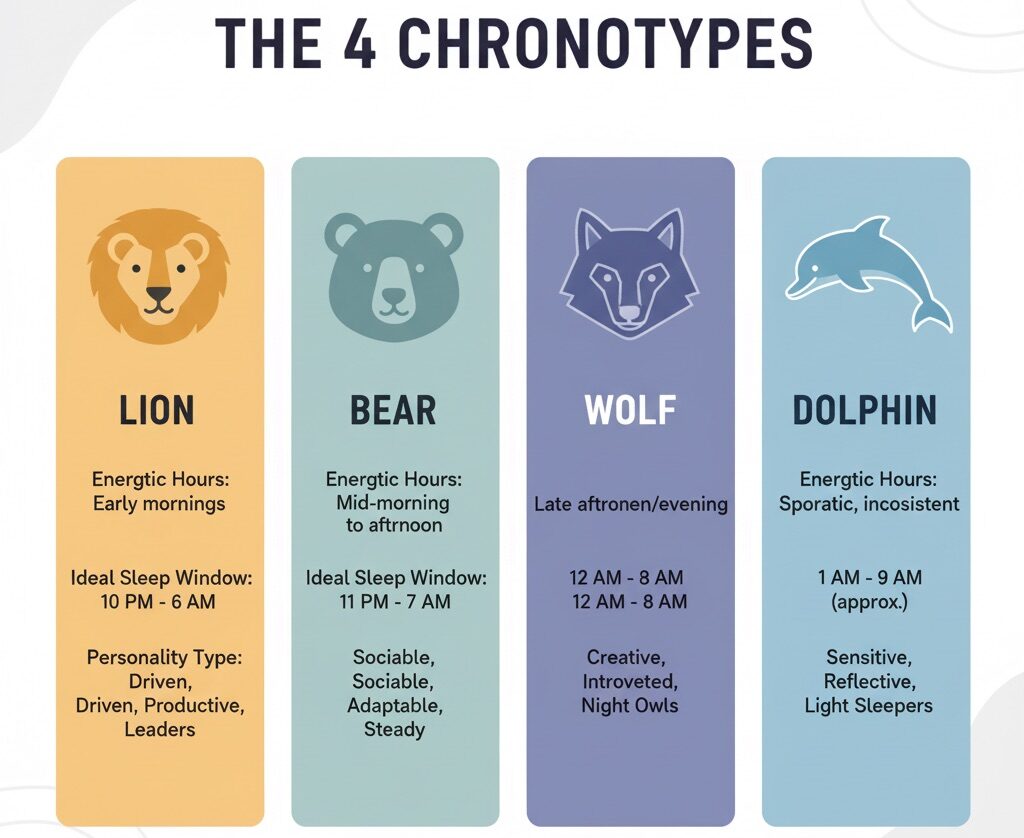
Sleep expert Dr. Michael Breus popularized a more detailed classification using animal types — lions, bears, wolves, and dolphins — each representing unique patterns of alertness, creativity, and rest.
How modern life disrupts your natural rhythm
Unfortunately, our daily routines often clash with our biological timing. Work schedules, artificial light, caffeine, and screen exposure can all push us away from our natural sleep-wake cycles.
For example, if you’re a night owl forced to start work at 8 a.m., your body’s internal clock may still think it’s the middle of the night. This mismatch creates what scientists call “social jet lag” — the same fatigue and confusion you feel after changing time zones, but experienced every week.
Chronic social jet lag has been linked to:
Reduced sleep quality
Daytime sleepiness and irritability
Poor cognitive performance
Increased stress hormones and metabolic disruption
Over time, constantly fighting your biological clock can lead to exhaustion and even health issues — not because you’re “bad at mornings,” but because your internal rhythm is being ignored.
Recognizing this mismatch is the first step toward change. Chronotype hacking is about restoring the alignment between your lifestyle and your biology, not forcing your body to adapt to an arbitrary schedule.
Identifying your chronotype
You don’t need genetic testing to understand your chronotype — though research-backed DNA kits exist. Your body already gives you clear clues about its natural timing.
Ask yourself:
When do I feel most alert and productive during the day?
What time do I feel sleepy if I don’t set an alarm or use screens?
When do I experience my creative “flow”?
How do I feel when I wake up early vs. sleep in?
If you feel energized before noon and prefer winding down by 10 p.m., you likely lean toward a morning chronotype. If your brain feels sharp after sunset and you dread early meetings, you’re more evening-oriented.
You can also take chronotype questionnaires, such as the Munich Chronotype Questionnaire (MCTQ) or Morningness-Eveningness Questionnaire (MEQ), both validated by sleep researchers. These tools assess your daily rhythms and social habits to estimate where you fall on the chronotype spectrum.
Remember: chronotype isn’t fixed for life. It can shift slightly with age, lifestyle, and light exposure. For instance, teens and young adults tend to be night owls, while older adults gradually move toward earlier sleep patterns.
Chronotype hacking — aligning your life with your internal clock
Once you know your natural rhythm, the real transformation begins. Chronotype hacking means restructuring your day to work with your biology, not against it.
Start by identifying your natural sleep window — the time you fall asleep and wake most easily without external pressure. Then, adjust your environment and habits to support it:
Shift gradually. If you need to wake earlier for work, move your bedtime 15–20 minutes earlier each night until it aligns better with your obligations.
Use light strategically. Morning light exposure resets your circadian rhythm, helping you wake naturally. For night owls, 15 minutes of sunlight or bright light therapy after waking can help shift your clock earlier.
Limit evening light. Blue light from screens suppresses melatonin — your sleep hormone. Dim your lights and avoid screens 1–2 hours before bed.
Eat according to your rhythm. Meal timing affects circadian cues. Early chronotypes benefit from eating breakfast soon after waking, while night owls may prefer lighter mornings and larger lunches.
Move your body. Exercise timing can reinforce your rhythm. Morning movement boosts energy for early risers; evening workouts may help night owls wind down.
Align focus with energy peaks. Do deep work or creative tasks during your alert hours — typically late morning for larks and late evening for owls.
Chronotype hacking doesn’t require perfection — it’s about reducing friction between your biology and your schedule. Even small changes can dramatically improve your energy and sleep quality.
When your rhythm meets reality
Of course, not everyone can design their perfect schedule. Work demands, family routines, and social obligations often pull us out of sync. The key is to find micro-alignment opportunities — small ways to respect your rhythm within real life.
For example:
If you’re a night owl with early shifts, use a bright light box upon waking and keep a consistent sleep schedule on weekends to reduce “social jet lag.”
Morning types working late should lower light exposure in the evening and add short breaks to recharge when energy dips.
These small acts of self-awareness build long-term balance. Chronotype hacking isn’t about strict control — it’s about partnership between your biology and your lifestyle.
Morning and evening strategies for each chronotype
Understanding your chronotype is only the first step — the real benefit comes when you translate that knowledge into daily action. Below are tailored strategies for each major chronotype type. The goal isn’t to box yourself into one category but to use these insights to build a rhythm that supports your natural energy flow.
Morning types (Larks / Lions)
If you naturally wake up early and feel sharpest before noon, you belong to the morning-oriented group. Morning chronotypes thrive in structured environments, tend to complete tasks early, and often lose focus later in the day.
What to focus on:
Protect your mornings. Schedule important or creative work before lunch when your mind is clearest.
Fuel early. Eat a balanced breakfast with protein and slow carbs within an hour of waking to stabilize energy.
Exercise early. Morning workouts reinforce your natural rhythm and help sustain alertness through the afternoon.
Evening slowdown. Create calm after 8 p.m. — dim lights, avoid intense discussions, and disconnect from screens.
Guard against burnout. Morning types often start strong but fade fast. Add short breaks and avoid caffeine after 2 p.m.
Your challenge: resisting the pressure to stay productive late into the night. Instead, honor your early finish and prioritize restorative sleep.
Evening types (Owls / Wolves)
Night owls are biologically programmed for later sleep and activity. They often feel sluggish in the morning but reach their mental and creative peak in the late afternoon or evening. Society, however, isn’t always designed for their rhythm — which makes sleep consistency critical.
What to focus on:
Use light wisely. Bright light exposure within 15 minutes of waking helps shift your internal clock earlier. In the evening, dim lights 1–2 hours before bed to encourage melatonin release.
Don’t skip breakfast entirely. Even if you’re not hungry, small protein-based meals in the morning signal “daytime” to your body clock.
Move earlier. Try to schedule workouts before noon to prevent energy surges at night.
Evening creativity. Use your peak hours for brainstorming, design, or writing — but set a clear cutoff time to avoid overstimulation.
Consistent wake time. Even on weekends, wake up at roughly the same hour to prevent social jet lag.
Your challenge: avoiding the endless “second wind” that keeps you scrolling or working late. Gradual light reduction, warm herbal tea, and relaxing soundscapes (like brown or pink noise) can help.
Intermediate types (Bears / Third birds)
Most people fall into this middle category — neither extreme early birds nor full night owls. Bears follow the solar cycle: naturally waking with daylight and winding down by evening.
What to focus on:
Follow natural light. Let sunlight guide your schedule — work when it’s bright, rest when it dims.
Power mornings. You’re most productive mid-morning, between 9 and 11 a.m. Schedule focused work during that window.
Short siestas. A 20-minute afternoon rest around 2 p.m. can restore clarity without disrupting nighttime sleep.
Light dinners. Avoid heavy meals late at night; your digestive rhythm mirrors your sleep rhythm.
Evening reset. Gentle stretching, journaling, or gratitude reflections help calm the body.
Your challenge: maintaining routine consistency. Bears often adjust easily to change, but irregular schedules can throw them off quickly.
Irregular or sensitive types (Dolphins)
Dolphins represent those with light, fragmented sleep — often perfectionists or highly sensitive thinkers. They may struggle to fall asleep due to racing thoughts or environmental disturbances.
What to focus on:
Structured calm. Create a fixed pre-sleep routine that includes dim lighting, soft music, or meditation.
No stimulants after noon. Even small amounts of caffeine or late sugar can disturb rest.
Micro-breaks during the day. Short, mindful pauses prevent mental overload that spills into nighttime.
Bedtime journaling. Offload unfinished thoughts onto paper to quiet mental chatter.
Sound therapy. Soft white or pink noise can help mask small sounds and stabilize the nervous system.
Your challenge: finding stillness. Dolphins often equate productivity with self-worth; reframing rest as “essential recovery” is key to deeper sleep.
Chronotype and productivity
One of the most practical aspects of chronotype hacking is its impact on daily performance. Instead of forcing productivity at arbitrary hours, aligning tasks with your body’s natural energy waves creates flow and reduces fatigue.
| Chronotype | Energy Peaks | Ideal Activities |
|---|---|---|
| Morning type | 6 a.m. – 12 p.m. | Planning, deep work, exercise |
| Intermediate | 9 a.m. – 2 p.m. | Collaboration, problem-solving |
| Evening type | 4 p.m. – 10 p.m. | Creative work, strategy, analysis |
| Dolphin | 10 a.m. – 4 p.m. | Focused solo work, reflection |
Productivity isn’t about doing more — it’s about doing things when your body naturally supports them. Aligning your rhythm reduces mental resistance and improves concentration, creativity, and emotional stability.
Chronotype and wellbeing
Sleep timing doesn’t only affect energy — it also influences mental and physical health. When your rhythm aligns with your biology:
Mood improves. Stable circadian timing supports serotonin and dopamine regulation.
Hormones balance. Cortisol peaks and melatonin release become predictable.
Metabolism stabilizes. Eating and sleeping consistently reduces insulin resistance.
Cognitive clarity increases. Brain function improves when rest and wake times remain stable.
Conversely, chronic rhythm disruption — like staying up late one week and waking early the next — leads to internal desynchrony. You might feel wired yet tired, alert but foggy. The key to breaking this cycle is consistency over perfection.
Even small alignment steps — like steady wake times or regular morning light — signal to your body that it’s safe to rest deeply and wake fully.
The future of personalized sleep
The emerging field of sleep personalization is rapidly evolving. Wearable devices, smart lighting, and AI-driven trackers now analyze patterns in your movement, heart rate, and temperature to suggest optimal sleep and wake times based on chronotype data.
Some tools can even:
Adjust lighting in your room automatically as your melatonin levels shift.
Recommend meal or exercise timing to match your genetic rhythm.
Create adaptive sound environments that evolve through your sleep cycles.
As these tools mature, they’ll help us move beyond generic sleep hygiene and toward truly individualized rest strategies — where sleep becomes not just a routine but a reflection of your personal biology.
Conclusion — learning to live in sync
Chronotype hacking isn’t about rigid self-discipline or waking up at 5 a.m. to fit a productivity trend. It’s about listening to your body’s timeline and shaping your day to flow with it.
When you sleep in alignment with your natural rhythm, everything feels smoother: you fall asleep faster, wake up more refreshed, and move through your day with calm focus. Your energy stops feeling like a resource you constantly need to chase — it becomes something your body naturally provides.
The real secret of better sleep isn’t fighting your biology — it’s understanding it. Once you know your rhythm, you can build your world around it — gently, intentionally, and in balance with who you already are.