
You close your eyes and suddenly your mind lights up. A forgotten task. A social replay. Tomorrow’s to-do list. A swirl of thoughts, none urgent, all loud.
This is the paradox of bedtime: when everything gets quiet outside, the noise inside often gets louder. And for many, this mental activity doesn’t just delay sleep — it increases stress, activates the nervous system, and turns rest into effort.
But there’s a surprisingly effective strategy that doesn’t require meditation, supplements, or screen blockers. It’s called cognitive offloading — and it’s as simple as getting your thoughts out of your head and onto something else.
Whether through journaling, writing lists, recording a voice note, or even scribbling ideas onto sticky notes, externalizing your thoughts helps free up mental space, reduce internal pressure, and signal to your brain that it’s safe to stop spinning.
Let’s explore why this works — and how to make it a calming part of your evening routine.
What is cognitive offloading?
Cognitive offloading refers to the act of using external tools to manage information that would otherwise stay in your short-term memory. It’s a concept widely used in productivity research, but its value for sleep and emotional wellbeing is just as powerful.
In everyday life, we already use offloading without thinking:
Setting reminders on your phone
Making a grocery list
Leaving sticky notes on your desk
Using a calendar instead of remembering dates
At night, the same principle applies — except instead of organizing tasks, you’re organizing your mind. When you transfer thoughts out of your mental loop and into a physical or digital space, you reduce the load on working memory. Your brain no longer needs to juggle open threads.
The result? Mental relief. A subtle shift from holding to releasing. From rumination to regulation.
Why racing thoughts love a container
Your brain is a prediction machine. At night, when external input slows, the brain turns inward — scanning for unfinished business, loose ends, or unresolved emotions. It’s not trying to sabotage you. It’s trying to make sense of the day.
But without structure, this processing can become a free-for-all. Thoughts loop. Small worries amplify. You might go from “Did I send that email?” to imagining entire disaster scenarios.
That’s where offloading becomes useful. It offers your brain a container — something concrete and visible that holds the thoughts for you, so you don’t have to keep spinning them internally.
For example:
Writing “email Sarah re: budget” in a notebook lets your brain release it
Recording a voice memo with tomorrow’s tasks quiets the urge to rehearse
Listing three emotions from the day creates emotional closure
These small actions don’t just offload tasks — they offload pressure to remember, pressure to solve, and pressure to stay alert. And that’s what the brain needs most before sleep: to feel safe enough to let go.
We explore this same theme in evening reflection prompts, where self-directed writing supports mood regulation and emotional unwinding.
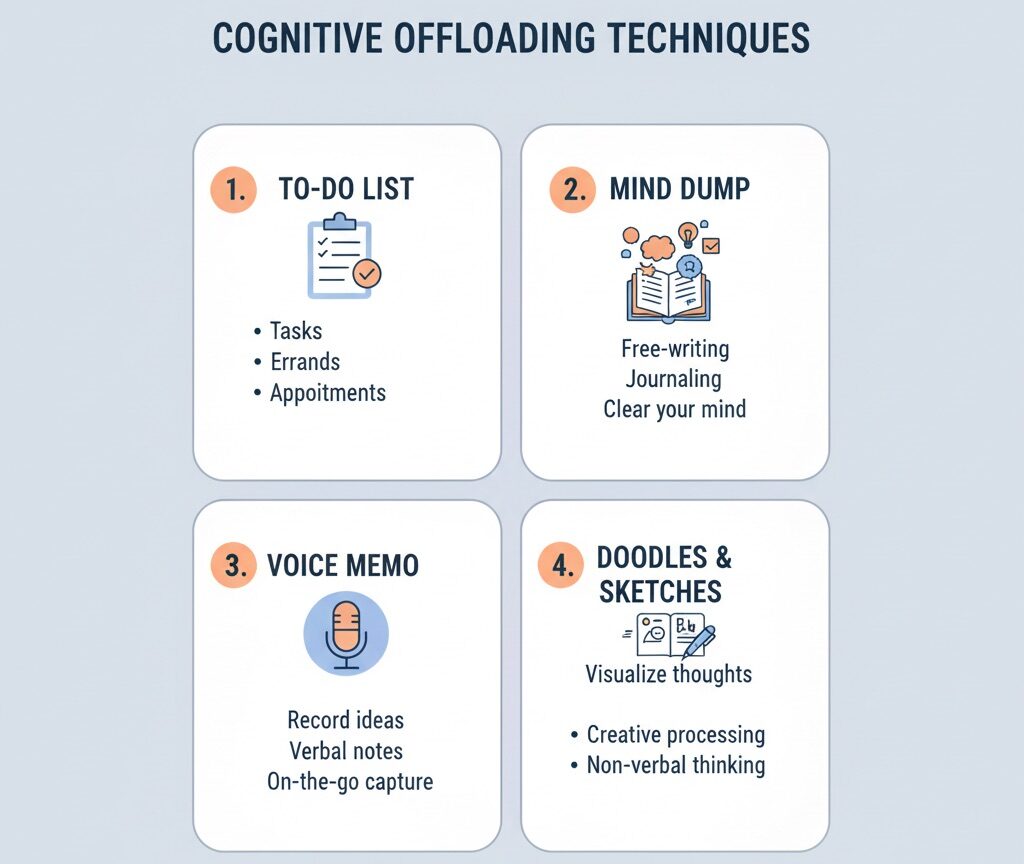
Forms of cognitive offloading before bed
There’s no one “correct” way to offload. The best method is the one that feels easy and repeatable for you — without requiring a perfect notebook, grammar, or even coherence.
Here are a few gentle forms of offloading to try:
Mind dump journaling
Set a 3–5 minute timer and write everything that’s on your mind — uncensored, unedited, unstructured. It’s not a diary. It’s a “thought release.”
Example:
“Remember to reschedule dentist. I didn’t call Mom back. That thing my coworker said bothered me. I don’t want to think about this now but I am.”
The goal is not to resolve — it’s to move the thoughts out of your head and onto the page.
This method is especially effective for those with overthinking patterns, a topic we unpacked in body scan meditation.
Mini to-do list for tomorrow
A simple bulleted list — no prioritizing, no deadlines. Just enough to tell your brain:
“I’ve captured it. You don’t need to remember it overnight.”
Example:
Confirm therapy appointment
Pick up dry cleaning
Outline presentation
Research from the Sleep Foundation suggests that people who write down specific future tasks fall asleep faster than those who write about completed activities.
Voice note unloading
Not a fan of writing? Speak your thoughts aloud into a voice memo. It’s surprisingly cathartic, especially when your thoughts feel jumbled or fast.
Try:
“Just talking this out… I’m worried about that meeting. I think I need to set a boundary.”
This method adds a personal tone and can help you reflect without effort. Bonus: it’s great if you feel physically restless — speaking moves energy.
Sketch or symbol map
Draw a few shapes, arrows, or quick diagrams to represent what’s going on internally. Think of it as visual shorthand.
Example:
An anxious thought could be a squiggly arrow, with a calm thought pointing in a different direction. The act of sketching creates separation between you and the thought.
This method is gentle, visual, and especially helpful for creatives or neurodivergent thinkers who don’t process emotions in words.
In all of these, the goal isn’t clarity — it’s release. As we explored in pre-sleep transitions, rituals like these help the brain downshift, even if they seem small.
Why offloading works: memory, emotion, and mental load
What makes this technique so effective? Let’s break it down through three lenses: memory, emotion, and mental energy.
Working memory relief
Our working memory — the part of the brain that temporarily holds thoughts — is limited. According to a study published by the NIH, trying to remember too much at once increases cognitive load and impairs decision-making and focus. At night, this translates to circular thinking and mental overactivation, which delays sleep.
By transferring those items to an external system — paper, app, voice note — you reduce the “tabs” open in your brain. This frees up bandwidth and allows your nervous system to begin shutting down for rest.
Emotional unloading
Cognitive offloading isn’t just about facts or tasks. It’s also about emotional processing.
When you write down or speak out a fear, annoyance, or thought, you shift it from subjective chaos into objective space. The thought becomes something you can observe, rather than something that owns you.
This creates a form of emotional distancing — not detachment, but perspective. It’s similar to what happens during reflective meditation, or when you journal out a troubling conversation and suddenly feel calmer.
As explained in Psychology Today, externalizing thoughts “helps transform emotion into language,” which reduces internal pressure and increases psychological safety — a vital precursor to sleep.
The safety signal for the brain
One of the brain’s primary concerns is unfinished business. If it believes there’s something you must remember, it’ll stay alert — even if you’re exhausted.
Cognitive offloading acts as a signal of completion. Writing something down communicates:
“This has been noted. I don’t need to keep rehearsing it.”
That small act of reassurance is often enough to shift the body out of problem-solving mode and into rest mode.
It’s a micro-signal of safety. And as we’ve explored in The 5-minute wind-down, even short signals like this can have a disproportionately calming effect when done with intention.
How to build an offloading habit — without pressure
Many people resist journaling or offloading because it feels like “just another thing to do.” That’s understandable — especially if your evenings are already full or if writing feels like a task, not a relief.
But here’s the secret: you don’t have to do it perfectly. You don’t even have to do it daily.
Offloading works best when:
It’s quick (1–5 minutes)
It’s consistent, but flexible
It feels safe and optional
It’s treated as a release, not a task
Try keeping a small notepad by your bed, or using a voice memo app with a one-tap start. Don’t overthink format. Write or say what’s real, messy, or half-formed.
The act of externalizing — no matter how small — is the benefit.
And if you skip a night? That’s okay. Like any ritual, it becomes effective over time through repetition, not perfection.
“But I hate journaling…”
No problem. You don’t need to be a journaler to benefit from offloading.
Here are alternative approaches for non-writers:
Bullet points — not sentences. Just words or fragments.
Example: “presentation / forgot laundry / need rest / Mom’s birthday”Audio dumps — speak into a voice memo and delete it after.
This adds relief without documentation. It’s for the release, not the record.Sticky notes — one thought per note. Toss them the next day.
The act of writing + discarding can be deeply symbolic.Sketches or mind maps — some people think visually. Let yourself draw instead of describe.
The goal is to interrupt the swirl — to move the energy of the thought from your inner world to something outside of you. Whatever method creates that space is valid.
How to integrate offloading into your bedtime routine
The beauty of cognitive offloading is how easily it fits into a broader wind-down flow. For example:
Your 10-minute pre-sleep ritual could look like this:
Dim lights and put away your phone — creating a digital twilight
Sit for 2 minutes and offload your thoughts into a notebook
Take 3 deep breaths or do a short body scan
Get into bed with a small signal of closure — such as saying “enough for today”
Done. No need for long essays or deep analysis. These micro-moments can reset your entire relationship with rest.
Final thoughts: sleep is not forgetting — it’s trusting
Cognitive offloading isn’t just about remembering less — it’s about trusting more.
It tells your brain:
“I don’t need to hold it all.”
“I can return to this later.”
“I’m safe enough to rest now.”
In a world where we carry so much in our heads — calendars, emotions, tasks, mental load — the simple act of writing something down or speaking it aloud is revolutionary.
So if your nights feel noisy, or your mind won’t release its grip, try this:
Give your thoughts somewhere to go.
A notebook. A note app. A voice memo. A scrap of paper. A ritual done not to be productive, but to be free.
Because in that space of release, sleep doesn’t have to be forced.
It just arrives — like silence after the last word has been spoken.