Journaling is often recommended as one of the most reliable bedtime rituals. A few minutes with a notebook can create a buffer between the stress of the day and the vulnerability of sleep. It gives you the chance to offload thoughts, regulate emotions, and establish a sense of closure. But while journaling can support relaxation, it’s not automatically restful — and for some, it becomes a subtle trigger for mental spirals rather than a pathway into calm.
This contrast is especially true for individuals prone to anxiety or rumination. What starts as quiet reflection can quickly shift into overanalysis, looping thoughts, or self-evaluation. And because the practice feels intentional, we may not notice that it’s contributing to bedtime arousal.
Instead of helping the mind wind down, journaling — if unstructured or emotionally intense — can reawaken the very systems we’re trying to quiet.
Why nighttime writing can backfire
As the body prepares for sleep, the nervous system begins to shift from sympathetic (alert, activated) into parasympathetic (calm, restorative) mode. This physiological transition is delicate, and can be disrupted by anything that reactivates the prefrontal cortex — especially problem-solving, planning, or emotional intensity. Certain types of journaling do exactly that.
In our article on cognitive offloading, we explored how writing things down can reduce mental load. But this benefit only holds when the process doesn’t introduce new cognitive loops. Journaling that involves replaying mistakes, forecasting challenges, or critiquing the day may increase arousal — keeping the brain in “do” mode rather than allowing it to shift into “let go.”
Research from the Sleep Foundation supports this paradox. While gratitude journaling and structured offloading can improve sleep outcomes, emotional dumping and open-ended processing — especially when done right before bed — may intensify nighttime stress and delay sleep onset.
The subtle shift from reflection to rumination
It’s easy to confuse helpful reflection with emotional overexposure. You might begin writing about a difficult interaction, intending to release it. But instead of clarity, you find yourself reliving it — rewriting the dialogue, imagining different outcomes, questioning your reaction. Rather than creating emotional distance, the journal becomes a magnifier.
The same happens with goal-setting or planning. A quick intention to outline tomorrow’s priorities can turn into a cognitive rabbit hole. The mind begins projecting scenarios, anticipating what could go wrong, or solving problems that haven’t happened yet. As one Healthline article puts it: “Nighttime overthinking often escalates because the brain no longer has distractions to regulate thought volume.”
This cognitive activation is the opposite of what the brain needs to fall asleep. Instead of winding down, it ramps up.
Signs your journaling is keeping you awake
If your journaling habit leaves you mentally stimulated, emotionally raw, or physically tense, it may not be serving its intended purpose. You might notice that your thoughts feel louder after you write. Or that closing the notebook doesn’t close the internal dialogue.
You may even feel pressure to write the “right” thing — especially if you’re tracking moods, setting goals, or evaluating your habits. In our piece on evening reflection prompts that regulate mood, we explore how overly structured or perfectionistic journaling can undermine rest by creating emotional performance rather than emotional presence.
Sometimes the harm isn’t what’s written — but how it’s written. Rushed handwriting, long tangents, or obsessive rewrites are subtle signs that the act of journaling has activated your stress response.
Future-focus, shame loops, and emotional reactivation
Certain journal topics — while common — are particularly risky when done at night. These include:
Problem-solving tomorrow’s worries (“What if I don’t sleep well again?”)
Self-critique disguised as reflection (“I shouldn’t have reacted like that… I always mess it up.”)
Mood monitoring without containment (“Why was I anxious again today?”)
Forced gratitude (“I should be more thankful, but I just feel numb.”)
A 2021 article by the APA highlights how certain journaling formats — especially those focused on diagnosis, perfection, or obligation — may backfire by reinforcing shame or hypervigilance.
When this pattern becomes part of your nightly routine, it’s no longer self-care — it’s mental labor disguised as wellness.
Soothing reflection, not emotional rehearsal
The brain craves containment at night — not analysis. This means offering space for thoughts to exist without asking them to perform or resolve. It’s the difference between noticing and fixing. Your journal doesn’t have to be deep, profound, or transformative. It can simply be a place to land softly.
In the second half of this article, we’ll explore how to reimagine your journaling practice — with gentle formats, grounded prompts, and an emphasis on emotional safety. You’ll learn how to transform your notebook from a stage for spiraling into a space for surrender. And we’ll look at how to build a sustainable bedtime habit that actually protects your sleep — one that helps your mind release the day, not rehearse it.
Evening commutes: unwinding the cognitive day
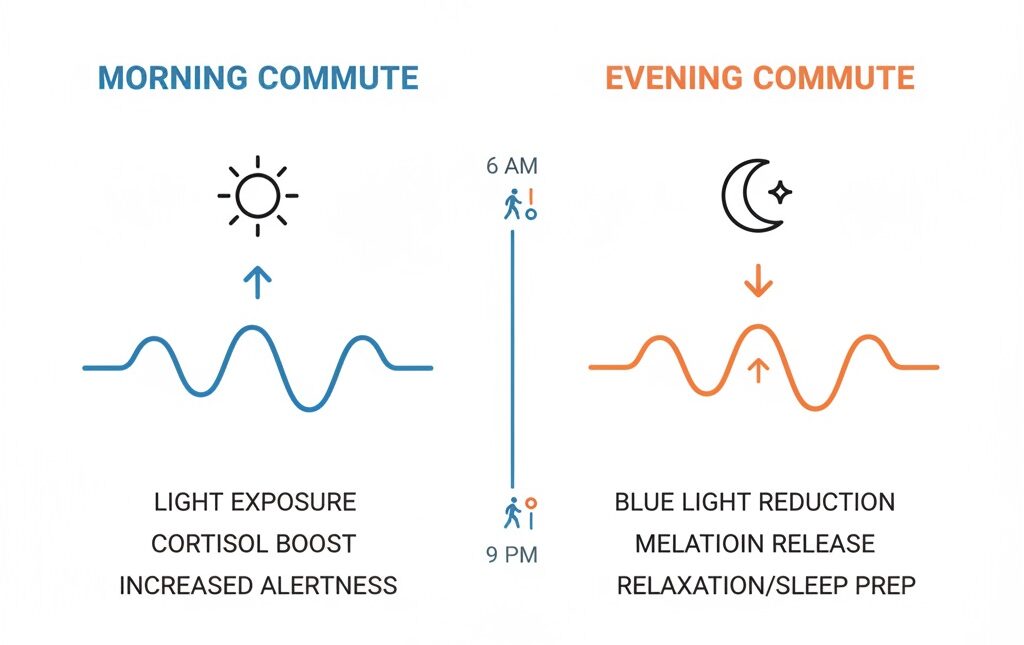
If the morning commute acts as a biological “on” switch, the evening commute does the opposite — it gently powers the system down. The transition home marks a shift from sympathetic (active, focused) nervous system activity into parasympathetic (rest-and-digest) dominance. This is not just psychological. Movement through space, decreasing light levels, and the gradual reduction of mental stimuli all prepare the body for melatonin production, slower thinking, and emotional release.
But what happens when this buffer is skipped?
For those with short or nonexistent commutes, the boundary between task-mode and rest-mode becomes blurry. You may finish your last message at 8:00 pm and be in bed by 8:15, but your brain hasn’t registered that a shift occurred. Without sensory contrast — sound, light, temperature, movement — your nervous system may still be “on” internally, even if the work is done.
This is where a conscious decompression ritual becomes important. In The 5-minute wind-down, we showed how short, deliberate breaks — even five minutes of stretching or breathwork — can signal the nervous system to transition into low arousal. You can build these micro-routines into your “commute substitute.” It might be a walk around the block, music in a separate room, a change of clothes, or journaling in dim light.
Artificial commutes: do they work?
Surprisingly, yes — but only if they mimic the key features of real ones: temporal regularity, sensory change, and directional movement. It’s not about distance or destination. It’s about creating a clear mental and physical signal that you’re shifting modes.
You can:
Walk the same path each morning before logging on, ideally outdoors.
Use light as a signal — step outside into natural daylight, or sit by a bright window.
Change your clothes from “home” to “focus,” then back again.
Designate a workspace boundary, even in a small space — a different chair, a specific desk, a scent only used while working.
These habits may feel symbolic, but as Harvard Health notes, the circadian system responds strongly to cues — especially light, contrast, and movement. Rituals create rhythm. And rhythm builds sleep resilience.
When hybrid schedules confuse your rhythm
One hidden disruptor of circadian alignment is inconsistency. For those with hybrid jobs — working from home some days, commuting on others — the variation in morning exposure, timing, and movement can send conflicting signals to the biological clock.
If your body receives early daylight and motion three days a week, but wakes later and stays indoors the other two, your internal clock begins to drift. This mismatch is similar to changing time zones — a subtle form of social jet lag. You may feel alert at odd times, struggle to fall asleep, or wake up unrested despite a full night in bed.
In our article on Weekend jet lag, we explored how even a two-hour difference in wake-up time can disrupt sleep architecture. The same applies to irregular morning activity. To counteract this, standardize your morning signals, even if your work location varies. Wake up at the same time, seek natural light, and move your body in a consistent way — whether that means walking, stretching, or simply stepping outside.
Replacing lost rhythm with layered cues
When natural commute cues disappear — daylight, movement, temperature shifts — it’s possible to layer in other inputs to maintain biological coherence. Think of your circadian system like a blindfolded orchestra: it relies on rhythm, repetition, and well-timed signals to stay in sync. If light is missing, movement can compensate. If movement is reduced, temperature or sound patterns can help. The key is consistency.
Practical cues that support circadian rhythm:
Morning light exposure: 5–15 minutes outdoors or near a bright window, especially before 10am.
Morning motion: walking, dynamic stretching, or even dancing in place — enough to raise body temperature slightly.
Soundscapes: consistent music or ambient noise that marks the start or end of the workday.
Scent-based cues: using energizing essential oils in the morning, and calming ones at night.
Digital light control: using warmer color temperature lighting in the evening to avoid melatonin suppression.
Each of these can function as circadian anchors. Alone, they may feel subtle. But together, they signal the brain: “You are in rhythm. You are safe to rest.”
Final thoughts: moving through time with intention
We often underestimate the body’s sensitivity to rhythm. Yet it listens constantly — not to our words, but to our patterns. A short commute can be a biological message, a soft nudge that aligns internal time with the external world. It says, Now it’s morning. Now it’s evening. This is your time to shift.
In a world where routines are increasingly fluid, reclaiming that message is a gift. It doesn’t require hours of discipline or rigid schedules. It simply asks you to move with intention, to step into light, and to let your body feel the difference between doing and being.
Because the commute was never just about getting somewhere. It was about becoming — alert, present, ready to engage. Or later, ready to let go.