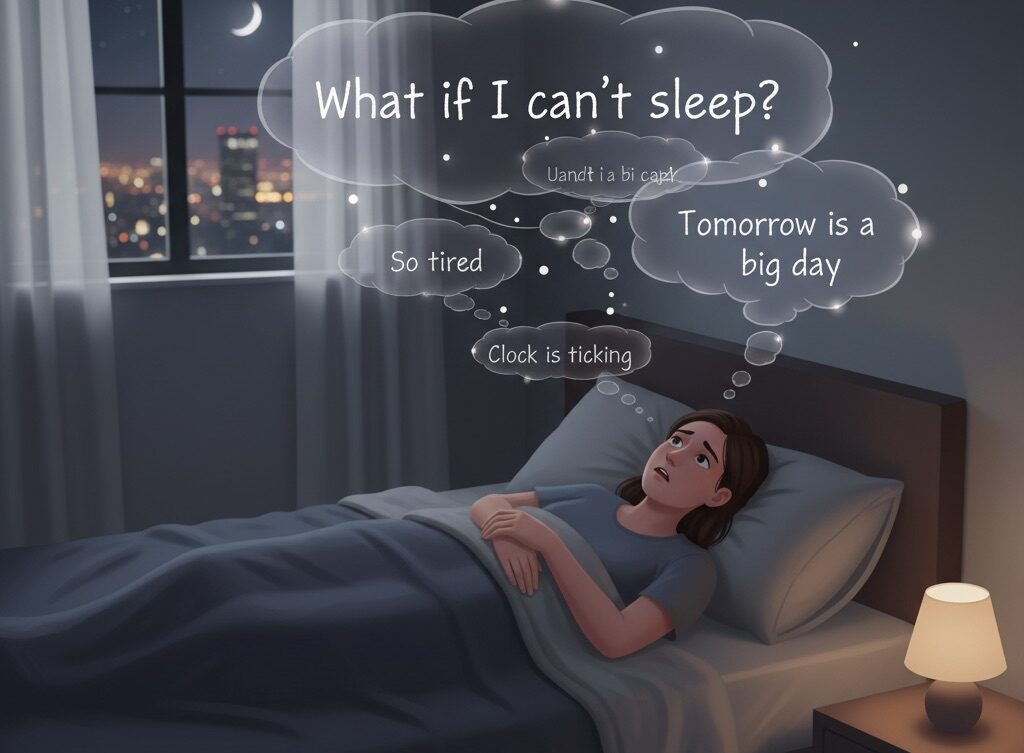
You lie in bed, lights off, everything quiet — except your thoughts.
“What if I can’t sleep again?”
“What if I’m tired tomorrow?”
“Why is this happening — again?”
Ironically, it’s not always the stress of the day that keeps you up.
Sometimes, it’s the stress about not sleeping itself.
This is known as meta-anxiety — a second layer of fear that spirals from your original worry. Instead of just experiencing a restless night, you begin to fear the consequences of insomnia. That fear activates your nervous system, and the result is paradoxical: the harder you try to sleep, the more alert you feel.
Meta-anxiety isn’t uncommon — and you’re not broken if this sounds familiar. But learning to understand the loop can help you step outside of it. And from there, it becomes easier to restore calm, reduce resistance, and invite sleep back in.
What is meta-anxiety?
At its core, meta-anxiety means:
being anxious about being anxious.
In sleep, this often shows up as a fear of not falling asleep, which then fuels a cascade of worry: about tomorrow’s fatigue, about health effects, about control, about the identity of being a “bad sleeper.”
This second layer of worry activates a stress response — even if there’s no real threat in the room. Your brain perceives the idea of being sleepless as a danger signal, which triggers alertness… the exact opposite of what you need.
Over time, the bed — a place meant for rest — can become associated with frustration, overthinking, and dread.
And it’s not all in your head. As the NIH notes in its research, cognitive models of insomnia show that pre-sleep arousal — both mental and physical — is a major contributor to delayed sleep onset and nighttime awakenings.
This cycle of anticipation → fear → alertness is a real psychological feedback loop.
And the more you try to break it by force, the stronger it becomes.
How the loop keeps itself alive
Let’s look at how meta-anxiety unfolds, step by step:
You anticipate difficulty sleeping, based on past experience or high stress
You lie in bed and feel slightly alert or restless
This triggers the thought: “It’s happening again — I won’t sleep”
That thought sparks fear — heart rate rises, muscles tense, cortisol increases
You start clock-watching, trying harder to sleep
The pressure to sleep increases wakefulness
You stay awake longer — which confirms your fear
The brain registers this experience as proof: “Sleep is hard. I need to worry about this.”
And the next night, it starts again — often before you even get into bed.
This loop can form in anyone, but it’s especially common in those who:
Have experienced insomnia or jet lag
Are highly sensitive or anxious by temperament
Have perfectionist tendencies (“I must sleep well to perform well”)
Use strict sleep hygiene rules that turn into pressure
The problem isn’t that you can’t sleep — it’s that your brain has started to associate bedtime with performance anxiety.
Why trying harder doesn’t work
Sleep isn’t a task you complete — it’s a biological process you allow.
But when you’re caught in the meta-anxiety loop, sleep can start to feel like a goal, a test, or even a punishment. You might think:
“I have to get at least 7 hours or I’ll be wrecked.”
“If I don’t sleep now, tomorrow is ruined.”
“Why can everyone else fall asleep except me?”
These thoughts aren’t wrong — they’re understandable. But they signal to the brain that sleep is high-stakes. And that creates pressure.
Pressure creates hyperarousal. Your nervous system enters a sympathetic (fight-or-flight) state — even if there’s no danger. In this state:
Cortisol stays elevated
Heart rate stays high
Muscles remain tense
The prefrontal cortex overthinks and won’t shut down
It becomes harder to let go. Harder to drift. Harder to access the body’s natural rhythm.
And so you try even harder — and it backfires.
The shift: from control to curiosity
The turning point in breaking the cycle isn’t to try harder to sleep — it’s to stop trying so hard not to feel anxious.
This doesn’t mean giving up. It means shifting your relationship to nighttime anxiety — from resistance to gentle awareness.
Instead of:
“Oh no, I’m anxious. This will ruin my night.”
Try:
“Ah, I notice some anxious energy. That’s okay. It’s allowed to be here.”
This form of permission-based mindfulness tells the body: “You don’t have to fight.” And when the fight ends, calm has room to return.
If you want to practice this, our article on body scanning is a helpful starting point. It brings attention gently into the body without fixing — just noticing.
You can also try cognitive offloading — writing down your thoughts before bed — which we cover in detail here.
These practices reduce the charge around thoughts — making space for rest, even if sleep doesn’t arrive instantly.
Gentle ways to interrupt the loop
Breaking the cycle of meta-anxiety doesn’t require force — it requires subtle redirection.
Here are three gentle approaches that can help the brain unlearn the fear of not sleeping:
1. Externalize the worry
One of the quickest ways to lower mental pressure is to move thoughts out of your head and onto something else. This is known as cognitive offloading, and it’s a simple but powerful intervention.
Instead of lying in bed spiraling in thoughts like:
“What if I can’t fall asleep again?”
“What if I’m up all night like last week?”
“What if this ruins tomorrow?”
You write those down. Or say them out loud (quietly). Or even type them on your phone and then close the tab.
Externalizing doesn’t fix the worry — but it gives it shape. And once it’s outside of you, your nervous system doesn’t need to guard it as tightly.
Learn more about this in our guide on cognitive offloading before bed.
2. Try structured but low-pressure techniques
When you can’t sleep, the brain craves structure — but not stress. This is where sleep-compatible mental techniques can help. They’re not about forcing sleep, but about anchoring attention gently, so the system can deactivate.
Some examples include:
“Sleep counting” — counting in creative patterns to occupy working memory
Mental visualization — imagining a slow, familiar walk or peaceful setting
Gratitude loops — gently repeating 3–5 things that felt OK today
Breathing in sync with a phrase — e.g., inhale “I release,” exhale “I rest”
These methods work by distracting the overactive analytical brain, while giving your nervous system cues of safety.
The key is to use them not as sleep “hacks,” but as companions in the night. Let them be soothing, not strategic.
3. Shift your goal from “sleep” to “rest”
This might be the most powerful — and hardest — mindset shift:
Stop trying to sleep. Start allowing rest.
When the goal is sleep, the brain assesses every moment:
“Am I asleep yet? Why not? What’s wrong?”
But when the goal is rest, you give your body permission to just be still, warm, and supported — without a demand to perform.
You can try saying:
“It’s okay if I don’t fall asleep right away.”
“My body knows how to rest, even if my mind is alert.”
“I’ve survived tired days before. I’m still safe.”
This permission can deactivate the loop that says: “Fix this now.”
It’s not resignation — it’s trust. Trust that your system will sleep when it’s ready.
And that rest still holds value, even when sleep feels far away.
Rebuilding your relationship with sleep
The longer you’ve struggled with nighttime anxiety, the more your bed becomes a trigger. That’s okay — but it also means your relationship with sleep needs repair.
Here are small ways to start rebuilding that connection:
Make bedtime feel safe again
Instead of using bedtime as a test of control, turn it into a gentle transition.
Use a soft sensory cue — scent, light, or sound — to signal a shift into calm.
We explain this in detail in our article on the “one sensory cue” rule, which also works beautifully at night.
This cue helps your body feel familiarity, which builds safety — even before sleep arrives.
Build “success” around small wins
Redefine what a good night looks like. Instead of measuring sleep by hours, consider:
Did I avoid scrolling for 30 minutes before bed?
Did I notice my thoughts without fighting them?
Did I offer myself kindness during wakefulness?
These are nervous system wins — and they matter.
Sleep improves most sustainably when it grows out of self-compassion, not self-punishment.
Trust that one bad night doesn’t undo your progress
Even when you build a calm routine, anxiety can spike again. This doesn’t mean you’ve failed. It means your system is still learning what safety feels like.
If you experience a rough night, try saying:
“Tonight was hard. But I’m still on the path. My body is always listening. I don’t need to be perfect.”
This is how you shift from fear to trust. Not by never waking up — but by responding differently when you do.
Final thoughts: your sleep isn’t broken — it’s protective
Meta-anxiety isn’t a flaw. It’s your nervous system’s way of saying:
“I’m trying to protect you — I just don’t know how.”
The thoughts that say “You must sleep or else…”
The fear that says “You’re the only one struggling…”
The pressure that says “This must stop right now…”
They all come from a place of care. But that care has turned into fear.
And fear doesn’t let the body relax.
To break the loop, you don’t need a perfect routine or the right product.
You need permission to rest, even when sleep doesn’t come easily.
Your body hasn’t forgotten how to sleep.
It just needs a chance to feel safe again.
And you’re allowed to take that chance — one night at a time.