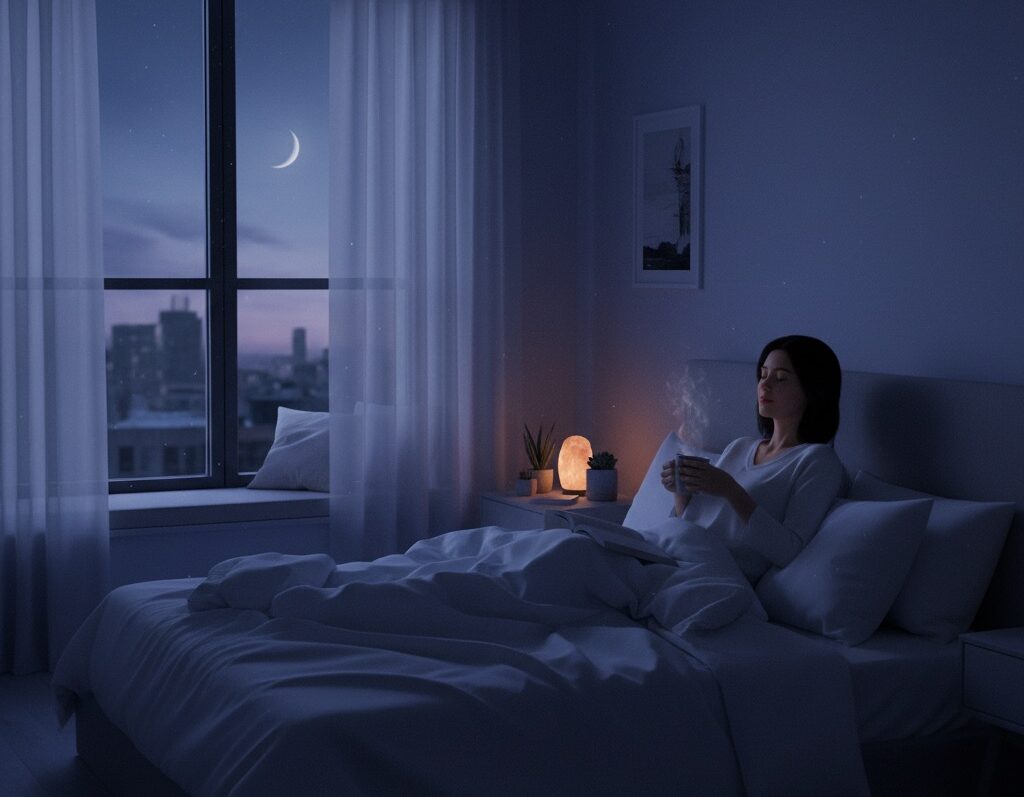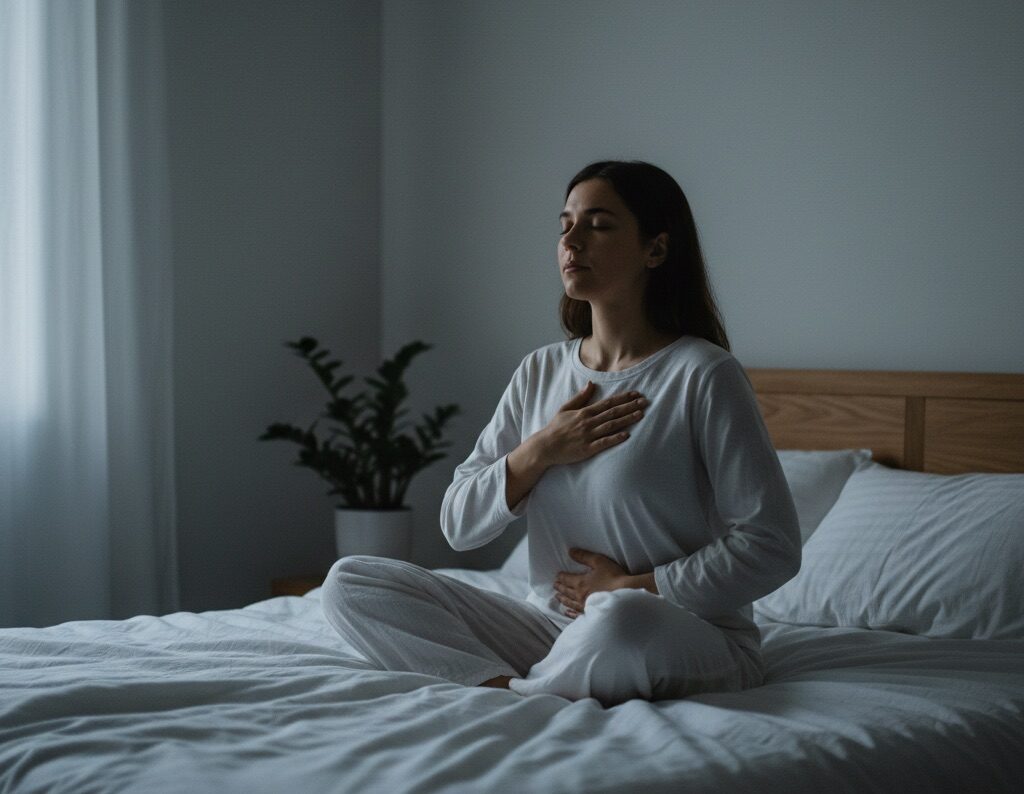
Many people notice a familiar pattern: they feel generally fine during the daytime, but once the evening quiets down — and especially once they lie in bed — anxiety seems to sharpen. Thoughts move faster, sensations feel stronger, and the emotional landscape becomes more reactive. What often goes unnoticed is that this shift doesn’t happen in isolation. For many people, nighttime anxiety rises at the same moment the body becomes more sensitive to temperature.
You might feel suddenly too hot even if the room is cool.
Or you may feel chilled even under warm blankets.
Or perhaps the slightest temperature fluctuation — the air changing when you shift positions, the blanket trapping more warmth than before — causes a spike in discomfort or internal alertness.
This link between nighttime anxiety and temperature sensitivity is rarely discussed, yet it plays a major role in how the nervous system behaves at night. Emotional intensity is not just cognitive; it’s physiological. And temperature is one of the body’s deepest regulators.
Understanding this connection can transform how you experience nighttime calm. Temperature isn’t just a comfort factor — it’s an emotional one.
The physiology of nighttime heat sensitivity
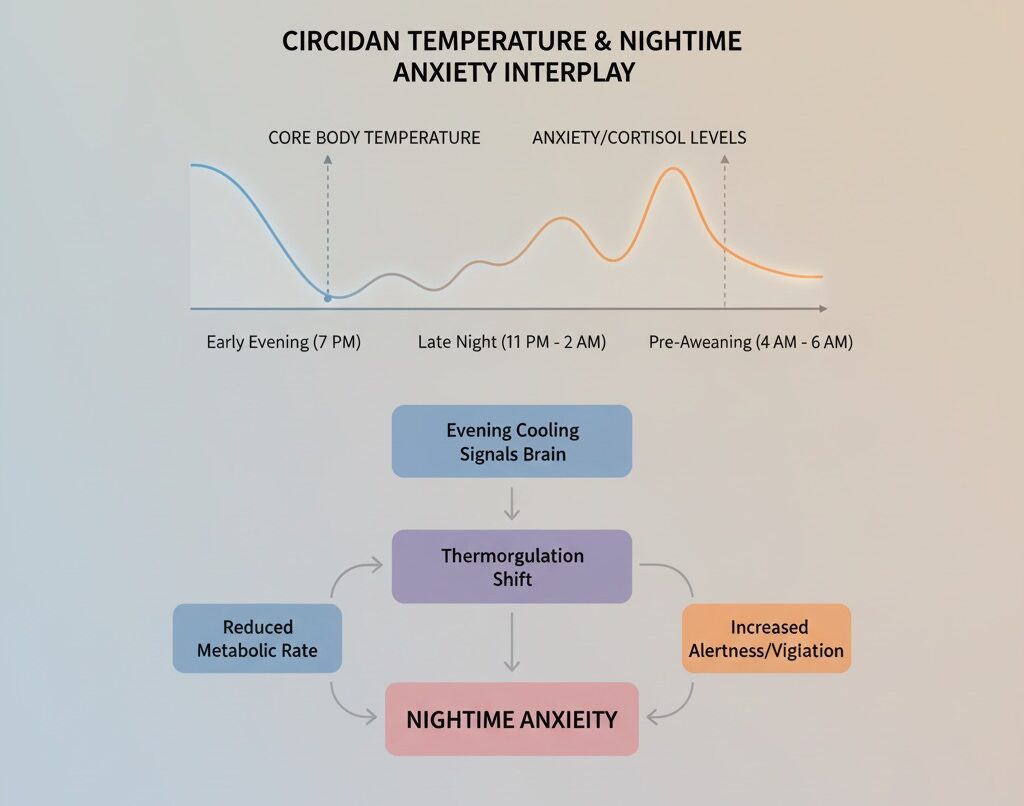
The body is naturally designed to cool down in the evening. This cooling is essential: it signals the brain that night has arrived and prepares the system for sleep. Core body temperature drops gradually, while skin temperature slightly rises as heat moves outward. When this process flows smoothly, the nervous system senses safety. When it doesn’t, anxiety often increases.
Heat sensitivity at night often appears when the body struggles to release heat. Instead of cooling steadily, it holds warmth — sometimes from late meals, stress hormones, overactivity, or the simple build-up of daily stimulation. When internal heat rises, the heart rate can nudge upward, breathing becomes slightly shallower, and the brain interprets these signals as mild threat.
Nothing dramatic — just a subtle physiological mismatch that the mind translates into restlessness.
Harvard Health notes that overheating disrupts sleep quality and increases nighttime stress responses.
Even small deviations in temperature can create a feedback loop: heat raises alertness, alertness raises perceived heat, and the cycle continues.
This explains why some nights feel emotionally charged for no clear reason. Temperature becomes the quiet catalyst.
How overheating triggers mental arousal
Anxiety is not only a cognitive state — it’s a physiological one. Overheating activates similar pathways as stress: elevated heart rate, faster breath, heightened awareness. The brain receives signals indicating that something requires attention, even if there’s no external threat.
This is why being “a little too warm” can suddenly make your thoughts feel louder or your worries feel sharper. The mind uses bodily cues as context, and heat is a powerful cue.
Overheating can:
reduce the depth of early sleep cycles
increase nighttime awakenings
intensify emotional reactivity
make rumination easier to fall into
cause restlessness or a sense of urgency
When the body feels too warm, the mind instinctively tries to stay alert. It doesn’t matter if the cause is simply an extra blanket or a warm bedroom — the nervous system interprets it through the lens of survival.
It’s a subtle but profound shift: comfort becomes vigilance.
And once vigilance is present, nighttime anxiety becomes more likely to surface.
Why some people experience cold-related anxiety at night
Heat sensitivity is common, but some people experience the opposite: nighttime anxiety emerges when they feel cold. This often surprises them, because culturally we focus more on being “too hot” at night.
Cold sensitivity at night happens when the body experiences cold stress — when skin or extremities cool too quickly or too intensely. The nervous system interprets sudden cold as a signal requiring alertness. Muscles tense, the breath tightens, and the mind becomes slightly more watchful.
This doesn’t always manifest as full anxiety. Sometimes it shows up as:
restlessness
subtle emotional discomfort
irritability
a feeling of unease
difficulty letting go into sleep
If your feet, hands, or shoulders get cold easily, you may notice that your mind becomes slightly more active when cold sets in. The body doesn’t want to relax into sleep when it feels unprotected.
Interestingly, some people oscillate between heat and cold sensitivity — feeling overheated under blankets but chilled when uncovering. This ambivalence often comes from instability in the body’s internal thermostat, which can be influenced by hormones, stress, or circadian shifts.
Temperature becomes not just a physical sensation but an emotional one.
The role of circadian temperature drops — and what happens when the body can’t cool
Every evening, your core temperature is meant to fall gradually — a change of just 1–2 degrees Fahrenheit. This drop supports melatonin release, reduces metabolic activity, and prepares the brain for sleep.
But when this drop doesn’t happen smoothly — whether because of stress, late exercise, a warm bedroom, heavy bedding, alcohol, or rich evening meals — the nervous system becomes confused. The body tries to cool, but external or internal factors block the process.
This mismatch — trying to cool + failing to cool — often feels like anxiety.
The Cleveland Clinic notes that the body’s temperature curve is one of the strongest physiological drivers of sleep transitions.
When that curve is disrupted, cognitive quieting becomes harder.
Instead of drifting into sleep, you may feel:
warm pressure in the chest
a quickening heart tempo
inability to find a comfortable position
subtle agitation
a sense of “being stuck in the body”
These sensations are easy to misinterpret as emotional.
Sometimes they are emotional.
But often, they’re thermoregulatory — the body trying to reach its nighttime state and struggling along the way.
How subtle temperature shifts affect emotional processing during the night
Temperature doesn’t just affect comfort — it influences dream cycles, emotional consolidation, and the brain’s ability to regulate mood. During sleep, the brain processes emotional experiences from the day, especially during REM cycles. If the body overheats or experiences cold stress, REM sleep can become shorter, lighter, or more fragmented.
This can amplify nighttime anxiety in two ways:
1. Pre-sleep:
Temperature discomfort creates physiological arousal that the mind interprets as emotional tension.
2. During sleep:
Shallow REM cycles lead to less emotional processing, which can cause the mind to feel more unsettled, even if the dream content isn’t remembered.
This subtle relationship often explains why some nights feel emotionally “heavier” than others, or why you wake with a feeling you can’t fully place.
Your temperature environment influenced your emotional night.
The Sleep Foundation’s overview of optimal sleep temperature highlights how a few degrees’ difference can significantly shift sleep depth.
Temperature is not passive — it’s emotional architecture.
Identifying your personal temperature triggers
Before adjusting your environment, it helps to understand your personal pattern. People often fall into one of three categories:
Heat-sensitive sleepers
These individuals feel warm quickly, wake up from overheating, or experience racing thoughts when too warm.Cold-sensitive sleepers
These individuals feel anxious, unsettled, or unable to relax when they get even slightly chilled.Dual-sensitive sleepers
They overheat under blankets but feel anxious when uncovered — often shifting repeatedly to find equilibrium.
Your triggers may also change depending on stress, hormones, or seasonal rhythms.
The goal isn’t to “fix” the pattern — it’s to understand it so your environment can support your emotional regulation at night.
Designing an evening environment that stabilizes both body and mind
Temperature isn’t just about comfort — it’s a form of emotional regulation. When the environment supports your body’s natural cooling curve, your mind feels safer to settle. And when your mind softens, your body regulates more easily. It’s a circular, interdependent process.
The goal in the evening isn’t to find the “perfect” temperature — it’s to create a temperature-stable environment that helps your nervous system downshift without sudden fluctuations. Even small changes can feel surprisingly grounding.
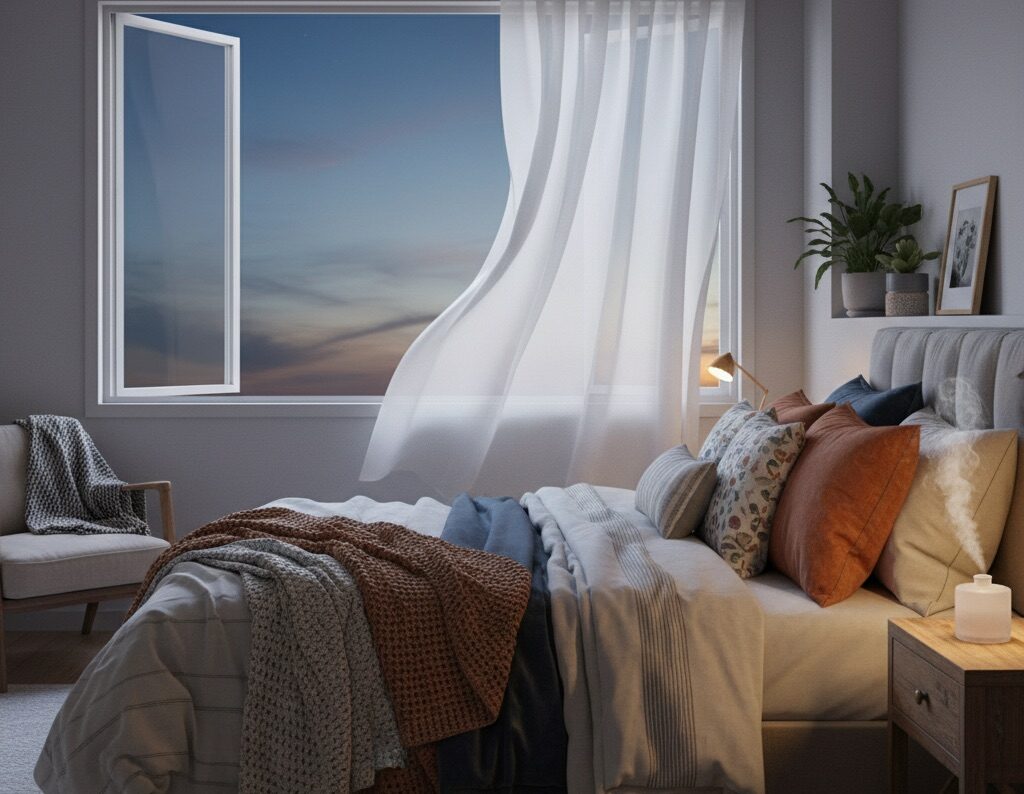
Start with airflow.
A gentle, consistent current — from an open window or a quiet fan — prevents pockets of trapped heat from building around the body. Many people experience overheating not because the room is too warm, but because still air traps warmth around the chest, neck, and shoulders. Airflow helps that heat disperse naturally.
Bedding matters more than most people realize.
Heavy bedding can lock in heat even in a cool room. Light, breathable materials (cotton, bamboo, linen) help maintain a more even temperature and reduce nighttime awakenings caused by heat buildup. For cold-sensitive sleepers, layering is often the most supportive approach — thin, adjustable layers rather than one thick blanket. Layers allow small adjustments without dramatic shifts.
Temperature-stabilizing gestures — opening a window slightly, flipping the pillow, letting a foot peek out from under the covers — may seem small, but they create a sense of control that your nervous system feels immediately.
This is similar to the grounding strategies explored in Somatic navigation: how body-based mapping calms the mind before sleep.
When the body feels physically regulated, the mind follows.
How evening habits influence nighttime temperature sensitivity
Temperature sensitivity at night doesn’t begin at night — it builds through the afternoon and early evening. A few habitual factors can amplify internal heat before bedtime without you realizing it.
Late exercise can raise core temperature for hours, sometimes long after the stimulating feeling has faded. If you often feel restless at night after working out, it may not be the exercise itself — it may be the delayed cooling curve.
Heavy evening meals, especially high in fat or protein, also increase internal heat as the body works to metabolize them. This can create subtle warmth in the chest or abdomen that’s easy to mistake for emotional activation.
Alcohol produces a unique paradox. It may make you feel flushed or warm initially, then lead to nighttime chills. This temperature swing can make emotional states feel unpredictable.
Even bright screens influence temperature. They don’t heat the body physically, but their stimulating effect delays melatonin release — and when melatonin is delayed, the circadian temperature drop is delayed too. If the body hasn’t cooled, the mind often can’t settle.
This is one reason the gentle evening routines described in
How to do a digital detox evening for better sleep and mental clarity help restore internal temperature rhythms without strain.
Your temperature story begins hours before bedtime.
The psychological side of temperature discomfort
Temperature sensitivity creates a physical sensation — but the interpretation of that sensation is psychological. The mind builds meaning around the body’s thermal signals. Many people don’t realize how quickly this interpretation happens or how deeply it shapes nighttime anxiety.
For example, feeling overheated can create a subtle spike of urgency: something feels off, I need to adjust. The mind then pulls that sense of urgency into thought patterns — often the ones that already trouble us. Heat becomes the doorway through which anxious thoughts enter.
Cold discomfort can trigger a sense of vulnerability: I feel exposed, I need more protection. This, too, becomes emotional. The mind begins scanning for metaphorical sources of danger.
The temperature itself doesn’t cause the anxiety — but it sets the stage for anxiety to rise.
When the body is comfortable, the mind has fewer sensory cues to interpret as threat.
But when the body feels unsettled, the mind tries to explain it — and sometimes it explains it through worry.
This is why regulating temperature can often reduce nighttime anxiety more effectively than purely cognitive techniques. You’re addressing the sensation before it becomes a story.
The hidden temperature–heart rate–anxiety triangle
One of the most subtle but impactful connections in nighttime anxiety is the link between temperature, heart rate, and mental arousal.
When the body overheats even slightly, the cardiovascular system increases blood flow to the skin to help dissipate heat. This can cause a mild increase in heart rate — sometimes only 3–5 beats per minute, but enough for sensitive nervous systems to notice.
Once heart rate rises, the mind interprets it as emotional arousal.
Not consciously — instinctively.
The sequence goes like this:
temperature rises → heart rate rises → alertness rises → thoughts quicken
Cold stress follows a similar pattern, but through muscle tension rather than cardiac response. Sudden chills activate small shivers or micro-tensions, and the nervous system interprets those as “stay alert.”
This triangle explains why temperature regulation is often more calming than expected. It isn’t only about physical comfort — it’s about breaking the physiological chain that leads to anxiety.
Your body is always speaking, and temperature is one of its clearest languages.
Recognizing temperature-driven anxiety vs. emotionally driven anxiety
It can be helpful to distinguish between anxiety that begins with the body and anxiety that begins with the mind. Temperature-driven anxiety often has a slightly different rhythm.
Temperature-driven nighttime anxiety may feel like:
“I can’t get comfortable.”
“My chest feels warm.”
“I keep moving to find the right spot.”
“My heart feels a bit quicker.”
“Everything feels too much, all of a sudden.”
Emotionally driven anxiety may feel more like:
mental loops
anticipation
replaying conversations
general unease or rumination
Both can interact. Temperature can amplify emotional sensitivity, and emotional sensitivity can heighten temperature awareness. But noticing which one starts the process gives you more clarity — and more control.
When temperature is the initiator, small adjustments can make a surprisingly big difference: cooling the room slightly, adjusting blankets, changing sleepwear, shifting to the cooler side of the bed.
Tiny changes, big emotional impact.
Creating a temperature-stable night: gentle guidance
There’s no single “ideal” sleep temperature, but for many people, a range around 60–67°F (15–19°C) creates the most stable environment. What matters more than the exact number is consistency. Sudden temperature shifts often trigger the nervous system more than a mildly imperfect temperature.
These gentle principles can help:
Keep the bedroom slightly cooler than the rest of the home.
Choose breathable fabrics and adjustable layers.
Prioritize airflow; even small movements of air reduce heat accumulation.
Warm cold feet or hands before bed to avoid cold-triggered alertness.
Avoid heavy, heat-retaining meals close to bedtime.
Allow the room’s temperature to stay stable throughout the night if possible.
These aren’t rules — they’re forms of emotional support.
Your environment becomes part of your nervous system’s regulation.
This aligns with the approach explored in
Home sleep hacks: how to optimize your bedroom environment where environment becomes a key partner in calming the mind.
Conclusion: temperature as an emotional regulator
Nighttime anxiety often feels complex — mental, emotional, personal. And it is. But beneath the emotional layers lies a foundation of physiology, and temperature is one of its most influential pillars. Your body’s thermal state shapes your nervous system’s sensitivity, your emotional regulation, your dream cycles, and your cognitive quiet.
When the body can cool steadily, the mind follows.
When the body feels stable, the mind softens.
When temperature stays predictable, nighttime anxiety loses its foothold.
This connection isn’t obvious at first. It’s quiet, subtle, hidden in the background. But once you notice it, nighttime becomes less mysterious — and much easier to support.
Your temperature story is part of your emotional story.
And understanding it gives you a gentler path into the night.