Most people know that light influences sleep. But few realize just how much the type of light — its color, intensity, and timing — can either support or disrupt the body’s ability to fall and stay asleep. As sleep hygiene becomes more personalized, the conversation around nighttime lighting has shifted from “turn off the lights” to “choose the right lights.”
Two common contenders have emerged: red light lamps and warm white bulbs. Both claim to be sleep-friendly. Both offer soft, low-stimulation environments. But how do they actually compare when it comes to supporting your circadian rhythm?
Let’s explore the science behind each — and how to decide which is better for your evening routine.
The biology of light and sleep: a quick primer
Before comparing bulbs, it helps to understand why light has such a profound effect on sleep.
Your body has a built-in clock — the circadian rhythm — that regulates when you feel awake and when you get sleepy. This rhythm is tied to the suprachiasmatic nucleus (SCN) in your brain, which takes cues from external light exposure to align your biological processes with the time of day.
When light hits the retina, it signals to the SCN that it’s daytime. In response, the brain suppresses melatonin — the hormone that promotes sleepiness. As evening arrives and light fades, melatonin is released, initiating the transition to sleep.
But here’s the catch: not all light has the same effect on melatonin suppression.
Blue light (in the 460–480 nm range) is the most potent in signaling wakefulness. It’s abundant in daylight — but also in LED screens and many indoor lights. This is why exposure to bright or cool-toned artificial lighting in the evening can delay sleep onset and shift circadian timing. (source: NIH)
What is red light?
Red light refers to light with longer wavelengths (620–750 nm), which sit at the opposite end of the spectrum from blue. It has:
Lower color temperature (typically < 3000K)
Minimal melatonin suppression
A dim, amber-red glow that many find soothing
Because it avoids the blue spectrum almost entirely, red light has become a popular evening lighting option. In fact, studies have shown that red light exposure in the evening does not interfere with melatonin production, making it one of the most circadian-neutral light sources.
Some animal studies even suggest that red light may enhance melatonin secretion compared to no light at all — though evidence in humans is more limited.
What’s more important is that red light is perceived as less alerting — it doesn’t stimulate the brain the way bright white or blue light does.
The appeal of warm white bulbs
Warm white bulbs (often labeled 2700K–3000K) emit light that mimics the softer tones of incandescent bulbs — more yellow or amber than white daylight bulbs, but still part of the white light category.
They are typically marketed as “soft white,” “relaxing,” or “bedroom-friendly.” And they do have some advantages:
Less blue light than cool white or daylight bulbs
Compatible with standard fixtures
A more natural aesthetic for reading, winding down, or evening ambience
However, warm white bulbs still contain some blue light — especially in the LED versions. While much less stimulating than daylight or device screens, they are not entirely melatonin-safe, particularly when used at high brightness levels or close to bedtime.
A 2018 study published in Chronobiology International found that even dim warm white LEDs could delay melatonin onset when used continuously during the evening. (source)
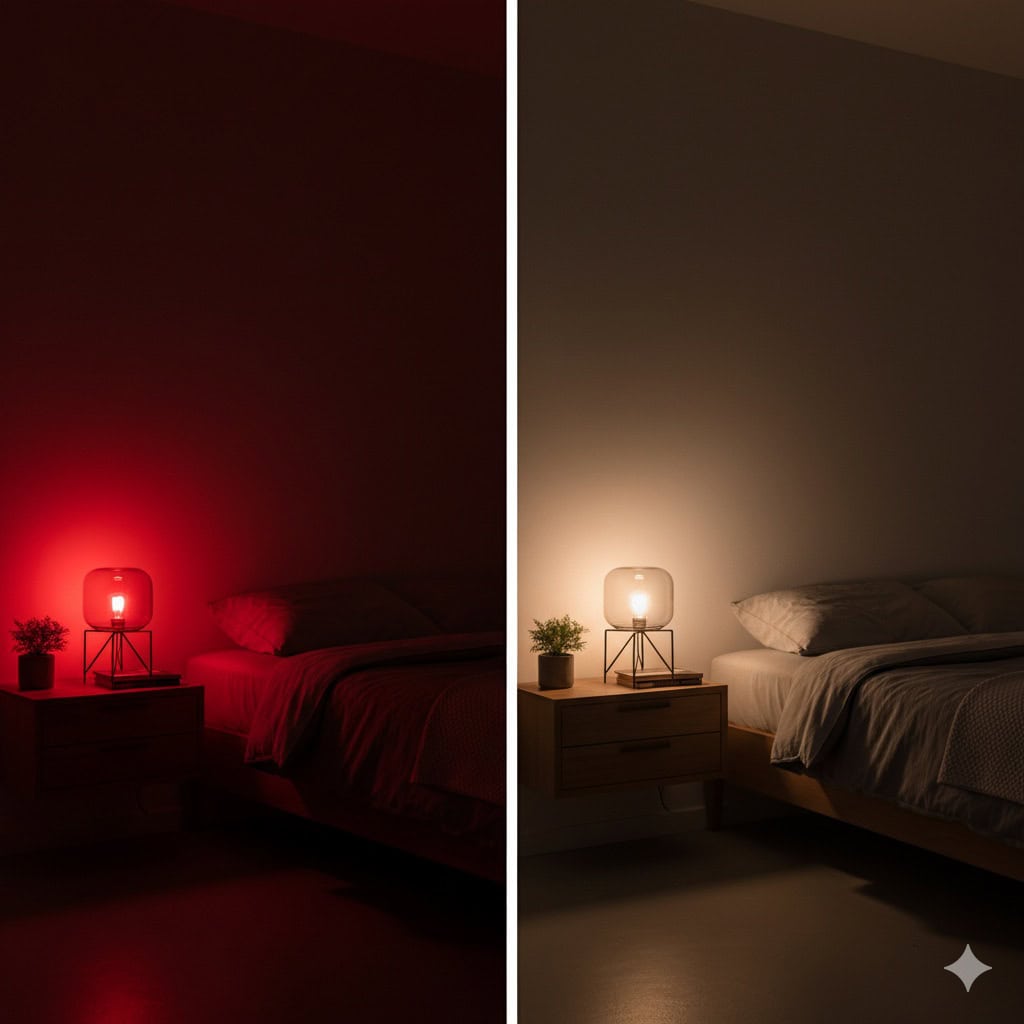
Comparing sleep impact: red vs. warm white
| Feature | Red Light | Warm White Bulb |
|---|---|---|
| Melatonin suppression | Minimal to none | Moderate (depends on intensity) |
| Color temperature | < 2000K | 2700K–3000K |
| Circadian disruption | None | Possible with prolonged use |
| Alertness impact | Low | Medium |
| Ideal use | Last 1–2 hours before sleep | Early evening, before switching to red or no light |
| Compatibility | Requires specific red-spectrum lamps | Widely available in most home fixtures |
While both options are better than blue-enriched daylight bulbs, red light wins in terms of pure circadian neutrality. It’s the closest to darkness you can get while still seeing your environment.
That said, warm white light can still be sleep-supportive when used thoughtfully — especially when paired with dimming features and used earlier in the evening.
When red light makes the most sense
Red light is ideal if you:
Are extremely sensitive to light exposure
Struggle with falling asleep after screen use
Have a delayed circadian rhythm or tend to stay up late
Want a light source for middle-of-the-night awakenings that doesn’t disrupt sleep drive
Practice wind-down rituals like journaling, stretching, or reading before bed
It’s particularly useful for people navigating insomnia, shift work, or jet lag recovery — situations where any blue light exposure can delay internal sleep signals.
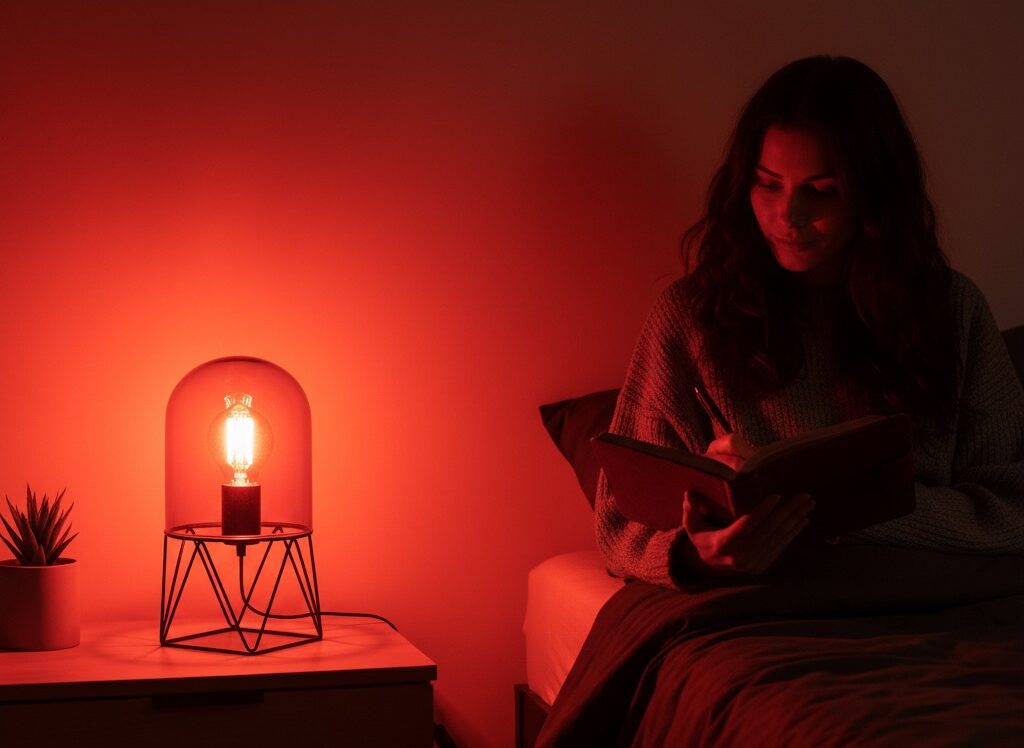
You can use a red light lamp as your final light source before bed — especially in the last 30–60 minutes before you intend to fall asleep. Many people also use them in the bathroom or hallway for nighttime navigation, so they don’t accidentally wake themselves up with bright overhead lighting.
When warm white is still the better choice
Despite the advantages of red light, there are valid reasons to prefer warm white bulbs in certain evening contexts.
Warm white bulbs may be a better fit if you:
Prefer a natural-looking environment (e.g., for dinner, reading, or family time)
Want to see colors accurately — red light can distort color perception
Live in a shared space where red lighting feels impractical or jarring
Need more brightness earlier in the evening but still want to avoid blue-toned light
Importantly, warm white bulbs can be sleep-supportive when dimmed. Many modern LED bulbs are dimmable, and some smart lights offer color temperature adjustment, allowing you to shift from warm white to red or amber tones closer to bedtime.
The key here is timing and intensity. Using warm white lighting in the early evening (6–8 p.m.) is unlikely to disrupt melatonin too much, especially if followed by lower stimulation light like red lamps or candlelight closer to bed.
This gradual reduction in brightness and color temperature supports what circadian researchers call “evening light tapering” — a smooth descent into darkness that mimics natural sunset transitions.
Smart light setups: combining both
For many people, the best strategy isn’t choosing one light type — but layering them over the course of the evening. Here’s a simple routine:
6:00–8:00 p.m. – Use dimmable warm white bulbs in common areas (kitchen, living room) to stay functional but wind down gradually.
8:00–9:30 p.m. – Shift to lower intensity lights in bedrooms or use amber-tinted bulbs. Minimize overhead lighting.
9:30 p.m. onward – Use only red light lamps or salt lamps near your bed. Switch off all main lights and avoid screens.
Night awakenings – Use red nightlights in hallways or bathrooms to avoid blue light activation.
This flexible approach offers realistic circadian support without compromising visibility or comfort.
As mentioned in Home sleep hacks: how to optimize your bedroom environment, even small shifts in lighting routines can improve sleep quality — particularly when supported by consistent bedtime and wake-up rhythms.
What to look for in a red light product
Not all “red light” lamps are created equal. Some products on the market are labeled “red” simply due to bulb tint, but they still emit wavelengths close to white or amber.
To ensure your red light lamp actually supports circadian rhythms:
Check the wavelength – Ideal range is 620–750 nm. Avoid devices that mix in blue or green.
Avoid infrared-only models – These are meant for therapy, not ambient light, and may not produce visible glow.
Look for dimming capability – Adjustable intensity allows for more control at different stages of the night.
Shielding is a plus – Lamps with shades or directed light reduce scatter and feel more calming.
Avoid flicker – Some cheap red LEDs have high flicker rates, which can be subtly stimulating. Look for flicker-free design.
Popular examples include low-lumen red LED bulbs, salt lamps with red-toned bulbs, or rechargeable red nightlights for flexible placement.
You can also find smart red light bulbs that integrate into existing lamps and can be controlled by app or voice, letting you switch between warm white and red modes automatically.
Common mistakes to avoid
Using bright red light: Just because red is circadian-friendly doesn’t mean it should be intense. Overly bright red light can still feel alerting to the eyes, especially if used overhead.
Leaving warm white lights on too late: Even if warm-toned, keeping lights on past 10 p.m. can disrupt your natural wind-down process.
Using red light with screens: The benefit of red lighting can be canceled out by phone, tablet, or TV screens. Try pairing red light with blue-light-blocking glasses or going screen-free entirely.
Relying solely on bulb color: Remember, the timing, brightness, and duration of exposure all matter. A perfect red lamp won’t help if you’re surrounded by other bright lights.
Lighting and melatonin: what the research says
Multiple studies have confirmed that:
Blue and bright white light suppress melatonin significantly, especially in the 2–3 hours before sleep (Harvard Health)
Red light has little to no melatonin suppression effect, even at moderate intensities (NIH study)
Evening use of dim, warm-toned light supports the natural circadian drop in core body temperature, heart rate, and alertness — all markers of sleep readiness
Some night shift workers benefit from using red light to reset rhythms or maintain night vision without disturbing melatonin cycles
The conclusion? Red light has the biological edge, but light behavior overall — when, where, and how you use it — matters just as much as the spectrum.
Final thoughts: it’s about rhythm, not rules
You don’t need to overhaul your lighting overnight. Nor do you need to commit to a red-lit room forever. The goal is to create a gentle, consistent lighting curve that mirrors your body’s ideal rhythm.
Use brighter, warmer white lighting to ease out of the day. Transition to red or low-level lighting to prepare for rest. Let light become a form of sleep communication — a signal to your body that it’s safe to slow down.
As we discussed in Sleepwear shifts to temperature-tech, small environmental changes can cue deep physiological shifts. Lighting is one of the most powerful — and most overlooked — of these cues.
Summary: red or warm white?
| If your goal is… | Choose… |
|---|---|
| Maximize melatonin protection | ✅ Red light |
| Maintain natural evening atmosphere | ✅ Warm white (dimmed) |
| Read or relax late at night | ✅ Red light |
| Ease into evening with family or guests | ✅ Warm white |
| Avoid circadian disruption | ✅ Red (especially post-9 p.m.) |
| Simplify with one bulb | ✅ Smart bulb with tunable spectrum |