You don’t need to travel across the globe to feel like your sleep has fallen apart. Even a two-hour shift or the start of daylight saving time can leave you feeling mentally foggy, emotionally off, and physically drained. Your internal clock hasn’t broken — it’s just confused. That’s where circadian realignment comes in.
The circadian rhythm is your body’s internal timekeeper. It tells you when to wake, when to sleep, and when to feel alert or hungry. But it’s sensitive — and travel, time changes, or even an unpredictable schedule can throw it off. The good news is, your rhythm is built to adapt. And with the right nudges, it can realign within a few days.
This article will guide you through how to reset your circadian rhythm naturally using four key elements: light, timing, movement, and food. Whether you’re recovering from jet lag, adjusting after a daylight saving change, or just trying to get back on track, this gentle method can help.
Your rhythm isn’t broken — it just needs new cues
When you cross time zones, your body doesn’t immediately recognize the shift. It still thinks it’s on “home time,” producing melatonin, cortisol, and other hormones based on your previous schedule. Even staying up late on weekends — something we explore in Weekend jet lag: how to recover from social sleep debt — can throw off your rhythm in similar ways.
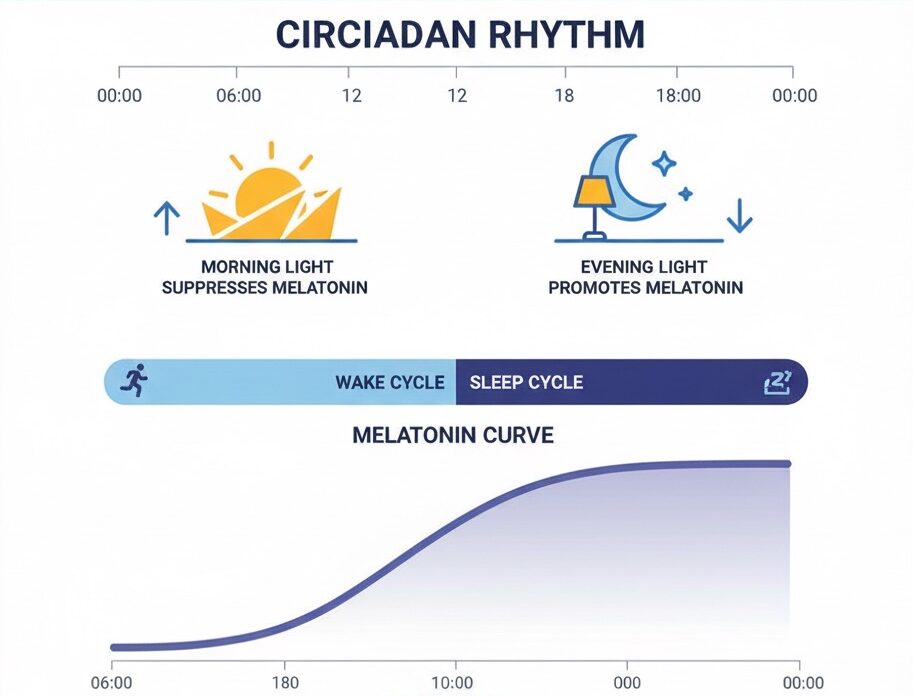
Light is the primary signal your body uses to orient its internal clock. Exposure to natural light — especially in the morning — resets the suprachiasmatic nucleus (SCN), the brain’s master clock. According to Harvard Health, this kind of light exposure is more effective than any supplement for resetting your cycle. It suppresses melatonin, increases alertness, and gives your body a clear “this is day” signal.
But it’s not just light. Timing of movement, meals, and social interaction all help your body decide when to feel alert — and when to start winding down.
A natural strategy for resetting your clock
You don’t need a strict regime or radical shift to get back in sync. A few gentle, consistent signals will help your body adjust at its own pace. This approach is rooted in the idea of circadian entrainment — aligning your biology to external cues.
Begin with the morning. That’s your foundation. As we covered in Sleep anchoring: how fixed wake-up times reset your body clock, waking at the same time each day gives your brain a reliable anchor. Once you wake, spend time outside — or near a window — for at least 15–30 minutes. Even cloudy skies provide enough brightness to trigger a biological reset.
Add movement. A short walk or light mobility sequence outdoors helps reinforce the “day has started” message. It also supports natural cortisol rhythm, which should peak in the morning. If possible, delay caffeine by 60–90 minutes to support this natural process.
Food also plays a role. Your digestive system follows a circadian rhythm too. Eating a light, protein-rich breakfast within a couple of hours of waking helps reinforce your new schedule. Shift your meals to local time, even if you’re not hungry at first — your metabolism will catch up.
These cues — light, wake time, movement, food — build a scaffolding for your body to reorganize itself. They don’t need to be perfect. Just consistent.
What to do when the evening doesn’t match your rhythm
Falling asleep is often the hardest part of adjusting to a new time zone. Your brain may still be operating on your previous schedule, producing alertness hormones late into the night. Trying to “force sleep” usually doesn’t work — but creating an environment that supports natural sleep onset does.
Start winding down 90 minutes before your new target bedtime. This can include dimming the lights, turning off bright screens, and moving into quiet, tactile activities. In The role of body scanning in reducing nighttime overthinking, we explore how shifting attention away from the mind and into the body helps ease the nervous system into a calmer state.
Avoid heavy meals late at night and limit alcohol, which can fragment REM sleep and delay your ability to reach deeper stages of rest. Even though it’s tempting to unwind with a glass of wine or stay up watching movies, these patterns make it harder to truly reset.
If you can’t fall asleep on time the first night, don’t stress. What matters more is that you wake at your planned time the next day and repeat your morning cues. As we shared in The 90-minute sleep cycle trick, sleep regularity improves quality — even if duration temporarily drops.
What the science says about timeline
Most people need 1 day per time zone crossed to fully adjust without help. So, if you travel from San Francisco to London (8-hour difference), it might take a full week to feel completely synced. But with light exposure and meal-timing strategies, you can often shorten that window.
According to a CDC guide on body clock disruption, travelers who structure their mornings with consistent wake times and daylight tend to recover faster. Timing is everything — and your body responds best to small, repeated nudges.
For daylight saving shifts or milder timezone changes, 2–3 days is often enough to reorient the system — especially when you prioritize light and reduce evening stimulation.
The role of melatonin — when and how it helps
Melatonin is often seen as a quick fix for jet lag or time change fatigue. But while it can help shift your internal clock, its effectiveness depends heavily on timing and context.
Melatonin is a hormone your brain naturally produces in the evening, in response to darkness. Its release signals the body that it’s time to wind down. When taken as a supplement, it can help nudge your circadian rhythm forward or backward — depending on when you take it, and in what dose.
If you’ve traveled east and need to fall asleep earlier than usual, taking a small dose (0.3–1 mg) 2–3 hours before your intended bedtime can help. It’s important not to take it too late in the evening, as that can interfere with natural melatonin production. If you’ve traveled west and want to delay your rhythm slightly, the timing shifts — usually melatonin is unnecessary, as light exposure in the evening is more helpful.
The Sleep Foundation offers a helpful guide to how melatonin works with circadian realignment, and the National Institutes of Health breaks down studies on its use for jet lag in this review.
Still, melatonin should not be used as a crutch. It works best when used alongside other environmental cues — morning light, activity, meal timing — and not as a substitute for them. Think of it as a temporary assistant to the body’s natural rhythm, not a replacement.
How long does it take to fully reset?
The time it takes to realign your circadian rhythm depends on:
How many time zones you crossed
Whether you traveled east or west
Your baseline sleep habits and flexibility
How consistently you apply the right cues
As a general guideline, your body typically adjusts at a rate of 1 hour per day when traveling east, and a little faster when traveling west. If you’ve shifted by 6 hours, expect about 5–7 days before you feel fully settled.
Interestingly, research from the Centers for Disease Control shows that people with structured wake times and healthy sleep pressure can sometimes adapt in as few as 3 days — especially if they use strategic light exposure and limit variability.
We’ve explored this concept in depth in our post on “sleep anchoring”, which outlines how fixed wake-up times can stabilize the rhythm more quickly than changing bedtimes alone.
The most common mistakes
In the effort to reset quickly, it’s easy to make choices that unintentionally delay your recovery. Here are a few subtle patterns that often go unnoticed:
Sleeping in to “catch up” — while tempting, this can confuse your clock further. Instead, stick to your target wake time and allow your body to build sleep pressure naturally.
Using alcohol or heavy meals late at night — both can disrupt REM sleep and push your circadian rhythm later, even if you fall asleep fast.
Spending mornings indoors or in dim light — natural light is non-negotiable. Without it, your brain won’t know it’s day.
Overusing caffeine in the afternoon — which can delay melatonin onset, making it harder to shift earlier.
Skipping wind-down time — trying to “go to bed” without transitioning into it leaves your mind too active.
If you’re struggling, revisit the basics: light in the morning, calm in the evening, consistent timing, and gentle patience.
Our article on weekend jet lag offers deeper guidance on managing subtle schedule shifts without disrupting your internal clock.
What if you’re always shifting time zones?
Some people live in a near-constant state of time dislocation. Flight attendants, international business travelers, and remote workers operating across global time zones often face ongoing rhythm instability.
In these cases, instead of resetting to a new schedule every time, it can be helpful to establish a “base rhythm” — a default sleep-wake window that works across most locations. This may not align perfectly with local time, but it reduces the shock of repeated full adjustments.
Support that rhythm with tools like:
Blue-light blocking glasses in the evening
Light therapy lamps in the morning (especially in dim environments or northern latitudes)
Portable white noise or pink noise devices to improve sleep consistency (explored in our comparison: white noise vs. pink noise)
Calming wind-down rituals, including techniques like “sleep counting” or body scanning
The goal is not perfection — it’s minimizing disorientation and offering your system enough stability to maintain restorative sleep, even in flux.
A gentle daily reset routine (example)
If you’ve just returned from travel or your clocks have changed, here’s what a soft day-one recovery plan might look like:
7:30 a.m. — Wake up at your target time, get sunlight or use a lamp, do light stretching
8:00 a.m. — Eat a light, protein-rich breakfast
12:00–1:00 p.m. — Get outside again; walk or engage in gentle movement
2:00 p.m. — Optional nap (20–30 min) if extremely tired
6:00–7:00 p.m. — Light dinner; avoid caffeine or sugar afterward
8:00 p.m. — Begin wind-down: dim lights, reduce screens, journal or stretch
9:30–10:00 p.m. — Sleep; avoid trying to force it, but stay in a restful setting
Repeat this rhythm for 3–4 days, and your body will likely catch up. If you’ve crossed many zones, extend the process gently, allowing time for adaptation.
Final thoughts — let rhythm lead
You don’t need to force your body to reset overnight. In fact, pressure often backfires. What your circadian rhythm craves is consistency, clarity, and signals — not control.
Travel and time changes will always disrupt the balance briefly, but with light in the morning, a softened landing in the evening, and conscious transitions throughout the day, your body will find its way back.
Instead of fighting your biology, let it recalibrate on its terms — and support it with tools, not expectations.
The rhythm will return.
It always does.