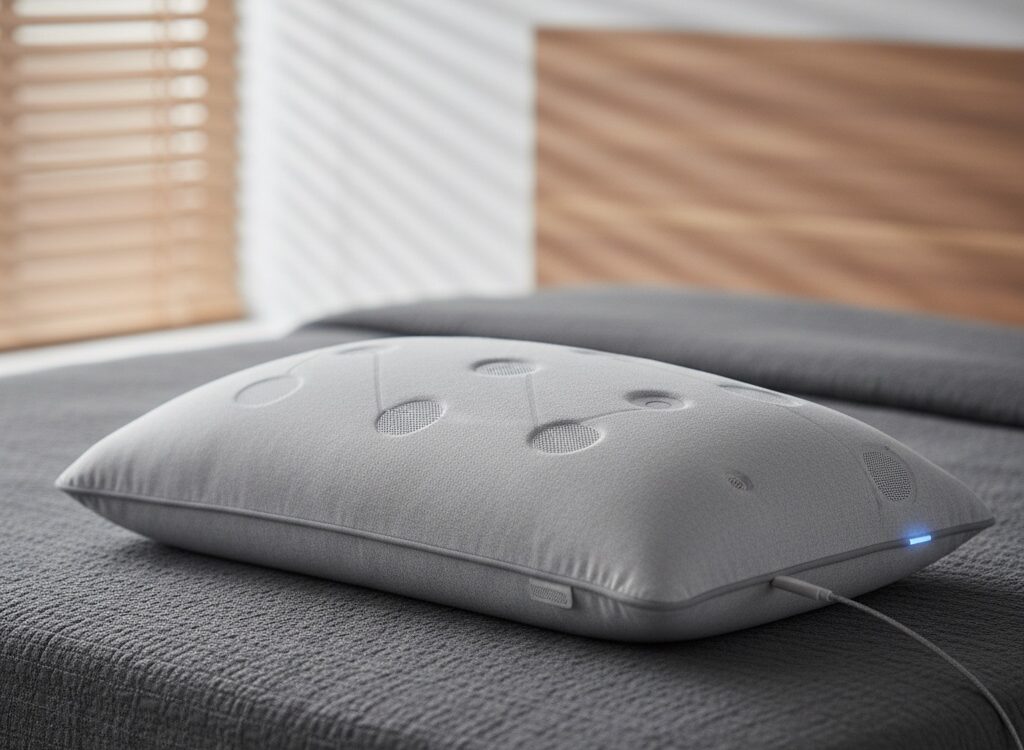
Most of us think sleep begins at night — when we dim the lights, silence our phones, and close our eyes.
But in reality, your sleep starts in the morning.
Specifically, it starts with the time you wake up.
Waking up at the same time every day might seem like a small habit, but it’s actually one of the most powerful tools for stabilizing your sleep-wake rhythm. This is the idea behind “sleep anchoring” — using a consistent wake-up time to regulate your body’s internal clock.
In this article, we’ll explore what sleep anchoring means, why it matters more than bedtime, and how just one fixed point in your day can transform your nights.
What is “sleep anchoring”?
Sleep anchoring is the practice of choosing one consistent moment in your 24-hour rhythm and making it non-negotiable — usually your wake-up time.
Think of it like tying a boat to a dock. No matter how stormy the water is (late nights, stress, travel), the boat stays near its base. In the same way, anchoring your wake-up time gives your body clock a fixed reference point — a stable rhythm to orient around, even when everything else fluctuates.
This technique comes from chronobiology, the science of biological rhythms. Instead of forcing a strict bedtime, it focuses on consistency in when your day begins, trusting that regularity will ripple backward into the night.
Why wake-up time matters more than bedtime
You’ve probably been told to “go to bed earlier” if you’re feeling tired. But bedtime is surprisingly difficult to control directly — especially when stress, late meals, screens, or racing thoughts are involved.
Wake-up time, on the other hand, is:
-
More measurable
-
Easier to control with an alarm or external cue
-
More influential in setting circadian rhythm
Here’s why:
-
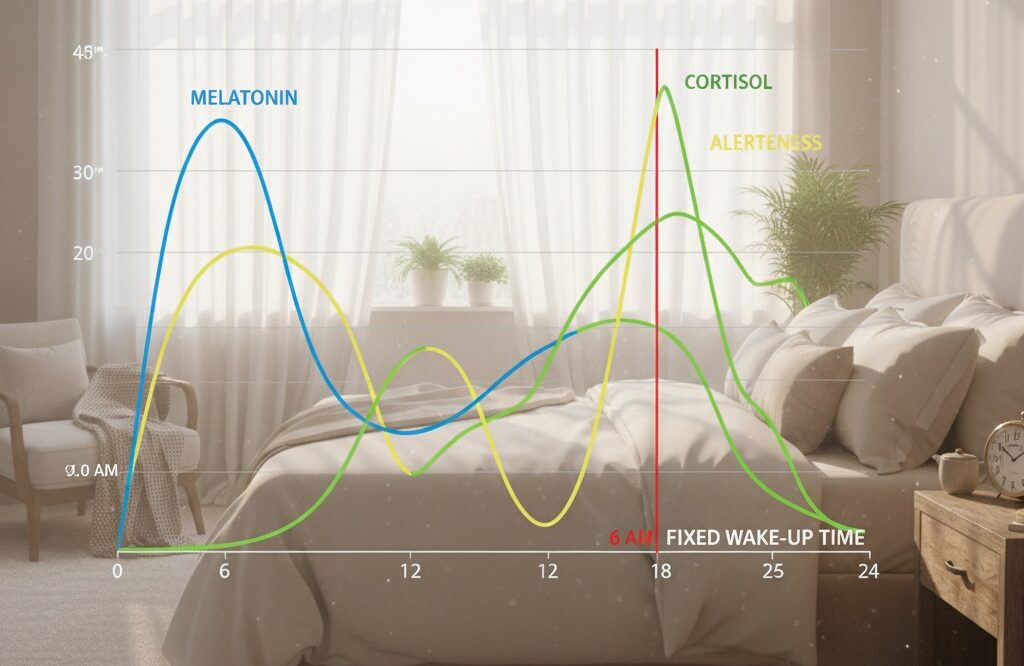
Morning light exposure resets your body clock. The moment you open your eyes and receive light — especially natural light — your brain begins a new 24-hour cycle. This exposure suppresses melatonin, increases cortisol in a healthy way, and sets the countdown for your next melatonin release at night.
-
Fixed wake time = consistent sleep pressure. When you get up at the same time, your brain builds up “sleep pressure” more predictably across the day. This makes it easier to feel sleepy at the right time in the evening — rather than tossing and turning.
-
It’s easier to shift downstream than upstream. While you can’t force yourself to fall asleep, you can wake up at a chosen time — and let your body gradually adapt in response.
That’s why sleep specialists often say:
“Don’t chase an earlier bedtime — anchor your morning first.”
The science of circadian entrainment
Your body’s internal clock (the circadian rhythm) runs on a roughly 24-hour cycle. But it’s not perfect — it needs external cues, called zeitgebers (German for “time-givers”), to stay aligned with the actual day-night cycle.
The most powerful zeitgebers are:
-
Light (especially blue-enriched morning light)
-
Temperature changes
-
Eating patterns
-
Social interaction
-
Movement and physical activity
But perhaps the most overlooked zeitgeber is your wake-up time.
When you wake up consistently, your entire biological system — hormone secretion, digestion, mental alertness, body temperature — begins to sync around that anchor.
Studies show that people who maintain a regular wake-up time report:
-
Shorter sleep onset latency (they fall asleep faster)
-
Deeper sleep and more stable REM cycles
-
Reduced symptoms of insomnia or early waking
-
Better mood, energy, and focus during the day
The opposite is also true. Irregular wake-up times (especially sleeping in on weekends) are linked to:
-
Increased social jet lag
-
Circadian desynchronization
-
Greater risk of metabolic issues, mood disorders, and fatigue
We covered this in detail in our article “Weekend jet lag: how to recover from social sleep debt”, where even two hours’ difference between weekday and weekend wake-up times can confuse your internal clock as much as flying across time zones.
“But what if I didn’t sleep well?” — the paradox
Here’s the mental block many people face:
“If I had a bad night’s sleep, shouldn’t I sleep in to recover?”
It’s an understandable instinct — but it actually works against your long-term rhythm. While one day of extra rest might help acutely, frequent variations in wake-up time confuse your circadian system and make future sleep harder.
Sleep anchoring teaches you to wake up at the same time, even after a short night. You’ll feel groggy, yes — but your body will build stronger sleep pressure during the day and recover better the next night.
In other words:
-
Consistency builds rhythm
-
Rhythm builds depth
-
Depth restores energy
This principle is especially useful for those dealing with delayed sleep phase, insomnia, or inconsistent work schedules.
If you feel tempted to sleep in, try this instead:
-
Get up at your usual time
-
Take a short nap (ideally 20–30 minutes, as we explored in NASA’s nap optimization)
-
Expose yourself to bright light
-
Stick to your evening wind-down
This keeps the rhythm intact while giving you some recovery.
How long does it take to work?
Like all habit changes, sleep anchoring takes time. Your circadian rhythm may need 5 to 10 days of consistency before your body fully adjusts.
The first few days may feel worse — especially if you’ve been relying on late mornings to catch up. But with consistency, most people notice:
-
Falling asleep earlier without trying
-
More refreshing mornings
-
Fewer night awakenings
-
Stable energy during the day
This process is called circadian entrainment — when your internal rhythm syncs to your external cues.
How to choose a realistic wake-up time
Sleep anchoring only works if your anchor is sustainable. That means:
You can stick to it every day (including weekends)
It allows for enough total sleep time (ideally 7–9 hours)
It matches your real-world schedule as closely as possible
If your current wake-up time is inconsistent or overly late, don’t rush to shift it drastically. Instead, choose a wake-up time that feels neutral — not too ambitious, not too lazy — and stick with it for 7 days before adjusting.
If you’re a night owl or struggling with delayed sleep phase, start with small changes (15–30 minutes earlier) every few days. Sudden shifts can feel punishing to your system and may trigger sleep resistance.
How to shift your anchor (gently)
Sometimes life requires a change in rhythm — a new job, a trip, or a health reset. In those cases, here’s how to shift your wake-up anchor smoothly:
Adjust in 15–30 minute steps every 3–4 days
Expose yourself to bright natural light within 30 minutes of waking
Avoid naps during transition days, unless absolutely necessary
Wind down consistently, even if you’re not sleepy yet
Use low-dose melatonin temporarily (under medical guidance) if needed
This method supports your circadian system while avoiding the shock of sudden schedule overhauls.
What if your schedule isn’t consistent?
Not everyone has the luxury of a stable 9-to-5 lifestyle. Shift workers, parents, and travelers often face unavoidable variability.
In those cases, you can still practice “soft anchoring.”
Here’s how:
Set a wake-up window, not an exact time (e.g. between 7:00–7:30 a.m.)
Choose one or two “anchor days” each week that are consistent
Build in anchor cues beyond time — like waking to the same sound, light, or scent (see: “The one sensory cue” rule)
Use sleep hygiene strategies to keep your wind-down routine stable, even if wake-up time shifts
Sleep anchoring is a tool — not a test. The goal is stability, not perfection.
Weekend temptations and the “social jet lag” trap
Let’s talk about Saturday and Sunday.
Sleeping in “just a little” feels harmless — and sometimes it’s needed. But a consistent +90-minute delay can shift your body clock as much as flying two time zones west. That’s why many people feel groggy on Monday morning — not because they didn’t sleep, but because their rhythm is off.
To avoid this:
Stick to your wake-up anchor ±30 minutes, even on weekends
Take a midday nap if you need extra rest
Use bright morning light, movement, or gentle cold exposure to reset your system
Don’t punish yourself — just return to your anchor the next day
You can learn more in our article on weekend jet lag, where we explore how to repair circadian drift without losing flexibility.
Common pitfalls to avoid
Even with good intentions, sleep anchoring can go sideways if we’re not mindful of these traps:
1. Being too rigid, too fast
Starting a new schedule with a 2-hour shift and military discipline may backfire. Your body doesn’t respond well to extremes. Think in gradients, not leaps.
2. Ignoring evening cues
Waking at the same time is powerful — but evening wind-down still matters. If you’re staying stimulated past 11 p.m., anchoring won’t fix everything. Use body scanning or calming rituals to help the mind ease off.
3. Overcompensating with caffeine
If you’re groggy in the first week of anchoring, it’s normal — but don’t push through with triple coffee. Overuse of stimulants can mask sleep debt and delay your evening drowsiness.
Try: light movement, hydration, bright light exposure, and gentle patience.
How to reinforce your morning anchor
Beyond setting an alarm, you can use rituals and cues that train your brain to recognize “this is the start of the day.”
Try adding one of these within 30 minutes of waking:
Natural light exposure — open blinds, step outside, or use a light therapy lamp
Scent trigger — peppermint, citrus, or eucalyptus help alertness
Movement — gentle stretching, walk, or mobility warm-up
Hydration + protein — a simple breakfast can align energy rhythms
Consistent audio — same song, playlist, or chime that cues “wake mode”
The goal is not just to wake up — but to signal your body that the day has begun.
How sleep anchoring fits with other routines
Once you establish your wake-up anchor, it becomes the foundation for:
A predictable morning routine (see: Pre-sleep transitions and digital twilight)
A consistent wind-down window
Better timing of exercise, meals, and screen use
Aligning sleep cycles — like the 90-minute REM trick
It’s one decision that simplifies many others.
Final thoughts: the stability your brain craves
In a world of shifting inputs — news, tasks, worries, lights — your body craves rhythm.
It doesn’t need perfection. It needs one reliable signal that says:
“This is where the day starts. This is where safety begins.”
That’s what a fixed wake-up time does.
Sleep anchoring isn’t about controlling your whole day. It’s about giving your brain one unchanging cue — a safe place to return to, no matter how your night went.
It’s gentle. It’s biological. And when done consistently, it reshapes your nights from the ground up.
So tomorrow, when your alarm rings, pause and smile.
You’re not just waking up — you’re resetting your rhythm.
And that’s one of the kindest things you can do for yourself.