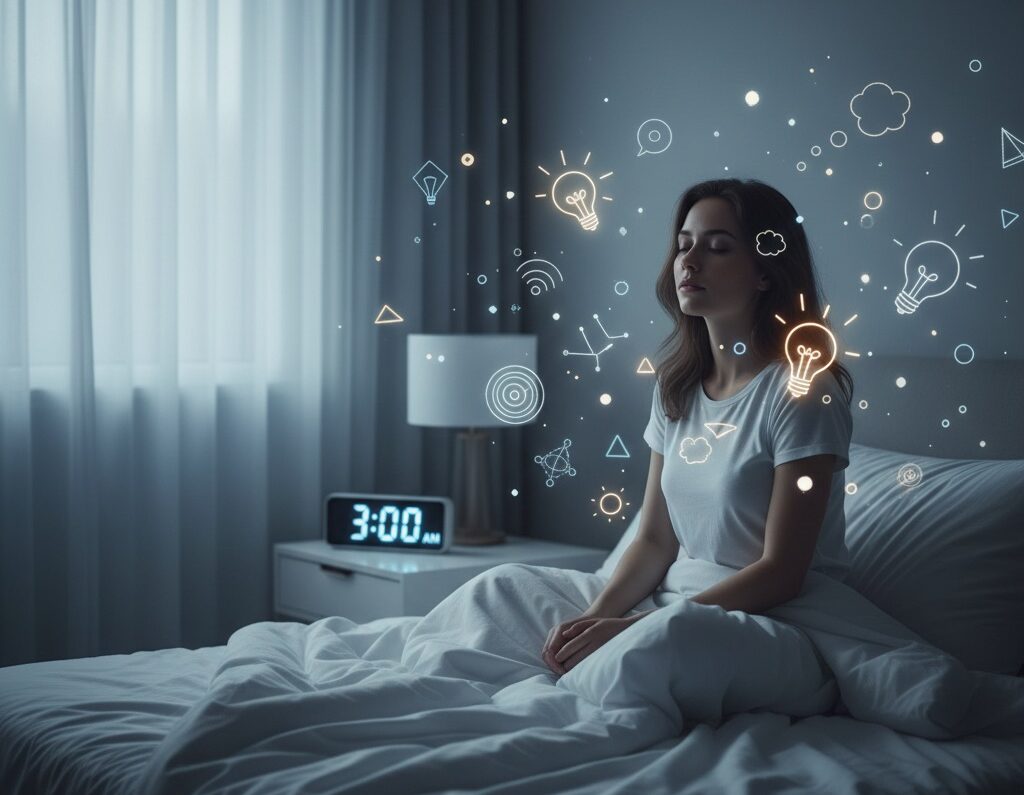
Nighttime creativity has a mysterious reputation. You may fall asleep feeling stuck, overwhelmed, or unsure about a project — only to wake at 3 a.m. with an idea that feels strangely brilliant. Or perhaps you’ve had moments when a solution “downloads” into your mind just as you drift off to sleep. Artists, scientists, musicians, and writers have shared similar stories for centuries.
And yet, this spark rarely feels random. In fact, modern neuroscience has a clear explanation for why the quiet hours of the night can unlock ideas that stay inaccessible during the day. When the brain transitions into its nocturnal rhythm — lighter sensory load, slower brainwaves, freer associations, reduced inhibition — creativity is not only possible, but more likely to emerge.
Understanding how sleep reshapes memory, loosens mental filters, and reorganizes information can help you make sense of this experience. More importantly, it can help you use your nighttime mind more intentionally, without letting it turn into overthinking or nocturnal stress.
This article explores the science behind nighttime creativity, why the 3 a.m. window is unique, and how to work with these moments instead of fighting them.
The quiet brain: why creativity rises when the world sleeps
During the day, the brain is bombarded with input — messages, screens, conversations, minor decisions, background noise. Your cognitive bandwidth is consumed by processing, managing, and filtering. Creativity struggles to thrive in this mental environment.
But at night, the world goes dark and your sensory field narrows. This shift triggers a state that neuroscientists call reduced cognitive interference: fewer distractions, fewer expectations, and fewer social filters. With less noise from the outside world, your mind is free to explore connections without constraint.
This aligns with the Sleep Foundation’s explanation of how relaxation states reduce mental friction.
Your brain is not trying to “perform.” It’s wandering — and wandering is fertile ground for creativity.
Why 3 a.m.? The brainwave explanation
Although the exact timing varies from person to person, the early-morning window often overlaps with light sleep stages or brief awakenings between REM cycles. These states are ideal for spontaneous insight.
Here’s why:
1. Brainwaves slow — but not too much
During light sleep and transitions between sleep cycles, the brain shifts into a mix of alpha and theta waves. These same waves appear during daydreaming, flow states, and moments of intuitive thinking.
Theta waves, in particular, support:
associative thinking,
imagery,
emotional insight,
memory integration.
This is creativity’s neurological playground.
2. The prefrontal cortex relaxes its grip
This region — responsible for logic, self-censorship, and filtering ideas — becomes less active at night. With fewer mental “rules,” unusual connections emerge more easily.
Harvard Health notes that reduced cognitive control is one reason creative ideas surface when the mind relaxes.
3. Memory reorganizes itself
As the brain processes the day’s information, fragments from different domains mix together. A design concept might collide with a memory from childhood; a work problem might meet a melody you heard earlier. These collisions produce insights unavailable to your daytime mind.
This ties into emotional-cognitive processing described in our article Sleep anxiety and orthosomnia: when sleep tracking backfires.
When memory reorganizes, new meaning can emerge.
Hypnagogia, micro-awakenings, and the dream-creativity bridge
Creativity doesn’t happen only during sleep — it often emerges in the borderlands between wakefulness and dreaming.
This liminal state is called hypnagogia.
Famous creatives like Salvador Dalí and Thomas Edison used micro-naps to intentionally enter this state, because hypnagogia combines:
vivid imagery,
symbolic thinking,
relaxed logic,
light dream-like associations.
When you wake up at 3 a.m., you briefly pass through a similar state. The brain is loose enough to think abstractly but awake enough to form coherent ideas. This creates the perfect cognitive “sweet spot.”
How your emotional mind influences 3 a.m. creativity
While creativity can flourish at night, emotional content also becomes more accessible. This is because:
the amygdala (emotional center) stays active during sleep,
noradrenaline — a stress-related chemical — drops during REM,
memories are replayed with softened emotional charge.
This combination allows your brain to revisit problems with less intensity and more openness. It’s why some night ideas feel strangely wise or intuitive.
If you’ve ever experienced nighttime anxiety, this emotional openness also explains it. When the mind is quiet and filters are reduced, unresolved thoughts can rise — for better or for worse.
To manage this gently, pairing insights with grounding practices can help. A calm example from Calm Sleeply is the reflective approach explored in Evening reflection prompts that regulate your mood overnight.
Creativity and emotional clarity often travel together.
Daytime logic vs. nighttime intuition
During the day, you make decisions using structured, logical pathways. These pathways are efficient for problem-solving but not ideal for creative leaps.
At night, the rules loosen. Instead of linear thinking, you experience:
non-linear association,
intuitive pattern recognition,
emotional influence on ideas,
symbolic thinking,
blurred boundaries between memory and imagination.
This is the “3 a.m. intuition” effect — the mind pulls from deeper layers rather than surface-level reasoning.
When the brain loosens its grip: the cognitive science behind 3 a.m. ideas
One of the most striking features of night-time creativity is how effortless it feels. An idea that seemed unreachable during the day suddenly appears fully formed at 3 a.m., as if your brain had been quietly working in the background. Neurologically, this “effortlessness” has an explanation.
During late-night hours and early morning awakenings, the brain reduces executive control — the function responsible for analyzing, filtering, and dismissing ideas. At night, those filters soften. Thoughts that normally get rejected (“too strange,” “not realistic,” “not polished enough”) are allowed to surface.
This softening aligns with what creativity researchers call hypnopompic cognition — the mental phase when you transition from sleep toward wakefulness. In this state, the brain blends dream logic with waking insight, generating ideas that feel intuitive rather than forced.
A 2021 neurology review even showed that reduced prefrontal filtering during micro-awakenings correlates with increased access to associative memory networks — the same networks involved in creative problem-solving.
When your brain is no longer focused on output or task completion, it becomes surprisingly good at pattern-spotting, connection-making, and reframing.
Why emotional clarity rises at night
Late-night ideas aren’t only intellectual — they often feel emotional, almost revelatory. This happens because the brain processes emotional memories during sleep, especially during REM.
According to the Sleep Foundation’s review on REM sleep and emotional regulation, the brain performs a kind of emotional “digesting” during the night. When you briefly wake at 2 or 3 a.m., you temporarily interrupt that process — and catch a glimpse of the emotional insights emerging beneath the surface.
This is why nighttime creativity often has a tone of clarity or meaning. Your brain is not simply generating ideas; it’s reorganizing emotional context.
This also makes 3 a.m. ideas feel urgent. They aren’t always urgent — but they feel like revealed truth because they rise from a state where your emotional and cognitive networks overlap.
The downside: when nighttime creativity becomes rumination
Of course, not every 3 a.m. idea leads to a breakthrough. For some, nighttime awakenings trigger spirals of overthinking — not insight. This distinction is important.
Creativity feels expansive, curious, and often surprising.
Rumination feels repetitive, heavy, and urgent.
The brain’s heightened emotional access can produce either experience. The difference often lies in nervous system state. When the nervous system leans toward calm, late-night awakenings produce fluid thought. When it leans toward stress, they produce worry.
If you notice your nighttime awakenings tilting toward tension, integrating one or two grounding elements before bed can help. A simple approach is a slow breathing technique like the one described in our article Deep breathing for better sleep: a simple nighttime technique.
Winding down your body helps influence the tone of your nighttime mind.
How to capture nighttime ideas without disrupting sleep
The challenge with nighttime creativity is simple: insights arrive when your body needs to stay asleep. Writing on your phone or getting out of bed may wake you further, while holding the idea in your mind rarely works.
Here are science-aligned strategies that protect sleep while preserving ideas:
1. Use a bedside voice recorder (no screen, no light)
A small, analog-style recorder allows you to speak an idea in 4–6 seconds and fall back asleep without activating the visual cortex.
2. Keep a dim-light notepad
Using an amber or red low-intensity light allows you to jot a few keywords. Harvard Health’s guide on evening light exposure explains why avoiding blue wavelengths is essential for maintaining melatonin production.
3. Use a “keyword method” instead of full sentences
Your 3 a.m. brain doesn’t need full grammar. A few anchor words are enough to re-trigger the idea in the morning.
4. Return to sleep with a grounding cue
After capturing the idea, place one hand on your ribcage and inhale slowly. This re-engages the relaxation response and helps prevent the brain from “latching on” to more ideas.
These methods flow beautifully into the routines described in Home sleep hacks: how to optimize your bedroom environment.
Together, they help you maintain creative access while protecting sleep quality.
How to encourage “healthy” nighttime creativity
If you want to work with your brain’s natural creative rhythm rather than against it, small adjustments throughout the day can help ideas feel less intrusive at night and more integrated.
Support your mind earlier in the day
A cluttered mind produces cluttered nighttime thought. A 3-minute journaling session or a short breathwork pause can decrease the mental load that spills into sleep.
Give your brain space for creative wandering before bed
Light daydreaming, slow reading, or listening to gentle audio gives your mind a soft landing zone. Creativity thrives when not forced.
Let your nervous system downshift gradually
Nighttime creativity becomes disruptive when the nervous system is still “in gear.” The simple hot-cold balancing techniques outlined in
Cold and hot therapy for better sleep: how and when to use them.
Avoid harsh self-judgment of late-night ideas
Some ideas that feel profound at 3 a.m. will still be brilliant at 9 a.m. Others will not. That’s part of the process. Creativity is iterative, and nighttime thought is just one input.
The morning-after effect: integrating insights
Not all nighttime insights hold their shape in daylight, but many do — they just need gentle refinement. Here’s how to transition them into your waking creative process:
1. Review with curiosity, not urgency
Approach your notes slowly. Your daytime brain will add structure, while your nighttime brain supplied novelty.
2. Look for emotional patterns
Nighttime ideas often reveal emotions you didn’t articulate during the day. Notice themes: resistance, desire, clarity, fatigue, longing.
3. Turn the insight into a single action
A 3 a.m. idea may feel huge. But often, its actionable version is small. Reduce it to one manageable next step.
4. Keep a “creative residue” folder
Some thoughts aren’t immediately useful, but they shape future ideas. Collect them without pressure.
This approach mirrors what researchers call creative integration — allowing the intuitive and analytical parts of the brain to collaborate.
Why honoring nighttime creativity matters
Instead of dismissing nighttime ideas as random or inconvenient, you can see them as a signal: your mind is still working, reorganizing, synthesizing.
Nighttime creativity shows that the brain is:
metabolizing emotions,
reorganizing memories,
linking thoughts,
searching for meaning,
and exploring possibilities.
It’s doing what it’s designed to do.
And instead of trying to suppress that process, the goal is to work with it — to create conditions where the brain’s late-night creativity feels supportive, not overwhelming.
Sleep doesn’t silence creativity; it releases it.
Dreamlike thinking opens doors that daytime logic often keeps closed.
When you understand this rhythm, you begin to trust that the ideas arriving at 3 a.m. aren’t interruptions — they’re invitations.
Conclusion: honoring the quiet imagination
Creativity is not a daytime phenomenon. It moves in cycles, woven into the same rhythms that guide your sleep. The insights that arrive at 3 a.m. are expressions of a mind unburdened by productivity or performance — a mind that is finally free to think without constraints.
When you create a restful environment, practice gentle wind-down routines, and learn to capture ideas without fully waking, you give yourself access to one of the most surprising and rewarding parts of the human experience: the imagination that awakens when the world goes quiet.
Nighttime creativity isn’t a disruption.
It’s a whisper from the deeper layers of your mind — the ones that speak only when the rest of life softens.