
For many people, the idea of better sleep means simply getting more hours. It feels logical: the longer we sleep, the more rested we should feel. Yet research and real-life experience suggest a different truth — that when you sleep can matter just as much as how long you sleep.
The concept of sleep consistency—going to bed and waking up at roughly the same time every day—has gained increasing attention in sleep science. It turns out that a predictable rhythm may do more for your energy, focus, and emotional balance than extra hours of fragmented sleep.
This article explains why sleep consistency matters, how it compares to total duration, and how to maintain it in daily life.
Understanding sleep consistency
Sleep consistency means maintaining regular sleep and wake times throughout the week, including weekends. It does not require perfection, but it relies on stability.
Your body operates on a 24-hour internal clock known as the circadian rhythm. This biological system regulates hormone release, digestion, temperature, and alertness. When you go to sleep and wake up at consistent times, your circadian rhythm synchronizes with the outside world.
This synchronization makes it easier to fall asleep, improves sleep quality, and enhances energy during the day. When the schedule fluctuates—staying up late on some nights and waking early on others—the circadian rhythm loses alignment. The result is slower adjustment in hormone cycles, delayed alertness, and lower overall energy.
How irregular sleep affects your body
Even small changes in bedtime and wake time can have significant effects. A one-to-two-hour difference is often enough to confuse the body’s timing. Researchers describe this phenomenon as social jet lag—a mismatch between your biological time and your social schedule.
When sleep is irregular:
Melatonin production becomes inconsistent, making it harder to fall asleep at a normal time.
Cortisol, which supports morning energy, may rise too late or too early, leading to grogginess or restlessness.
Blood sugar and appetite hormones fluctuate, increasing cravings for caffeine and quick energy.
Focus and emotional stability decrease as the brain struggles to regulate stress responses.
The overall effect is familiar: feeling tired despite “enough” sleep. Irregular sleep patterns interfere with the deep restorative phases that restore cognitive and physical energy.
Sleep duration and why it still matters
Duration remains important—most adults require between seven and nine hours of sleep to function optimally. However, the relationship between sleep length and restfulness is not always linear.
Two people may sleep the same number of hours but experience different levels of recovery. The difference lies in sleep architecture—how much time is spent in deep and REM stages. Consistent sleepers tend to move smoothly through these cycles, while irregular sleepers experience more interruptions and lighter sleep.
If bedtime changes frequently, the body struggles to enter deep stages at the right time, reducing sleep efficiency. This means that even eight hours of irregular sleep can leave you feeling less refreshed than seven hours of consistent, high-quality rest.
What research shows about consistency versus duration
Recent studies confirm that regular sleep timing often predicts better daytime performance than total hours of rest.
A 2021 Harvard Medical School study found that university students with irregular sleep schedules had lower alertness and slower reaction times, even when they slept the same number of hours as their peers with consistent routines.
Similarly, data from the Sleep and Health Research Program at the University of Arizona showed that inconsistent sleepers reported more fatigue and poorer mood stability, independent of total sleep duration.
Consistency helps because it strengthens circadian alignment—the coordination of internal biological processes with external cues such as light and temperature. When this alignment is maintained, energy levels remain stable throughout the day, and sleep becomes more restorative.
The limits of “catching up” on weekends
Many people try to recover lost sleep during weekends. While this may temporarily reduce fatigue, studies show that “recovery sleep” does not fully correct circadian misalignment.
A 2022 paper in Current Biology found that participants who slept longer on weekends still showed disrupted metabolic and hormonal patterns. Energy improved briefly but declined again within days.
The conclusion is clear: consistency protects long-term energy better than irregular cycles of deprivation and recovery. The body values rhythm more than compensation.
How to build consistency in real life
Maintaining a regular sleep schedule can be challenging in modern routines, but it is possible with gradual adjustments. The goal is to support stability, not strict discipline.
1. Establish a sleep window
Instead of a fixed bedtime, aim for a 30-minute window (for example, between 10:00 and 10:30 p.m.). The same flexibility applies to wake-up time. This allows for daily variation while keeping your circadian rhythm stable.
2. Use light as your primary cue
Light is the strongest regulator of your body clock.
Expose yourself to natural light within 30 minutes of waking—step outside, sit by a window, or go for a short walk. In the evening, reduce bright or blue light at least an hour before bed by dimming lamps or using warm tones.
3. Keep meals and caffeine consistent
Eating at regular times helps your circadian system stay synchronized. Try to finish dinner at least two to three hours before sleep and avoid caffeine after mid-afternoon. Late caffeine or irregular meal times can delay melatonin production.
4. Create a repeatable pre-sleep routine
Performing the same short sequence each night helps signal to your brain that rest is approaching. It could include light stretching, skincare, reading, or a short breathing exercise. Repetition matters more than duration.
5. Manage occasional disruptions
Travel, work changes, or social events will sometimes shift your schedule. If you stay up late, wake close to your normal time and add a short daytime nap if needed. Exposing yourself to morning light the next day will help realign your rhythm faster than sleeping in for hours.
How consistent sleep improves energy and focus
Consistency creates predictability for your body, which in turn improves energy efficiency. When your internal systems anticipate sleep and waking times, they prepare in advance: melatonin rises earlier, core body temperature drops on schedule, and cortisol increases smoothly before morning.
People who maintain regular sleep timing often report:
Shorter sleep onset latency (falling asleep faster)
Fewer nighttime awakenings
Greater morning alertness without relying on caffeine
Better concentration and mood stability during the day
This effect is cumulative—the longer you maintain regular timing, the stronger the benefits become.
Balancing consistency with flexibility
Rigid schedules can be counterproductive. The goal is to stabilize patterns without creating stress.
Small variations—up to one hour—are unlikely to cause harm. What matters is your weekly average, not daily perfection.
If you occasionally sleep later, adjust gradually over the next few nights rather than resetting dramatically. This maintains your biological rhythm without pressure.
Consistency should feel supportive, not restrictive. When applied gently, it improves both physical energy and psychological ease.
The bottom line
Sleep duration and sleep consistency are both essential, but they serve different purposes.
Duration provides the quantity of rest your body needs to repair and restore. Consistency ensures that this rest occurs in alignment with your biological clock, making every hour more effective.
If you must choose between slightly less sleep at a stable time or longer, irregular nights, science increasingly favors stability.
Energy is not built through occasional long nights of sleep but through regular patterns that teach the body when to rest and when to rise.
By maintaining predictable sleep and wake times, you create a foundation for steady energy, mental clarity, and emotional balance—without needing more hours in bed.
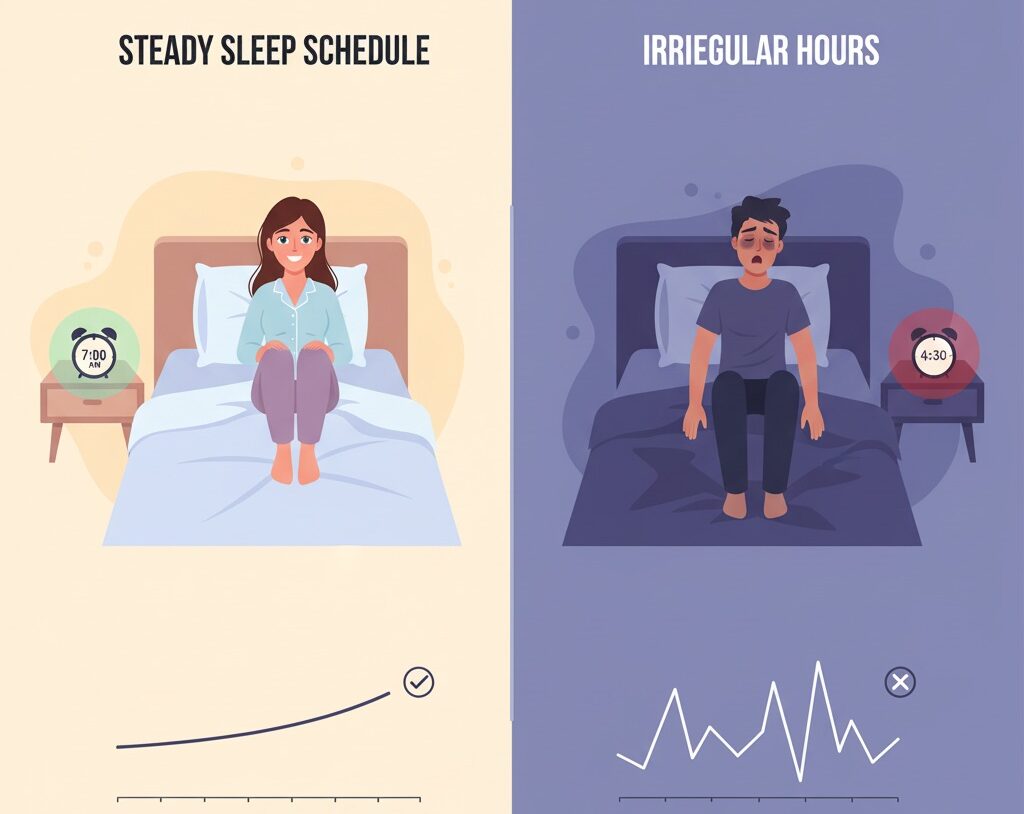
How sleep consistency influences long-term health
Sleep regularity affects more than how awake you feel in the morning — it has measurable consequences for long-term health.
Recent studies link consistent sleep timing to better cardiovascular and metabolic outcomes. Irregular sleep patterns, by contrast, have been associated with elevated blood pressure, increased risk of insulin resistance, and higher inflammation markers.
These effects occur because the body’s internal systems — hormone release, glucose regulation, digestion, and immune function — follow a daily rhythm. When sleep times shift frequently, these processes lose synchronization. For instance:
The release of insulin becomes less efficient, leading to energy crashes.
The digestive system remains active later into the night, reducing nighttime recovery.
Heart rate and blood pressure remain elevated longer than they should.
Maintaining regular sleep and wake times helps align all these systems, promoting steadier energy during the day and deeper recovery at night.
Why consistent sleep supports emotional balance
Sleep is also the foundation of emotional regulation. When your sleep schedule shifts dramatically, your limbic system — the part of the brain responsible for emotional responses — becomes more reactive.
Research from the University of California, Berkeley found that people who slept irregularly had higher activity in the amygdala, the brain’s “alarm center.” This overactivity leads to stronger stress reactions, irritability, and difficulty managing anxiety.
By contrast, regular sleep helps the prefrontal cortex communicate effectively with the amygdala. This connection promotes better impulse control, calmness, and clearer thinking.
The result is not only emotional stability but also greater resilience. People who follow consistent sleep patterns report fewer mood swings and are less affected by daily stressors — a benefit often underestimated compared to the focus on sleep duration alone.
How sleep duration interacts with consistency
It’s not a competition between the two. Sleep duration and consistency are complementary.
You need enough hours to support physiological recovery, but those hours are more effective when they occur predictably.
Think of consistency as the structure and duration as the content. You can’t build a strong routine without both, but one without the other quickly loses its benefit.
For example, someone who sleeps six and a half hours every night at the same time may feel more refreshed than another person who sleeps eight hours but shifts bedtime from 10 p.m. to 1 a.m. each night.
The consistent sleeper’s body anticipates rest, releases hormones efficiently, and transitions smoothly through the sleep stages. The irregular sleeper, however, spends much of the night readjusting internal rhythms — wasting energy that could have been used for restoration.
Building energy through rhythm, not quantity
One of the most overlooked aspects of sleep hygiene is how predictable rest creates efficient energy production. When your body learns your rhythm, it can prepare for sleep and waking in advance.
Morning readiness
Regular sleepers often notice that they wake up a few minutes before their alarm. This happens because cortisol begins rising gradually before your expected wake time, signaling alertness. When sleep is inconsistent, that signal arrives at unpredictable times, making mornings feel forced and groggy.
Daytime stability
Consistent sleepers maintain more even energy throughout the day. Instead of the sharp highs and lows caused by disrupted circadian patterns, they experience smoother focus and less afternoon fatigue.
Evening calm
A predictable routine teaches your nervous system to slow down naturally in the evening. Over time, melatonin release becomes automatic, helping you unwind without effort or supplements.
What happens when you reset your rhythm
The good news is that sleep consistency can be trained. Even if your schedule has been irregular for years, the body adjusts more quickly than most people expect.
Here’s how adaptation typically unfolds:
Week 1: You set consistent sleep and wake times. Your body resists slightly, and mornings may feel uneven.
Week 2: You begin falling asleep faster and waking more easily. Midday energy stabilizes.
Week 3–4: Hormones synchronize. You start to feel naturally sleepy at your target bedtime and more alert at the same morning time.
After one month: Your body clock becomes internally programmed, making rest automatic rather than forced.
Consistency is essentially teaching your body when to power down and when to activate. Once that cycle is established, maintaining energy feels effortless.
How to stay consistent while living a real life
Modern routines make perfect sleep schedules nearly impossible, but perfection is not required. What matters most is minimizing variability — keeping changes within a one-hour window whenever possible.
If you work late or travel frequently, focus on stable wake times instead of bedtime. Waking consistently each morning helps anchor your circadian rhythm even if the night before was shorter than ideal.
Other practical ways to stay consistent include:
Using morning light and gentle alarms to set a predictable start to the day.
Avoiding late-night screen exposure, which delays melatonin release.
Keeping weekends within one hour of your weekday schedule.
Prioritizing relaxing activities in the same order every night, so your body associates them with rest.
These cues act as external anchors, reminding your body when to sleep even if your environment changes.
Consistency and the future of sleep research
As technology advances, sleep science continues to highlight regularity as one of the strongest predictors of overall wellbeing. Wearables such as the Apple Watch, Oura Ring, and sleep-tracking apps now measure sleep regularity index (SRI) — a new metric that captures how stable your bedtime and wake times are across a week.
Researchers are exploring how improving this index may enhance metabolic health, productivity, and even longevity. Early findings suggest that consistent sleepers have lower inflammation markers and better heart rate variability, indicating more balanced nervous system function.
This emerging field suggests that the future of sleep improvement will not focus only on duration, but on stability as a form of recovery — a more sustainable path to energy than the “catch-up” mentality.
Better energy doesn’t come from sleeping the most; it comes from sleeping most consistently.
When your body can trust your routine, it performs with less effort. You wake clear-headed, handle stress more easily, and need fewer stimulants to stay alert.
Sleep consistency turns rest into rhythm — a pattern your body remembers and rewards.
The next time you think about improving your sleep, don’t start with “How many hours can I get?”
Start with “When can I sleep regularly?”
In the end, a steady rhythm restores more than energy — it restores balance.
Read also: