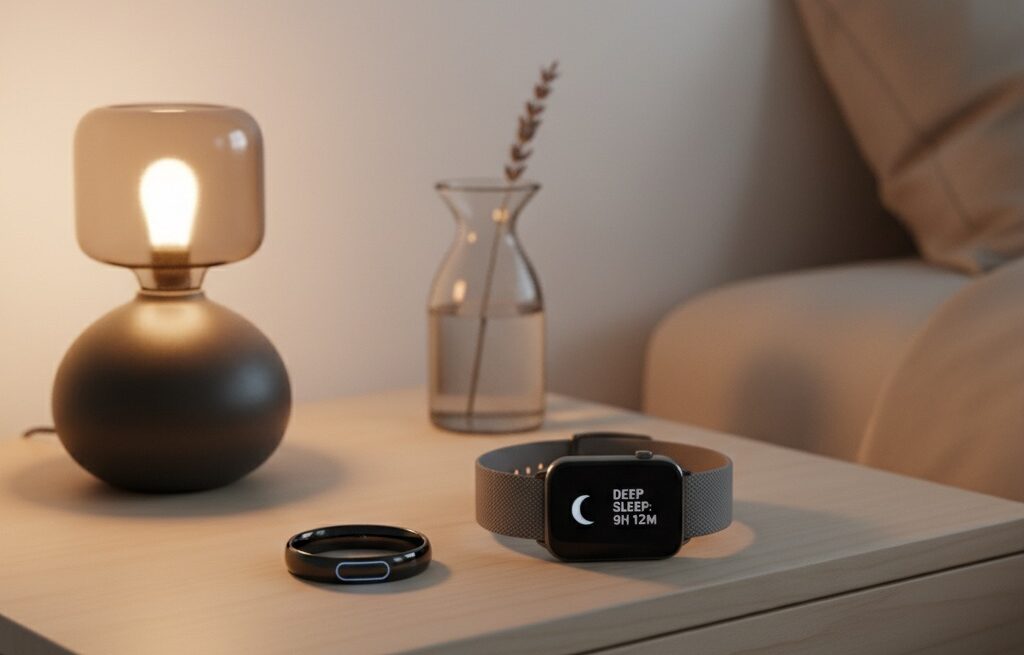
Sleep has moved from being a passive necessity to an active metric — something we monitor, quantify, and try to improve. It’s no longer just about feeling rested; it’s about sleep scores, readiness ratings, and deep vs. REM percentages. And at the center of this sleep-optimizing movement are wearable devices — particularly sleep rings and smartwatches.
Both claim to help you understand your nights better. Both offer data on your sleep duration, quality, heart rate variability (HRV), and recovery. But when the alarm goes off and you’re reviewing your night’s numbers, one big question remains: Which tracker gives more accurate, meaningful data for sleep — rings or watches?
What counts as “accuracy” in sleep tracking?
Before comparing devices, it’s helpful to ask: what does “accuracy” really mean in sleep tracking?
The gold standard of sleep analysis is still polysomnography (PSG) — a clinical test that records brain waves, eye movement, muscle activity, heart rhythm, and more. Consumer devices like rings and watches can’t match this level of precision. But they try to approximate it through sensors like:
PPG (photoplethysmography): to detect heart rate and oxygenation
Accelerometers: to detect motion and infer sleep/wake periods
Temperature sensors and HRV monitors: to estimate recovery and restfulness
What you’re really getting from a wearable is a probability-based picture of your night. It’s not 100% precise — but when used consistently, it can reveal patterns, habits, and trends that help you make better sleep choices.
As we discussed in The 90-minute sleep cycle trick, timing and rhythm matter deeply. So even if your device can’t perfectly detect every REM phase, it can help you understand when you’re most likely to benefit from waking — or when you’re cutting sleep short.
Why sleep rings are gaining popularity
Sleep rings, such as the Oura Ring and similar models, have surged in popularity for a few reasons:
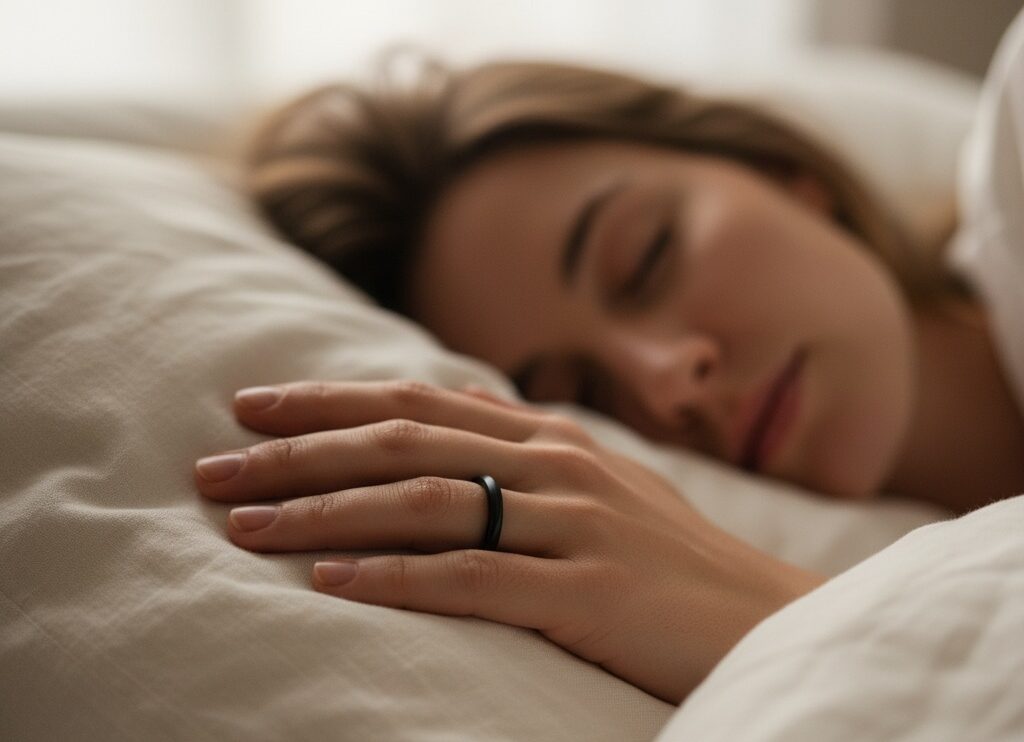
Minimalist and non-disruptive design. Unlike a bulky watch, a ring doesn’t move around your wrist at night or interfere with your sleep position. That alone makes it more appealing to side-sleepers and sensitive users.
Finger sensors offer a more stable signal. Because blood vessels in the fingers are closer to the surface, pulse and temperature signals tend to be clearer compared to the wrist — especially during still sleep periods.
Battery life and comfort. Many rings last up to a week on a single charge, and their lightweight form makes them almost unnoticeable. That improves consistency — and better consistency equals better data.
In a 2024 validation study comparing several consumer devices with lab-grade PSG readings (source), smart rings performed best in detecting total sleep time, sleep efficiency, and wake episodes. They also had better agreement on HRV and temperature variability — two key indicators of recovery quality.
Rings also tend to specialize in sleep and recovery, whereas smartwatches often split focus between fitness, notifications, and activity tracking. That narrower focus can mean more refined sleep algorithms and less data dilution.
Where watches still lead
Despite the growing praise for rings, smartwatches haven’t lost their appeal — especially when it comes to multifunctionality.
A smartwatch might not fit under your blanket as discreetly as a ring, but it does offer:
Continuous heart rate monitoring throughout the day and night
Workout and activity tracking, including GPS-based movement
Sleep plus stress plus fitness data, all in one ecosystem
Third-party integrations and health app syncing
If your goal is overall lifestyle optimization, not just sleep, a smartwatch can be a more comprehensive tool. Some modern watches, like the Apple Watch Series 9 or Garmin Venu 3, now include skin temperature, SpO2, and HRV tracking, which allows them to compete more directly with rings in terms of recovery insights.
However, it’s worth noting that wrist-based sleep data tends to fluctuate more due to movement and looser skin contact. That can result in lower sleep stage accuracy, particularly during light-to-deep sleep transitions. In studies comparing sleep stage breakdowns, watches were more likely to misclassify light and deep sleep compared to ring-based trackers (source).
Comparing key sleep metrics: ring vs. watch
Let’s break down how each type of wearable performs on commonly tracked sleep features:
| Metric | Sleep Ring | Smartwatch |
|---|---|---|
| Total sleep duration | High accuracy | Moderate to high accuracy |
| Sleep stage detection | Moderate (best in light/deep separation) | Variable (depends on brand/fit) |
| HRV tracking | High-quality nighttime data | Varies by model; more fluctuations |
| Temperature tracking | Stable finger-based readings | Moderate skin sensitivity at the wrist |
| Comfort during sleep | High (small, lightweight) | Medium (can disturb sensitive sleepers) |
| Battery life | 5–7 days | 1–3 days (typically less for Apple) |
| Fitness integration | Limited | Full (steps, workouts, GPS, etc.) |
In short: if you care primarily about overnight recovery, sleep stages, and consistency, the ring might edge ahead. But if you need a full picture of health behaviors, including activity and movement — the watch remains strong.
The subjective factor: how you feel still matters
One of the core messages of Calm Sleeply is this: data doesn’t replace intuition. Many users fall into the trap of orthosomnia — anxiety about not sleeping “well enough” based on their tracker’s report. But your body isn’t a spreadsheet.
In our article Nighttime anxiety and temperature sensitivity — the hidden connection, we explored how focusing too much on external metrics can actually disrupt internal sleep cues. This applies here, too.
Whichever device you choose — ring, watch, or none — the goal should be awareness, not obsession.
Real-world usage: who benefits most from each device?
Let’s make this more concrete. If you’re trying to decide which device fits your sleep lifestyle, it helps to look at real-world profiles — how different types of people engage with their sleep data.
The data-driven optimizer
This person already tracks meals, workouts, screen time, and mood. Sleep is just one more metric in the quantified-self toolkit. They may already use HRV trends to plan workouts and want to understand recovery in detail.
→ Recommendation: A sleep ring may be ideal — it offers recovery insights, high-fidelity HRV, and minimal disruption during rest.
The sensory-sensitive sleeper
This person is prone to nighttime awakenings, often adjusts pillows or blankets, and dislikes any wrist pressure. They may have mild insomnia or be experimenting with mouth taping or meditation.
→ Recommendation: Rings win here. They’re lighter, less distracting, and don’t interfere with movement. As explored in Does mouth taping really improve sleep?, small sensory details can significantly impact sleep depth.
The active lifestyle tracker
This person wants an all-in-one health companion. They care about steps, VO2 max, workouts, hydration reminders — and sleep is just one piece of the puzzle.
→ Recommendation: A smartwatch offers versatility. Though slightly less precise in sleep breakdowns, it provides a broader context for behavior change.
The anxious sleeper
This person is trying to sleep better but is also a bit overwhelmed. They may overanalyze their sleep score and feel worse after a “bad” night report.
→ Recommendation: Possibly no device — or use one with minimal feedback, like a ring with hidden displays or delay-view features. As discussed in AI-driven sleep coaching apps — can algorithms improve rest quality?, how data is delivered matters as much as the data itself.
How to use your sleep tracker wisely
Whichever device you choose, remember: the goal isn’t perfect data, it’s better patterns. Here’s how to make the most of your wearable without falling into the sleep-anxiety trap:
1. Look for patterns, not nightly judgments
Sleep fluctuates naturally. One rough night isn’t a failure. Instead, look at 7–14 day trends — are you getting to bed earlier, is your deep sleep increasing, are you waking more rested?
2. Use the data to reflect, not control
If you notice that screen time late at night drops your readiness score or reduces REM, you can gently adjust habits — like introducing pre-sleep transitions to ease into rest.
3. Don’t get hung up on “deep sleep” numbers
Consumer devices can’t reliably distinguish REM from light sleep with precision. Take these scores with curiosity, not panic.
4. Pair tech with body awareness
Use trackers as prompts for reconnection — not as substitutes for sensation. If your ring says you recovered well but you feel foggy, trust your body.
5. Avoid checking your sleep score first thing in the morning
Give yourself space to wake, stretch, hydrate — then, if you wish, glance at the data. But let your body tell you how you feel before your device does.
What wearables can’t do (and why that’s okay)
Despite all their advancements, sleep trackers remain limited. They:
Can’t measure brainwaves or muscle tone
Often miss micro-awakenings or sleep onset accurately
Don’t detect sleep disorders like sleep apnea reliably
Can’t replace the advice of a medical professional
If you feel persistently unrested despite “good” sleep scores, or suspect breathing interruptions, a proper sleep study is always recommended. Wearables are companions — not diagnostic tools.
The Sleep Foundation and Harvard Medical School both emphasize this: use these tools for awareness, not absolute truth.
Sleep rings vs. watches: what the science says so far
Recent comparative studies support the idea that rings tend to outperform wrist wearables in sleep-specific metrics like total sleep time, HRV, and sleep efficiency — largely due to their position on the body (better pulse reading) and focus on nighttime data.
Smartwatches, while catching up in many ways, still show more variance in sleep-stage scoring and are more prone to errors due to movement and loose fit.
A 2024 comparative study (PubMed) concluded:
Sleep rings showed “strong agreement” with lab PSG results on total sleep time and wake detection
Wrist devices were more likely to overestimate sleep, especially during long periods of lying still but awake
Neither type was reliable in detecting exact transitions between NREM and REM stages
So while both devices are helpful — the ring still edges ahead if sleep tracking is your primary goal.
Final thoughts: sleep, tech, and self-trust
In the end, choosing between a ring and a watch isn’t just about specs — it’s about how the device fits into your life. A tracker is only as useful as the mindset you bring to it.
Here’s what really matters:
Consistency over perfection
Trends over scores
Self-awareness over biohacking pressure
Wearables are amazing tools — but they don’t replace the body’s own wisdom. You still wake with a heartbeat, a breath, a sense of how rested (or not) you feel. Your device might confirm it — or not — but your body already knows.
Let your ring or watch be a gentle guide. But let your body lead.