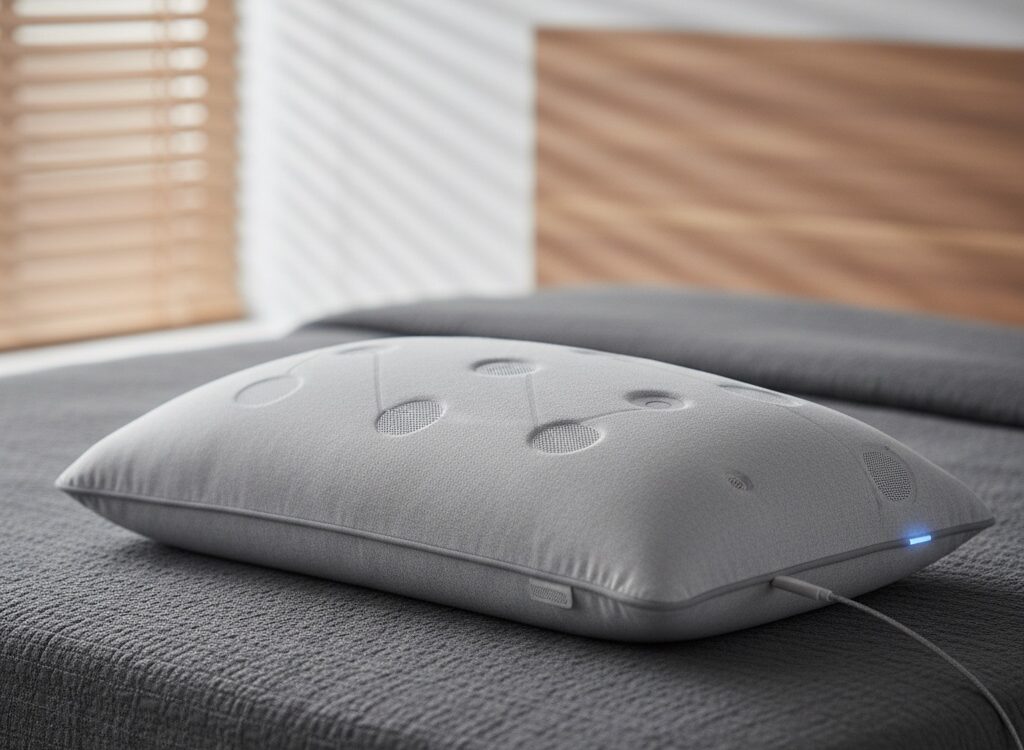
For years, the world of sleep technology has expanded around the body — rings, watches, apps, sensors, lighting. But now, it’s arriving directly under your head. Smart pillows promise to transform something deeply personal and analog — the pillow — into a hub for comfort and tracking, without requiring you to wear or charge anything else.
But do these high-tech pillows actually deliver? Or are they just another iteration of the quantified self — more data, more devices, and more things between you and rest?
In this review, we explore what smart pillows claim to do, how they work, what the evidence says, and how they compare to other sleep technologies.
What is a smart pillow?
A smart pillow is an enhanced version of a traditional pillow, embedded with technology designed to monitor, adjust, or influence your sleep in real time. While features vary by brand and model, most smart pillows offer a combination of the following:
Sleep tracking: Sensors measure movement, snoring, head position, and even breathing patterns.
Sound features: Built-in speakers for white noise, guided meditations, or music.
Anti-snoring functions: Some models detect snoring and subtly shift your head position to open airways.
Temperature regulation: Cooling or heating elements respond to body temperature or preset routines.
Smart alarms: Vibrations or sound cues to wake you during lighter sleep phases.
App integration: Companion apps display sleep data or let you customize pillow behavior.
The goal? A hands-free, device-free sleep companion that works where it matters most — under your head — without straps or wearable sensors.
Who are they for?
Smart pillows are marketed toward people who:
Want to track sleep without wearing a watch or ring
Are sensitive to noise and want built-in sound features
Struggle with snoring or disrupted breathing
Prefer a tech-integrated bedroom but dislike screens near the bed
Want to upgrade their sleep environment without full smart-home systems
In particular, they’re gaining popularity among those who want a blend of comfort and function — a familiar form (the pillow) with invisible tech benefits.
Do they actually help you sleep better?
Here’s where the answer becomes less straightforward.
Sleep tracking accuracy
While some smart pillows can track motion and audio quite well, they typically offer less precision than dedicated sleep wearables. As we explored in Sleep rings vs. watches — which trackers give more accurate data, wearable devices with heart rate monitoring generally produce more reliable insights than surface-level sensors.
Still, smart pillows may be accurate enough for:
Tracking general sleep duration and movement
Identifying snoring patterns
Noticing trends over time
They’re not medical devices — but they don’t pretend to be. Most offer trend-based awareness rather than clinical-grade metrics.
Comfort and sleep quality
Some users report falling asleep faster or staying asleep longer with integrated sound features, especially white noise or soft sleep music. Having speakers inside the pillow removes the need for headphones, which can be disruptive.
Anti-snore functionality — which gently nudges your head when snoring is detected — receives mixed reviews. For some, it’s a game changer. For others, it creates micro-awakenings that disturb sleep more than the snoring itself.
Temperature and ergonomics
Only a few models offer active temperature regulation, and these are often bulkier or require plug-in components. Passive cooling gels or ventilation designs are more common, but similar features exist in non-smart pillows as well.
Ergonomically, smart pillows vary widely. Some prioritize neck support and contouring, while others sacrifice comfort for technology.
The pros and cons of embedded sleep tech
Let’s explore what makes smart pillows appealing — and where they may fall short.
Pros:
No wearables required: Ideal for those who dislike rings or watches in bed
Discreet tech: No screens, buttons, or complex setups
Integrated sound: Good for those who listen to audio while falling asleep
Minimal behavioral change: No new habits required — just sleep as usual
Multifunctional design: Combines tracking, comfort, and ambient support
Cons:
Price: High-end smart pillows can cost $200–400+
Mixed tracking quality: Movement sensors are often less precise than wearables
Limited customization: Some models have fixed features that can’t be adjusted
Durability concerns: Tech inside the pillow may degrade faster than fabric
Noise leakage: Built-in speakers can sometimes be audible to bed partners
Setup and updates: Like any device, they may require firmware updates or app pairing
These trade-offs lead many users to ask: are we gaining rest — or just adding more complexity?
Brand comparison: what’s on the market?
There are now dozens of smart pillows available, but most fall into a few distinct categories. Let’s explore the key players and what sets them apart.
1. Zeeq Smart Pillow
Features: Built-in speakers, snore detection, motion tracking, smart alarm
App support: iOS and Android
Highlights: Offers sleep music streaming, sleep data export, and snore response (head movement)
Downside: Bulky for side sleepers, occasional Bluetooth connectivity issues
Ideal for: Tech-savvy users who want audio and light tracking in one
2. REM-Fit ZEEQ 2.0
Features: Snore sensing, wireless speakers, motion and audio tracking
Unique point: Sleep score and trend visualization via app
Downside: Lower battery life than competitors
Ideal for: Those interested in nightly trend tracking, especially for snore-related feedback
3. Moona Active Cooling Pillow Pad
Features: Water-based active cooling with real-time temperature adjustment
Design: Separate pad fits over your existing pillow
Benefit: Dynamic cooling through the night; app lets you set temperature schedules
Downside: Requires external unit with tubing — not truly a “pillow”
Ideal for: Hot sleepers or those dealing with hormonal night sweats
4. iSense Sleep Smart Pillow
Focus: Embedded sensors for subtle biofeedback and breathing tracking
Notable for: Long-term sleep environment studies
Downside: More of a research-grade product, not widely available
Ideal for: Users seeking high-resolution data for sleep experiments
For more consumer reviews and specs, see TechRadar’s roundup of best smart pillows and Sleep Foundation’s independent tests.
Are smart pillows worth the cost?
This depends on your sleep challenges and goals. For many, investing in a high-quality regular pillow ($80–150) brings more consistent results than a smart version at twice the price — particularly if poor sleep is related to posture or support.
However, smart pillows may be worth it if:
You’re already using white noise or audio nightly and want a cleaner setup
You dislike wearing sleep trackers but still want to observe your patterns
You or your partner snore and want to explore gentle non-invasive solutions
You enjoy experimenting with sleep tech and have already optimized other basics
They may be less helpful if your sleep issues are tied to:
Emotional or cognitive factors like meta-anxiety
Environmental issues like noise, light, or room temperature
Chronic pain or conditions requiring specific orthopedic support
Tech vs. basics: where smart pillows fit in
As we’ve emphasized in many Calm Sleeply articles, technology is not a replacement for sleep fundamentals. No smart pillow will compensate for:
Inconsistent sleep and wake times
Excessive evening screen exposure
Overstimulating routines or lack of wind-down rituals
Poor air quality (see: Humidity sensors and air-quality monitors)
Disrupted circadian rhythm due to irregular light exposure
That said, smart pillows can be part of a thoughtful sleep environment design. When paired with analog strategies — dim lighting, predictable routine, calming scent or touch — they can provide useful feedback or soothing elements without introducing new friction.
As with any tool, the question is: Does it make it easier for you to sleep — or easier for you to think about sleep? The two are not the same.
User experiences: what real people say
Across review platforms and sleep forums, users report:
“Love the white noise in-pillow — no more earbuds!”
“Stopped snoring and didn’t even notice the head shift.”
“Too bulky — I went back to my regular memory foam.”
“Helpful but not life-changing.”
“More aware of how I move during sleep — that helped me adjust my mattress too.”
The consensus: smart pillows aren’t magic, but when chosen well, they offer gentle nudges in the right direction. Less transformation, more tuning.
Final thoughts: gimmick or gateway?
Like many sleep gadgets, smart pillows occupy a gray zone between novelty and utility. Their value depends not just on features, but on context: how they fit your lifestyle, preferences, and sleep challenges.
If you’re looking for a silent, wearable-free way to:
Get feedback on sleep
Add soothing audio
Gently adjust snoring
Enhance sleep hygiene without too much extra effort
…then a smart pillow might be the quietest form of sleep tech available.
But if you’re expecting a dramatic fix — or if you’re not already sleeping on a pillow that supports your neck and spine — it’s wiser to start with fundamentals.
Smart pillows work best not as a replacement for good sleep habits, but as a supportive layer once your sleep environment is already in sync.