Most people think of falling asleep as a mental process — “quiet the mind,” “stop thinking,” “don’t overanalyze.” But the truth is gentler and more intuitive: the body often leads the mind into rest, not the other way around.
And this is exactly where somatic navigation comes in.
It’s a modern, body-based approach to calming the nervous system that focuses on mapping sensations inside the body — not to diagnose, not to fix, but simply to notice.
By shifting attention from thoughts to soft physical signals, somatic navigation guides you into a calmer, slower internal rhythm. It replaces mental effort with sensory presence. And for people who struggle with overthinking, tension, or sleep anxiety, this shift can be transformative.
Somatic navigation has roots in somatic psychology, mindfulness-based stress reduction, trauma-informed movement practices, and modern neuroscience around interoception (your ability to sense internal states). But in daily life, it’s much simpler:
It teaches you to navigate your inner landscape using sensations, breath, weight, temperature, and subtle movement — a quiet journey inward that naturally prepares the body and mind for sleep.
Why the mind struggles to slow down at night
You’ve probably had evenings when your body feels tired but your mind acts like it’s starting a night shift. Thoughts accelerate. To-do lists expand. Emotions rise up that you didn’t have time to process during the day.
This happens because of three predictable patterns:
1. Cognitive load from the day has nowhere to go
Your brain has been in problem-solving mode for hours. At night, with no external tasks, that momentum turns inward. Thinking continues because it hasn’t been given an alternative path.
2. The nervous system is still in “task mode”
Checking messages, answering emails, scrolling — all these evening activities keep you in a mild state of alert. Even when you stop, your nervous system doesn’t instantly switch to rest mode. It slows down gradually, like a train approaching a station.
3. The body is disconnected from awareness
During the day, most attention lives “in the head.”
We ignore the signals of tightening shoulders, shallow breathing, clenched jaw, or tense hips. But at night, those unprocessed signals finally become noticeable — and they compete with your need for rest.
According to Harvard Health’s discussion on mind-body approaches for stress, one of the most effective ways to reduce internal noise is to bring awareness back to the body.
Somatic navigation does exactly this. It shifts you from mental rumination → sensory presence, a transition that’s essential for sleep.
The science behind body-based awareness
To understand why somatic navigation works so well before sleep, it helps to look at three core physiological processes: interoception, vagal tone, and grounding.
1. Interoception: sensing the inside of your body
Interoception is your ability to feel internal signals — heartbeat, breath, warmth, heaviness, tension, release.
When you tune into these sensations, the brain receives a different kind of input: slower, quieter, more rhythmic than thoughts.
This sensory attention helps:
reduce rumination
lower mental noise
create a feeling of internal safety
shift into parasympathetic “rest and digest” mode
It’s not about analyzing sensations — it’s about feeling them.
2. Vagal tone: the body’s calming pathway
The vagus nerve helps regulate heart rate, breath rhythm, digestion, and emotional regulation. When vagal tone increases, you experience:
slower breathing
calmer heart rate
reduced stress
easier emotional processing
Gentle somatic practices — especially breath-and-touch techniques — stimulate vagal pathways and help guide the body into a calmer state.
3. Grounding: returning to the present moment through the senses
Grounding is simply the act of re-inhabiting your body.
Cleveland Clinic’s overview of grounding techniques notes that physical cues like pressure, warmth, and weight help anchor attention and soothe the nervous system.
Somatic navigation brings all these systems together. It creates a structured, sensory map that guides your mind downward — from thoughts into the body, from the body into rest.
What somatic navigation looks like in practice
Somatic navigation is not meditation, not yoga, not breathwork — though it can include elements of all three.
It’s more like soft inner orientation.
Instead of following your thoughts, you follow:
sensations
impulses to move
shifts in weight
temperature changes
places of ease
places of tension that slowly melt when noticed
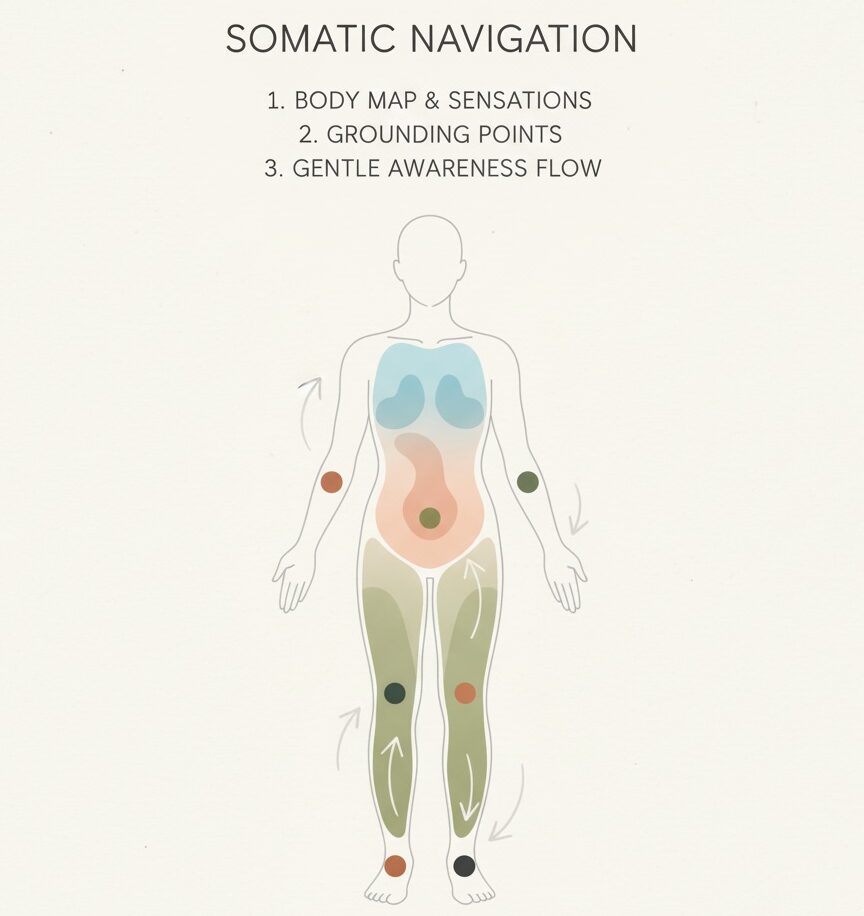
It’s a practice of “mapping” your internal landscape before sleep — gently, slowly, curiously.
You don’t try to fix anything.
You don’t judge sensations.
You don’t aim for silence.
You simply notice what’s already here.
This noticing naturally quiets the mental layer.
Technique 1: Micro-scanning the body’s compass points
Think of your body as having four soft “compass points”:
head, chest, belly, pelvis.
Micro-scanning means checking in with these areas one by one, without trying to change them.
How to practice:
Lie down in bed or sit comfortably.
Bring attention to the top of your body — the head.
Notice heaviness, warmth, tightness, blankness.
Move slowly to the chest.
Feel breath movement, pressure, space, or stillness.
Shift attention to the belly.
Sense softness, movement, or a gentle rise and fall.
Move down to the pelvis.
Notice weight, grounding, or tension releasing downward.
Spend 10–20 seconds on each point.
The goal is not to relax but to arrive.
Relaxation often follows naturally once attention acknowledges the body.
Technique 2: Somatic anchoring through breath and touch
Anchoring combines two sensory inputs — breath and touch — to stabilize the nervous system. Many people unknowingly hold tension in the chest or stomach when trying to fall asleep. Anchoring helps soften that.
How to practice:
Place one hand on your chest, the other on your belly.
Feel which hand rises first. Neither is “correct.”
Let the hands simply notice movement — no forcing the breath.
Allow exhalations to lengthen naturally by 1–2 seconds.
Feel the warmth of your own hands as a grounding cue.
This practice is quiet, simple, and powerful.
It integrates breath awareness without making it a performance.
It also pairs beautifully with the breathing style described in:
Deep breathing for better sleep: a simple nighttime technique
Somatic anchoring strengthens interoception and helps soften any residual emotional or mental intensity from the day.
Technique 3: Mapping tension release through gentle movement
For some people, stillness can feel too sharp at first. Gentle movement helps the body transition into quiet.
This is not stretching — it’s micro-movement:
rolling the shoulders a few millimeters,
gently rocking the head side to side,
soft circular motions of the pelvis,
tiny shifts of weight in the spine or shoulders.
How to practice:
Lie on your back or side.
Choose one tiny movement — a slow head turn, a hip rock, or soft shoulder roll.
Move with only 10% effort, slow enough that you can feel each phase.
Notice the sensation change as the movement fades into stillness.
Movement in somatic navigation isn’t about mobility — it’s about letting the nervous system find a slower rhythm.
When the movement quiets, the mind usually quiets with it.
Why somatic methods help with sleep anxiety and overthinking
Sleep anxiety often appears when the mind tries too hard to “shut down.” The pressure to fall asleep, combined with the fear of not sleeping, creates a loop of hypervigilance. Thoughts speed up. The heartbeat feels louder than usual. The body becomes restless even when it’s tired.
Somatic navigation interrupts this cycle not by fighting thoughts but by giving your attention a different anchor — one that feels safe, slow, and physical.
1. It creates a shift from thinking → sensing
Thoughts move fast.
Sensations move slowly.
When attention shifts to the rhythm of breath, warmth of hands, or weight of the body, the mind naturally loses momentum. You’re not suppressing thoughts — you’re outgrowing them moment by moment.
2. It reduces the brain’s threat response
When you bring awareness to supportive sensations — like heaviness, softness, or warmth — your nervous system receives cues of safety. This helps reduce the subtle alertness that keeps you awake.
3. It quiets internal noise by grounding attention
Overthinking is often a form of disembodiment — attention floating somewhere above the body.
Somatic navigation calls that attention home.
4. It gently separates emotion from sensation
Somatic awareness helps you notice:
“This is tightness,”
“This is warmth,”
“This is breath,”
…instead of spiraling into stories about those sensations.
This reduces emotional reactivity and builds an inner environment more suited for rest.
5. It brings you out of “problem-solving mode”
Sleep doesn’t happen when the brain is busy evaluating the day. By allowing the body to lead, somatic navigation moves you toward presence instead of analysis — a state where sleep naturally becomes possible.
Pairing somatic navigation with your wind-down environment
Somatic navigation works on its own, but its effects multiply when paired with a calming environment.
As we explored in Home sleep hacks: how to optimize your bedroom environment, your surroundings significantly shape how easily your body relaxes.
Here’s how to align your environment with your somatic practice:
1. Dim lighting signals the nervous system to soften
Soft, warm light (lamps, salt lights, low bedside lights) tells your circadian system that stimulation is decreasing. Harsh or cool light can work against somatic calm.
2. Reduce cognitive residue
A cluttered bedside table or laptop still open nearby signals “things left unfinished.”
Creating a simple evening space helps the body trust that the day is complete.
3. Quiet or consistent background sound
If silence feels too sharp, soft noise can help. Gentle hums, fans, or subtle soundscapes create a felt sense of containment.
4. Comfortable textures and warmth
Your skin is a major pathway for grounding. Soft blankets, warm pajamas, or a cozy mattress pad can deepen somatic signals of safety.
5. Minimal digital stimulation
Scrolling, notifications, and bright screens keep your attention in the mind, not the body. An intentional transition — even 10 minutes screen-free — amplifies somatic navigation dramatically.
By weaving together a calm environment and body-based awareness, you create a powerful downward shift toward rest.
How to combine somatic navigation with breathwork or gentle routines
Somatic work blends beautifully with the practices already familiar to Calm Sleeply readers.
Here are simple pairings:
1. Somatic navigation + Deep breathing
Using the technique from
Deep breathing for better sleep: a simple nighttime technique
You can guide breath down into the areas you’re mapping.
For example:
When scanning the chest, lengthen your exhale.
When sensing the belly, allow it to soften naturally.
When feeling tension in the shoulders, release it on each slow breath.
Breath becomes a thread connecting sensations.
2. Somatic navigation + Gentle pre-sleep stretching
If your body feels too tense to stay still, a minute or two of soft mobility can prepare you for deeper noticing. Think micro-movements — not a workout, but gentle loosening.
3. Somatic navigation + Weighted touch
Resting a hand on the chest, belly, or ribs intensifies grounding through pressure receptors. This touch communicates safety directly to the nervous system.
4. Somatic navigation + Visualization of descent
Imagine your attention slowly sinking:
from the forehead → to the chest → to the belly → to the legs → to the feet.
This descent mirrors the natural physiological shift into sleep.
How long does somatic navigation take to work?
For most people, somatic effects appear quickly — often within 1–3 minutes. The body responds fast to:
touch,
breath,
warmth,
contact with the mattress,
slow movement.
You don’t need to spend 20 minutes scanning every sensation.
Even small windows of attention can reduce mental overwhelm.
Here’s what typically happens:
First 30 seconds:
Mind notices sensations and begins shifting away from thoughts.
After 1–2 minutes:
Breath deepens naturally, shoulders soften, and heart rate slows.
After 3–5 minutes:
A wave of heaviness appears — the feeling that the body is “sinking” into the mattress.
After 5–7 minutes:
Thoughts lose their edge, and the transition into sleep becomes smoother.
Your experience may vary, but the body tends to respond quickly when awareness is gentle and non-demanding.
What somatic navigation is not
To set the right expectations, here’s what somatic navigation does not aim to do:
It’s not about “perfect relaxation.”
It doesn’t replace therapy or medical interventions.
It’s not a performance or a test.
It’s not about forcing the body to feel a certain way.
It’s not mindfulness in the formal, structured sense.
Somatic navigation is softer, less structured, more sensory, and more intuitive.
It’s the opposite of effort — it’s permission.
A simple somatic navigation routine for bedtime
Here’s a gentle, real-world routine you can use any night — especially if your thoughts feel loud or scattered.
Step 1: Arrive in the body (20–30 seconds)
Feel your weight supported by the bed.
Sense where your body meets the mattress — back, hips, shoulders, legs.
Step 2: Micro-scan the body’s compass points (1–2 minutes)
Head → chest → belly → pelvis
Just notice sensations without changing them.
Step 3: Let breath meet the body (1 minute)
Place one hand on the chest, one on the belly.
Feel movement under each hand.
Step 4: Add tiny movement (1 minute)
Choose one micro-movement:
a gentle head turn,
soft shoulder roll,
tiny pelvic tilt,
slow side-to-side sway.
Let the movement become smaller until it stops naturally.
Step 5: Rest in stillness (1–2 minutes)
Stop doing.
Feel the afterglow of sensation in your body.
Let yourself sink.
Step 6: Allow the transition into sleep
When the nervous system softens, sleep often feels like a natural next step — not something you try to make happen.
This practice creates a slow descent — a sensory path downward.
Why somatic navigation feels different from traditional relaxation techniques
While many relaxation methods focus on breath or thoughts, somatic navigation focuses on the felt sense — a term somatic practitioners use to describe subtle, shifting sensations in the body.
This makes somatic work especially valuable for:
people who struggle with meditation,
people who overthink at night,
those with sleep anxiety,
anyone who finds stillness uncomfortable at first,
individuals who benefit from sensory grounding.
Somatic navigation is not about creating stillness — it’s about discovering the stillness already hidden beneath tension.
Conclusion: sleep as a sensory descent, not a mental task
When we think of sleep as something we must “achieve,” it becomes harder. The mind becomes a loud, bright place. The body feels distant. Rest feels complicated.
Somatic navigation offers a different invitation:
Let the body lead. Let sensations guide the way.
By shifting into sensory awareness — feeling weight, breath, warmth, softness — you teach your nervous system that it can stop holding, stop planning, stop thinking.
You remind your body that nighttime is not a performance but a return to yourself.
Somatic navigation doesn’t force calm.
It reveals calm.
It uncovers the quiet already inside you.
And when the body softens enough to feel that quiet, sleep often follows gently behind.