Journaling is often recommended as one of the most reliable bedtime rituals. A few minutes with a notebook can create a buffer between the stress of the day and the vulnerability of sleep. It gives you the chance to offload thoughts, regulate emotions, and establish a sense of closure. But while journaling can support relaxation, it’s not automatically restful — and for some, it becomes a subtle trigger for mental spirals rather than a pathway into calm.
This contrast is especially true for individuals prone to anxiety or rumination. What starts as quiet reflection can quickly shift into overanalysis, looping thoughts, or self-evaluation. And because the practice feels intentional, we may not notice that it’s contributing to bedtime arousal.
Instead of helping the mind wind down, journaling — if unstructured or emotionally intense — can reawaken the very systems we’re trying to quiet.
Why nighttime writing can backfire
As the body prepares for sleep, the nervous system begins to shift from sympathetic (alert, activated) into parasympathetic (calm, restorative) mode. This physiological transition is delicate, and can be disrupted by anything that reactivates the prefrontal cortex — especially problem-solving, planning, or emotional intensity. Certain types of journaling do exactly that.
In our article on cognitive offloading, we explored how writing things down can reduce mental load. But this benefit only holds when the process doesn’t introduce new cognitive loops. Journaling that involves replaying mistakes, forecasting challenges, or critiquing the day may increase arousal — keeping the brain in “do” mode rather than allowing it to shift into “let go.”
Research from the Sleep Foundation supports this paradox. While gratitude journaling and structured offloading can improve sleep outcomes, emotional dumping and open-ended processing — especially when done right before bed — may intensify nighttime stress and delay sleep onset.
The subtle shift from reflection to rumination
It’s easy to confuse helpful reflection with emotional overexposure. You might begin writing about a difficult interaction, intending to release it. But instead of clarity, you find yourself reliving it — rewriting the dialogue, imagining different outcomes, questioning your reaction. Rather than creating emotional distance, the journal becomes a magnifier.
The same happens with goal-setting or planning. A quick intention to outline tomorrow’s priorities can turn into a cognitive rabbit hole. The mind begins projecting scenarios, anticipating what could go wrong, or solving problems that haven’t happened yet. As one Healthline article puts it: “Nighttime overthinking often escalates because the brain no longer has distractions to regulate thought volume.”
This cognitive activation is the opposite of what the brain needs to fall asleep. Instead of winding down, it ramps up.
Signs your journaling is keeping you awake
If your journaling habit leaves you mentally stimulated, emotionally raw, or physically tense, it may not be serving its intended purpose. You might notice that your thoughts feel louder after you write. Or that closing the notebook doesn’t close the internal dialogue.
You may even feel pressure to write the “right” thing — especially if you’re tracking moods, setting goals, or evaluating your habits. In our piece on evening reflection prompts that regulate mood, we explore how overly structured or perfectionistic journaling can undermine rest by creating emotional performance rather than emotional presence.
Sometimes the harm isn’t what’s written — but how it’s written. Rushed handwriting, long tangents, or obsessive rewrites are subtle signs that the act of journaling has activated your stress response.
Future-focus, shame loops, and emotional reactivation
Certain journal topics — while common — are particularly risky when done at night. These include:
Problem-solving tomorrow’s worries (“What if I don’t sleep well again?”)
Self-critique disguised as reflection (“I shouldn’t have reacted like that… I always mess it up.”)
Mood monitoring without containment (“Why was I anxious again today?”)
Forced gratitude (“I should be more thankful, but I just feel numb.”)
A 2021 article by the APA highlights how certain journaling formats — especially those focused on diagnosis, perfection, or obligation — may backfire by reinforcing shame or hypervigilance.
When this pattern becomes part of your nightly routine, it’s no longer self-care — it’s mental labor disguised as wellness.
Soothing reflection, not emotional rehearsal
The brain craves containment at night — not analysis. This means offering space for thoughts to exist without asking them to perform or resolve. It’s the difference between noticing and fixing. Your journal doesn’t have to be deep, profound, or transformative. It can simply be a place to land softly.
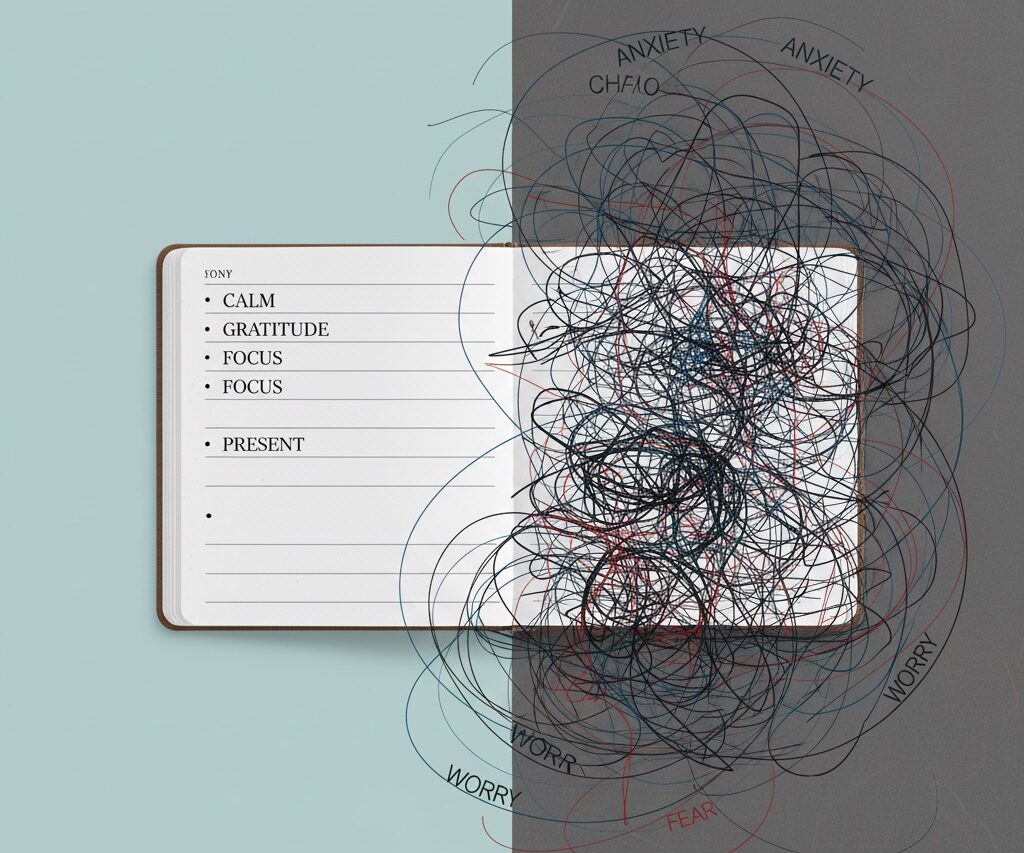
In the second half of this article, we’ll explore how to reimagine your journaling practice — with gentle formats, grounded prompts, and an emphasis on emotional safety. You’ll learn how to transform your notebook from a stage for spiraling into a space for surrender. And we’ll look at how to build a sustainable bedtime habit that actually protects your sleep — one that helps your mind release the day, not rehearse it.
How to journal for rest, not rumination
A restful journaling practice doesn’t begin with prompts. It begins with intention. Not “What should I write about?” but “What does my mind need in order to let go tonight?” If the answer is release, write with that in mind. If the answer is gentleness, choose words and rhythms that match. Your body is already preparing for sleep — and your writing should meet it there, not pull it back into the day.
The most effective forms of evening journaling are those that signal closure rather than activation. They support the brain’s natural shift toward inward awareness, slowing cognition, and sensory quiet. One of the simplest ways to encourage this is by shifting from thinking-based writing to sensation-based writing. For example, instead of narrating your worries or dissecting emotional patterns, you might describe what safety feels like in your body. You might write down physical cues of calm — soft blankets, a dim room, your heartbeat slowing. This pulls attention away from abstract thoughts and grounds it in present-moment experience, reinforcing parasympathetic engagement.
Another powerful shift is tone. The voice in which you journal matters. Is it urgent, critical, rehearsed? Or is it forgiving, neutral, patient? Even when the subject matter is difficult, a gentle tone can change the nervous system’s response. In our article on the five-minute wind-down, we explored how small sensory rituals signal the end of the cognitive day. Your writing can do the same — if it mimics softness rather than scrutiny.
It also helps to narrow the scope. Instead of writing until you feel “done,” you might commit to one paragraph. One page. One line. The goal isn’t to drain your thoughts — it’s to contain them. This gives the brain a sense of structure and lets you close the notebook knowing that it has done enough. This minimalist style — sometimes called micro-journaling — is especially helpful for people who find it hard to stop writing once they begin.
A gentler approach to prompts
If prompts work for you, they can be powerful — but they should never feel like tasks. The best bedtime prompts invite slowness and allow for emotional spaciousness. Here are a few examples that encourage winding down rather than winding up:
“Tonight, I give myself permission to stop…”
“What did I not have to fix today?”
“Something that felt calm or comforting…”
“What I want to carry into sleep…”
“What I can safely leave until morning…”
These reflections don’t demand analysis or achievement. They simply create room for quiet contact with self. They allow you to observe without interpreting, and to name without needing a solution.
Some people also benefit from writing a simple closing statement at the end of each entry — a phrase that gently seals the page and cues the mind to let go. For example:
“That’s enough for today.”
“I’m allowed to rest now.”
“Nothing more needs to happen tonight.”
This type of symbolic closure is similar to the “sleep scripts” used in guided relaxation, as seen in our article on sleep hypnosis vs. guided meditation. It tells the brain: the processing is over — now it’s time to surrender.
Paper, rhythm, and environment matter
Even the material side of journaling plays a role. A tactile, low-stimulation environment helps reinforce bedtime calm. Opt for warm, soft lighting. Use a pen and notebook that feel good in the hand. Choose paper that doesn’t overstimulate visually — avoid harsh lines, neon colors, or overly structured pages. These seem like small details, but they contribute to what psychology calls the sensory envelope of a habit — the container that holds and defines the behavior.
According to a recent review in Nature Reviews Psychology, sensory associations with calm can become potent cues for emotional regulation. When your brain consistently experiences journaling in a soothing context, it begins to link the act with safety and letting go. Over time, this creates a ritualized calm — a kind of conditioned exhale.
A journal is not a therapist — and that’s okay
Perhaps the most important reminder is that your notebook doesn’t need to fix anything. It doesn’t have to guide you toward insight or transformation. It simply needs to hold space. When journaling becomes another place to achieve, it risks replicating the very mental pressures you’re trying to escape.
Instead of asking “Am I journaling right?”, try asking “Is this helping me soften?”
This is the essence of what we explored in meta-anxiety and the fear of not sleeping: even helpful rituals can become rigid when loaded with expectations. The goal isn’t the perfect practice, but a relationship with your thoughts that feels less heavy.
A final note: when doing less is the better answer
If even gentle prompts feel too much some nights, it’s okay not to journal at all. Sometimes the most sleep-supportive choice is to let the page remain blank — to trust that your mind can process unconsciously, and that rest doesn’t always require review.
You can always return to the practice when your system is more open to it. And when you do, let the act of writing be something that closes the day, not reopens it.
Because your journal isn’t a container for chaos — it’s a quiet mirror for release. It’s not a place to rehearse every detail of the day, but a space to remember that you are already enough, even when the page stays silent.